Geography of Ancient Greece
Interactive passage with audio narration, comprehension questions, and printable PDF.
By completing this purchase you agree to our Terms of Use and Privacy Policy. Your subscription renews automatically until you cancel. You can cancel anytime from your account settings. All sales are final and non-refundable. Digital content is available for download in your account immediately upon purchase.
What's included
Part of this bundle

Geography of Ancient Greece preview and details
About this printable Geography of Ancient Greece reading passage (Grades 5-8)
Sample passage and quiz from Geography of Ancient Greece
Reading passage and comprehension quiz preview
Geography of Ancient Greece
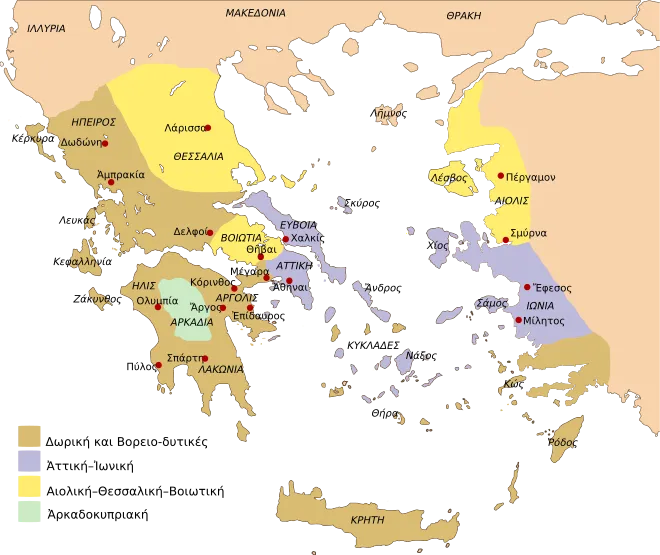
"Ancient greek dialects-grc" by Ancient greek dialects-en.svg: Future Perfect at Sunrise / derivative work: Homo lupus/
Source: Wikimedia Commons (Public domain).
The geography of Ancient Greece played a crucial role in shaping its civilization, culture, and history. Located in southeastern Europe, Ancient Greece was not a single unified country, but rather a collection of independent city-states scattered across a mountainous peninsula, hundreds of islands, and the coasts of the Aegean and Ionian Seas.
The rugged mountains of Greece, such as the Pindus range, divided the land into isolated regions. This physical separation encouraged the development of independent city-states like Athens, Sparta, and Corinth, each with its own government and customs. Archaeological evidence, such as the remains of city walls and temples from the 5th century BCE, shows how these communities built on hills or acropolises for protection. The mountains also made it difficult to grow enough food, limiting large-scale agriculture and leading to the importance of trade and colonization for survival.
The surrounding Mediterranean Sea was essential for Ancient Greek life. The Greeks became skilled sailors, using the sea for travel, trade, and communication. Ancient Greek ships, as depicted on pottery from the 6th century BCE, carried goods such as olive oil, wine, and pottery to distant lands. The Greeks established colonies as far as modern-day Turkey, Italy, and North Africa. This expansion was driven by the search for fertile land and resources, which their mountainous homeland could not always provide. Written records, like the works of historian Herodotus, describe how these colonies maintained ties to their original city-states.
Climate also influenced Greek society. The mild, Mediterranean climate—hot, dry summers and mild, wet winters—allowed people to spend much time outdoors. Many public events, such as theater performances and athletic competitions, took place in open-air spaces. The land supported crops like olives, grapes, and barley, but not wheat in large quantities. As a result, Greeks had to import food from other regions, further strengthening their trading networks. Evidence from ancient amphorae (storage jars) found in shipwrecks shows how widely Greek goods were traded.
Geography also shaped Greek social structure. Because farmland was limited, only a small elite owned the best land, while most people farmed small plots or worked as sailors, traders, and craftsmen. The geography contributed to both competition and cooperation among city-states, leading to alliances and conflicts such as the famous Peloponnesian War (431–404 BCE).
In conclusion, the geography of Ancient Greece influenced every aspect of its civilization, from government to daily life. The mountains and seas created both barriers and opportunities, encouraging independence, innovation, and widespread trade. Understanding this geography helps explain why Ancient Greece became a collection of unique city-states rather than a single empire.
This study of Greek geography connects to broader themes of world history, such as how humans adapt to and shape their environment.
Interesting Fact: The word "geography" itself comes from the Greek words "geo" (earth) and "graphia" (writing), showing how the Greeks valued studying their land!
Comprehension quiz (8 questions)
1. What divided Greek city-states?
2. Which sea was vital to Greece?
3. What is an acropolis?
4. Why did Greeks create colonies?
5. How did geography affect Greek farming?
6. What was a result of Greek geography?
7. Ancient Greeks traded goods by sea. True or false?
8. What does 'colony' mean in the passage?
Perfect for the way you teach
- Build comprehension skills
- Auto-graded quiz
- Differentiated reading
- Read together at home
- Improve fluency
- Quiet reading time
- Reading curriculum support
- Independent practice
- Track Lexile growth