Greek Polis
Interactive passage with audio narration, comprehension questions, and printable PDF.
By completing this purchase you agree to our Terms of Use and Privacy Policy. Your subscription renews automatically until you cancel. You can cancel anytime from your account settings. All sales are final and non-refundable. Digital content is available for download in your account immediately upon purchase.
What's included
Part of this bundle

Greek Polis preview and details
About this printable Greek Polis reading passage (Grades 5-8)
Sample passage and quiz from Greek Polis
Reading passage and comprehension quiz preview
Greek City-States
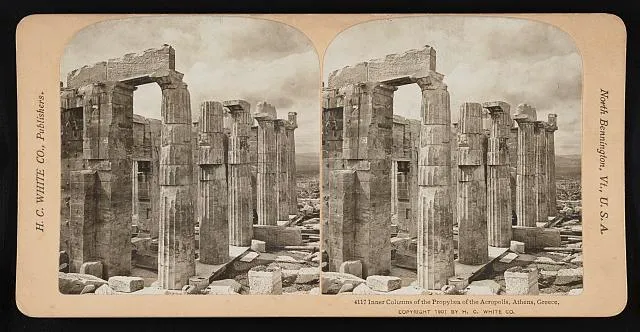
Source: Library of Congress - H.C. White Co.
The concept of the polis, or city-state, became the main form of political and social organization in ancient Greece by around 800 BCE. Unlike a single unified nation, Greece was divided into many independent city-states, each with its own government, laws, and customs. These city-states developed due to Greece's unique geography, which is filled with mountains and islands that separated groups of people from one another.
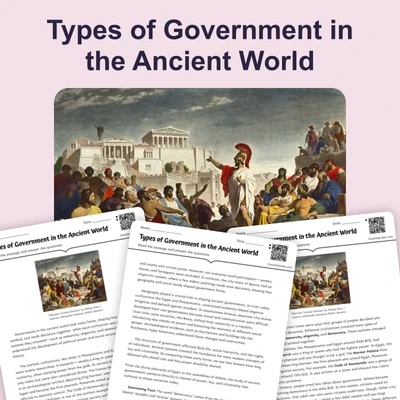
Each polis included a city and its surrounding countryside. The most important part of a city-state was usually the acropolis, a high hill where people built temples and public buildings. Below the acropolis, citizens gathered in the agora, or marketplace, which also served as a place for political discussions. Archaeological remains from Athens, such as the ruins of the Parthenon on the Acropolis, show the significance of religion and public life in daily activities. The city-state of Sparta, on the other hand, built its society around military strength and discipline, as described by ancient historians like Herodotus.
The independence of each polis led to both cooperation and conflict. City-states often competed for resources and power, resulting in wars such as the famous Peloponnesian War between Athens and Sparta (431–404 BCE). However, city-states could also unite, as seen when many Greeks joined forces to fight the Persian invasions in 490 and 480 BCE. Primary sources, like the writings of Thucydides, help us understand how city-states debated foreign policy and citizenship. Over time, the assembly became an important institution, especially in Athens, where citizens participated directly in government. In contrast, Sparta was ruled by a small group of elders known as the Gerousia.
Social structure in Greek city-states was typically divided into citizens, non-citizens, and slaves. Only male citizens could vote or hold office, while women, foreigners, and enslaved people had limited rights. Trade, colonization, and the exchange of ideas among city-states encouraged cultural and economic growth. Coins, pottery, and inscriptions discovered by archaeologists provide evidence of these connections. Despite their differences, the city-states shared a common language, religious beliefs, and participation in events like the Olympic Games, showing continuity in Greek culture.
The rise of the polis had a lasting impact on world history. Greek city-states developed ideas about democracy, citizenship, and government that influenced later societies, including Rome and modern democracies. The legacy of the polis reminds us how local communities can shape broader political and cultural traditions.
Learning about the Greek polis helps us understand the foundations of Western civilization and the ways geography and human choices create diverse societies. This topic connects to larger themes in ancient history, such as the development of government systems and cultural exchange.
Interesting Fact: The word "politics" comes from the Greek word polis, showing the lasting influence of Greek city-states on the language we use today.
Comprehension quiz (8 questions)
1. What is a polis?
2. What was the acropolis?
3. Who could vote in Athens?
4. Why did city-states develop in Greece?
5. What was the Peloponnesian War?
6. How did city-states cooperate?
7. Greek city-states influenced modern democracy. True or false?
8. What is an agora?
Perfect for the way you teach
- Build comprehension skills
- Auto-graded quiz
- Differentiated reading
- Read together at home
- Improve fluency
- Quiet reading time
- Reading curriculum support
- Independent practice
- Track Lexile growth