Gharial vs. Crocodile vs. Alligator
Interactive passage with audio narration, comprehension questions, and printable PDF.
By completing this purchase you agree to our Terms of Use and Privacy Policy. Your subscription renews automatically until you cancel. You can cancel anytime from your account settings. All sales are final and non-refundable. Digital content is available for download in your account immediately upon purchase.
What's included
Gharial vs. Crocodile vs. Alligator preview and details
About this printable Gharial vs. Crocodile vs. Alligator science reading passage, NGSS-aligned (Grade 6)
Sample passage and quiz from Gharial vs. Crocodile vs. Alligator
Reading passage and comprehension quiz preview
Gharial vs. Crocodile vs. Alligator
Crocodilians represent one of the most successful groups of semi-aquatic reptiles, with three major taxa that are often confused due to their similar ecological niches. The gharial, crocodile, and alligator belong to distinct evolutionary lineages within the order Crocodylia. By analyzing these distinguishing characteristics, scientists can better understand how these ancient archosaurs have diversified to occupy different ecological roles within aquatic ecosystems across various geographic regions.
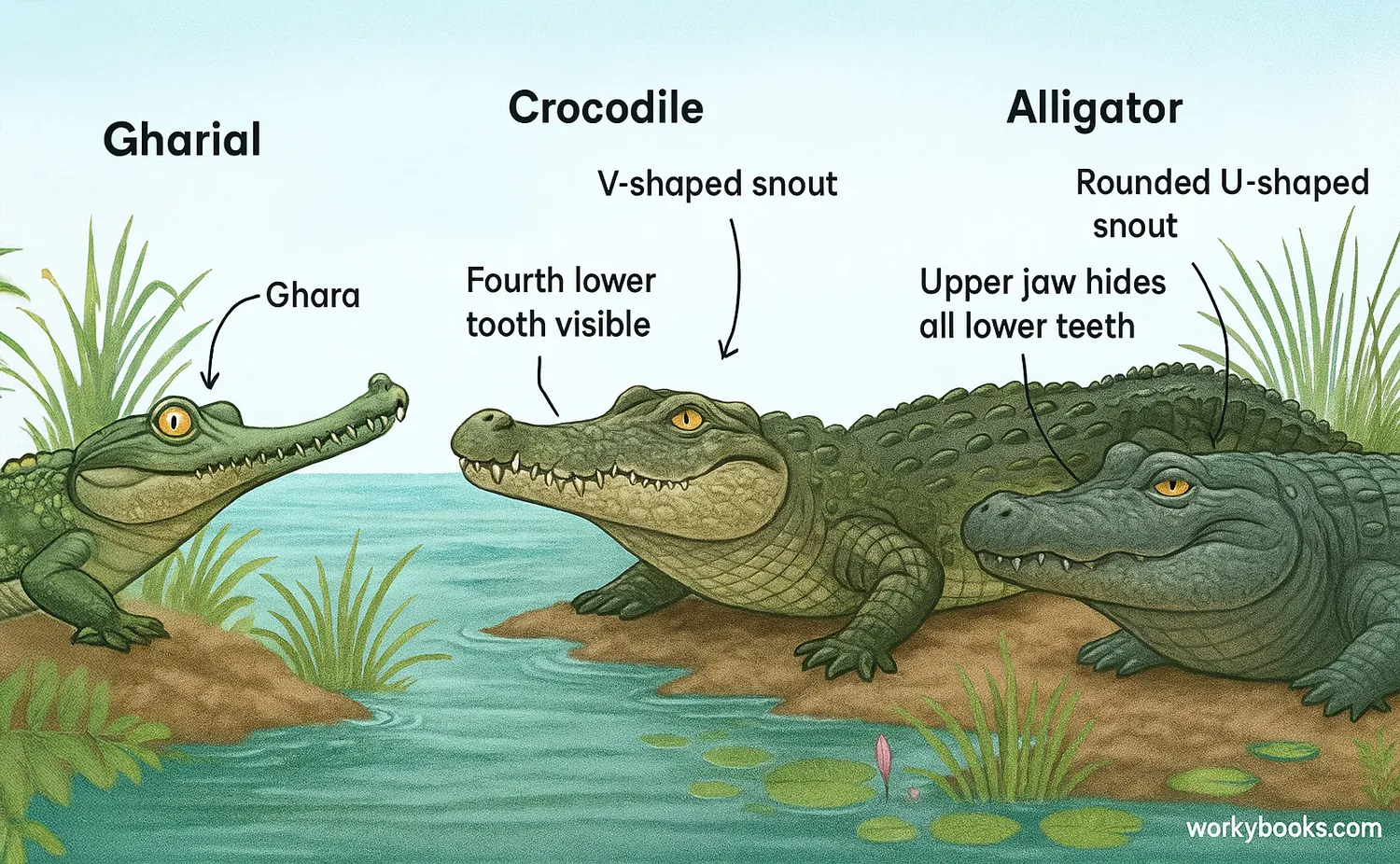
Let's start with the most unique: the gharial. Found primarily in freshwater rivers of India, gharials are easily identified by their incredibly long, narrow snout. This specialized snout is perfect for catching fish, which makes up almost their entire diet. Unlike other crocodilians, gharials have a small, rounded growth at the end of their snout, called a "ghara" (named after a type of Indian pot), which is more pronounced in males. Their thin jaws are lined with many sharp teeth, ideal for grasping slippery prey. Gharials are more shy and less aggressive towards humans than crocodiles or alligators.
Next, we have crocodiles. These powerful predators are found in tropical regions around the world, living in both freshwater and saltwater habitats. Crocodiles typically have a V-shaped snout, which is wider and more robust than a gharial's. One key way to tell them apart from alligators is that when a crocodile closes its mouth, you can usually see its fourth tooth on the lower jaw sticking out. Crocodiles are known for being highly territorial and can be very aggressive. They are opportunistic feeders, eating fish, birds, mammals, and even other reptiles.
Finally, there are alligators. Primarily found in the southeastern United States and eastern China, alligators prefer freshwater environments like swamps, rivers, and lakes. They have a broad, U-shaped snout that is wider than a crocodile's. When an alligator closes its mouth, all its lower teeth are hidden inside its upper jaw. This is a crucial difference from crocodiles. Alligators are also generally less aggressive than crocodiles, especially towards humans, but can still be dangerous. Their strong jaws are excellent for crushing hard-shelled prey like turtles and snails, in addition to fish and small mammals.
These three distinct reptiles, gharials, crocodiles, and alligators, each play vital roles as top predators in their respective habitats. By consuming other animals, they help control populations and maintain the health of their ecosystems.
Interesting Fact: Despite their fearsome appearance, alligators are known to make a variety of sounds, including a loud bellow during mating season that can travel for miles.
Comprehension quiz (10 questions)
1. Which reptile has a very long, narrow snout?
2. Which reptile's lower teeth are hidden when its mouth is closed?
3. What is the primary diet of gharials?
4. Which of these reptiles can live in saltwater habitats?
5. What shape is an alligator's snout?
6. Which reptile is generally considered less aggressive towards humans?
7. How do these reptiles contribute to their ecosystems?
8. What is a "ghara" on a gharial's snout?
9. Crocodiles are generally more aggressive than alligators.
10. What does "ecosystem" mean in the passage?
Perfect for the way you teach
- Build comprehension skills
- Auto-graded quiz
- Differentiated reading
- Read together at home
- Improve fluency
- Quiet reading time
- Reading curriculum support
- Independent practice
- Track Lexile growth