Giant Squid Anatomy
Interactive passage with audio narration, comprehension questions, and printable PDF.
By completing this purchase you agree to our Terms of Use and Privacy Policy. Your subscription renews automatically until you cancel. You can cancel anytime from your account settings. All sales are final and non-refundable. Digital content is available for download in your account immediately upon purchase.
What's included
Giant Squid Anatomy preview and details
About this printable Giant Squid Anatomy science reading passage, NGSS-aligned (Grade 6)
Sample passage and quiz from Giant Squid Anatomy
Reading passage and comprehension quiz preview
Giant Squid Anatomy
The giant squid ranks among the most mysterious and captivating animals on Earth, perfectly adapted to survive in one of our planet's most extreme environments. Deep beneath the ocean's surface, in a world of crushing darkness and intense pressure, lives a creature so massive it could stretch across an entire school bus. This deep-sea marvel serves as an extraordinary example of ocean diversity and the incredible adaptations that allow organisms to flourish in Earth's most challenging habitats.
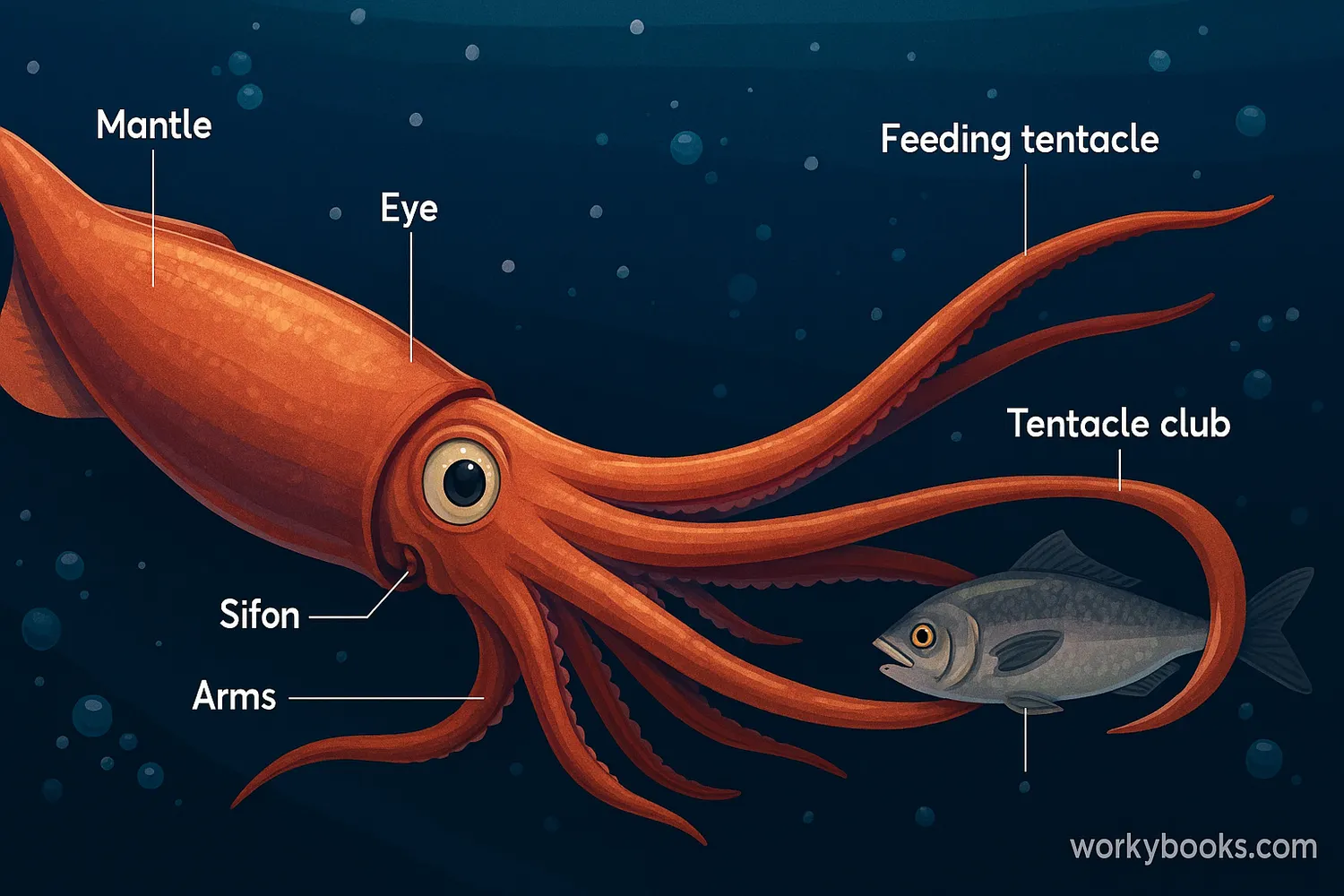
At the core of the giant squid's body is the mantle. This is a large, muscular, torpedo-shaped sac that contains most of the squid's organs, including its heart, gills, and digestive system. The mantle is crucial for movement; water is drawn into it and then forcefully expelled through a tube called the siphon. This process, known as jet propulsion, allows the giant squid to move quickly through the water, making it an efficient predator in the deep ocean environment.
Perhaps the most striking features of the giant squid are its arms and tentacles. It possesses eight shorter, muscular arms covered in suckers that help it grasp prey. Beyond these, it has two incredibly long feeding tentacles, which can be much longer than its body. These specialized tentacles have suckers only at their tips and are used to snatch prey from a distance. Once captured, the prey is brought towards the squid's powerful beak. This beak, located in the center of its arms, is made of chitin – the same tough material found in insect exoskeletons – and is strong enough to tear apart fish and other marine animals.
The giant squid also has remarkably large eyes, the biggest in the animal kingdom. These massive eyes, sometimes the size of a dinner plate, are essential for seeing in the dim light of the deep sea. They help the squid detect prey and predators in its dark habitat. Like other cephalopods, giant squids have a complex nervous system and a large brain, making them intelligent hunters. Their unique adaptations, from jet propulsion to specialized tentacles, highlight the incredible diversity of life and how species evolve to thrive in their specific niches.
Interesting Fact: Despite their immense size, giant squids are rarely seen alive, and much of what we know comes from specimens found washed ashore or caught by deep-sea trawlers.
Comprehension quiz (10 questions)
1. What body part contains most of the squid's organs?
2. How many feeding tentacles does a giant squid have?
3. The giant squid moves using jet propulsion.
4. Which word means 'the study of body structure'?
5. Why are giant squid eyes so large?
6. What material is the giant squid's beak made of?
7. How do scientists mostly learn about giant squids?
8. What makes giant squid efficient hunters?
9. How might a smaller deep-sea animal adapt to avoid giant squids?
10. If a squid's siphon was damaged, what would be the main impact?
Perfect for the way you teach
- Build comprehension skills
- Auto-graded quiz
- Differentiated reading
- Read together at home
- Improve fluency
- Quiet reading time
- Reading curriculum support
- Independent practice
- Track Lexile growth