Glacier Erosion and Deposition — Reading Comprehension
Rate this
Premium Resource
Present
Present in classroom. No work saved
Assign
Classroom with student accounts, Track progress
Quick Play
No student accounts, assign with a link
Grades
6
PRINT+DIGITAL RESOURCE
This learning resource is available in interactive and printable formats. The interactive worksheet can be played online and assigned to students. The Printable PDF version can be downloaded and printed for completion by hand.
This audio-integrated reading passage, 'Glacier Erosion and Deposition', is designed for Grade 6 students and explores the powerful ways glaciers sculpt our Earth. It delves into the processes of glacier erosion, explaining how ice scrapes and grinds away rock, and glacier deposition, describing how glaciers leave behind sediment and create unique landforms like moraines. Students will learn about the formation of U-shaped valleys and glacial striations, key indicators of past glacial activity. This passage aligns with NGSS MS-ESS3-3, encouraging an understanding of natural processes that impact the environment. It defines key terms like 'till' and 'erratics' to enhance comprehension.
CONTENT PREVIEW
Expand content preview
Glacier shapes landscape through erosion and deposition processes.
Have you ever wondered how some mountains have such unique shapes, or why you find huge boulders in fields far from any cliff? The answer often lies with glaciers! Glaciers are massive rivers of ice that move slowly over land. They are powerful forces that have shaped Earth's surface for millions of years through two main processes: erosion and deposition.
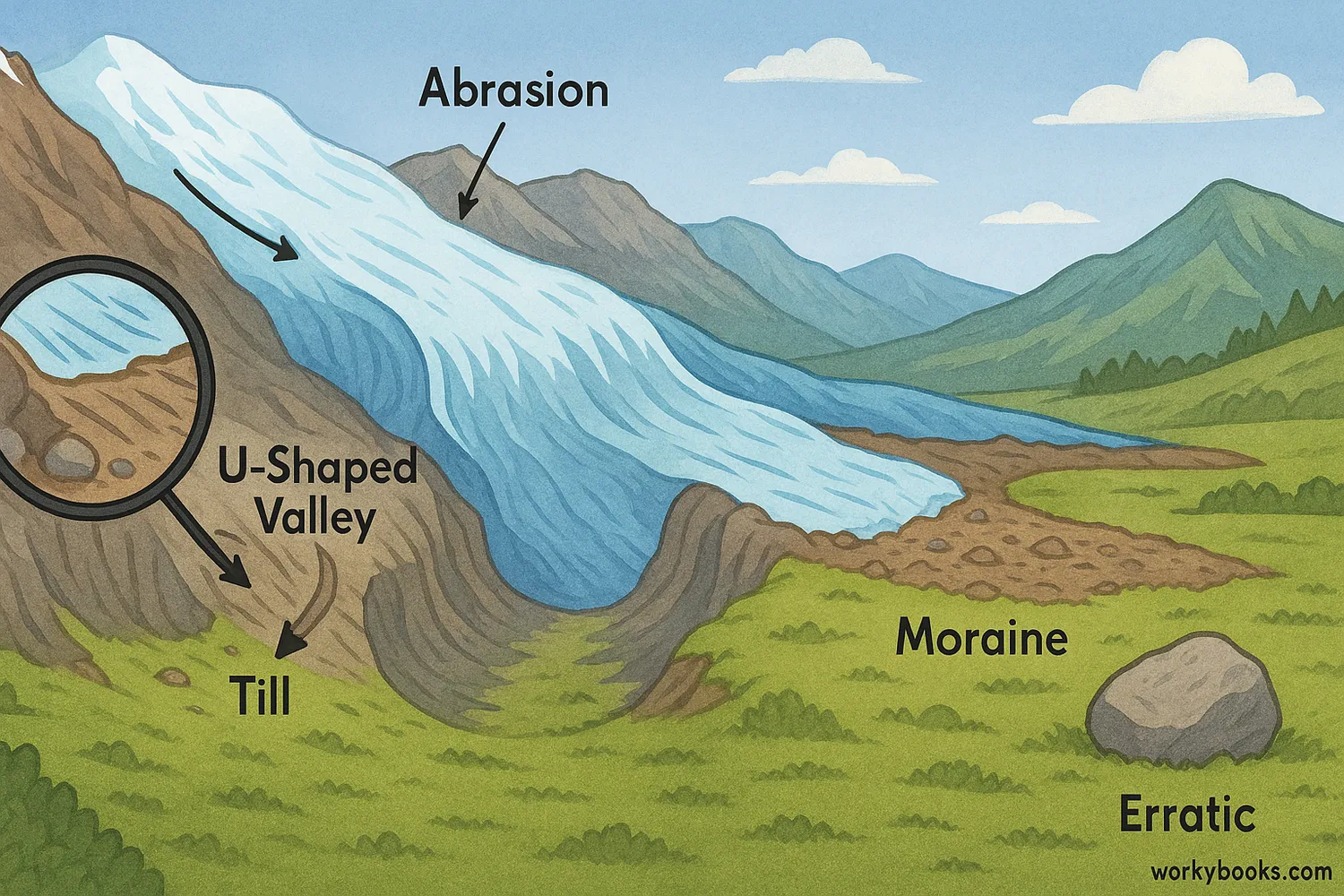
Let's start with glacier erosion. As a glacier slides across the land, it acts like a giant bulldozer and sandpaper all rolled into one. The sheer weight of the ice, combined with rocks and sediment frozen into its base, grinds and scrapes away at the bedrock. This process is called abrasion. Think of it like a giant piece of sandpaper rubbing against a wooden block. The glacier picks up loose rocks and carries them along. This plucking action can tear away large chunks of rock, creating jagged landscapes. Evidence of glacial erosion can be seen in U-shaped valleys, which are wide and rounded at the bottom, unlike the V-shaped valleys carved by rivers. You can also spot glacial striations, which are long scratches on rocks, like marks left by a giant's fingernails.
Now for glacier deposition. As glaciers move, they carry a lot of material with them – everything from tiny sand grains to enormous boulders. This mixture of unsorted rock fragments carried and deposited by a glacier is called till. When a glacier melts, it drops all this material, leaving it behind. This process is known as deposition. The piles of till that accumulate at the edges or front of a glacier are called moraines. These can form long ridges or hills. Sometimes, glaciers drop very large rocks, called erratics, far from their original source. These boulders stand out in landscapes because they are different from the local bedrock, a clear sign of past glacial activity.
Understanding glacier erosion and deposition helps us comprehend how Earth's landscapes were formed and how they continue to change, even in areas without active glaciers today. These processes are a vital part of Earth's natural history and are also relevant when discussing the impact of climate change on ice sheets and future landforms.
Interesting Fact: About 10% of the Earth's land area is currently covered by glaciers, but during ice ages, this figure was much higher, sometimes reaching 30%!
What are glaciers?
Rivers of iceTypes of mountainsUnderground cavesFlowing water bodies
What is the process of glaciers picking up rocks?
DepositionAbrasionPluckingMelting
True or False: U-shaped valleys are formed by rivers.
TrueFalse
Which landform is created by glacier deposition?
V-shaped valleysMorainesSharp peaksCanyons
How do glaciers create U-shaped valleys?
Water erosionWind erosionIce scrapingVolcanic activity
What term describes scratches on rocks from glaciers?
MorainesStriationsErraticTill
What distinguishes erratics from other rocks?
Very small sizeSame as local rockDifferent from localFound only in rivers
What is the primary difference between erosion and deposition?
Erosion builds, deposition destroysErosion removes, deposition addsErosion heats, deposition coolsErosion is fast, deposition is slow
If you see a wide, rounded valley, what caused it?
River activityWind erosionGlacial movementTectonic plates
Which of the following is an example of 'till'?
Pure waterSorted gravelUnsorted rock mixSmooth pebbles
Perfect For:
👩🏫 Teachers
• Reading comprehension practice
• Auto-graded assessments
• Literacy skill development
👨👩👧👦 Parents
• Reading practice at home
• Comprehension improvement
• Educational reading time
🏠 Homeschoolers
• Reading curriculum support
• Independent reading practice
• Progress monitoring
Reading Features:
📖
Reading Passage
Engaging fiction or nonfiction text
❓
Comprehension Quiz
Auto-graded questions
📊
Instant Feedback
Immediate results and scoring
📄
Printable Version
Download for offline reading
🔊
Read Aloud
Voice-over with word highlighting
Reviews & Ratings
No reviews yet. Be the first to share your experience!
Related Content
Tools and Technology in Earth Science
This middle school science reading passage explores the wide range of tools and technologies used in Earth science, from...
MS-ESS2-2MS-ESS3-2MS-ETS1-1MS-PS4-3
What Is Earth Science?
This engaging middle school science passage introduces students to the field of Earth science, aligning with NGSS standa...
MS-ESS1MS-ESS2MS-ESS3SEP
Scientific Inquiry in Earth Science
This passage explores scientific inquiry in Earth science for grades 6-8, aligned with NGSS standards MS-ESS1-4, MS-ESS2...
MS-ESS1-4MS-ESS2-1MS-ESS3-5SEP
What Is Space Weather and How Does It Affect the Earth?
This NGSS-aligned science passage for middle school explains what space weather is and how it affects Earth. Students le...
MS-ESS2-2
Earth: Our Home in Space
This engaging Grade 4-5 science passage, aligned to NGSS, introduces students to Earth's special place in the solar syst...
My Planet Earth
In this passage, students explore Earth as their home planet. They learn that Earth is made of land, water, and air, and...
FL.SS.2.G.1.1SS.2.G.1.3
Meteorite Impacts on Earth
This engaging science reading passage for Grades 4-5 explores meteorite impacts on Earth, aligning with NGSS standards. ...
Facts About Earth
This engaging science reading passage introduces Grade 4 and 5 students to Earth, our home planet. Aligned with NGSS sta...
Earth's Quick and Slow Changes
In 'Earth's Quick and Slow Changes,' students categorize 12 Earth events by their speed of occurrence, enhancing underst...
Earth Changes Over Millions of Years
This engaging, audio-integrated science passage for Grade 4-5 students explores how Earth has changed over millions of y...
Earth Day and Types of Pollution
Earth Day is coming! Get ready to learn about pollution and test your knowledge. Click for a free reading passage and qu...
RI.4.1RI.4.2ESS3.CESS3.A
What Makes Earth Perfect for Life?
This Grade 4-5 science passage, aligned with NGSS standards, explores the essential features that make Earth the perfect...
Rare Earth Minerals in Smartphones and Computers
Rare earth minerals are critical for smartphones, computers, and renewable energy. Mining them has environmental impacts...
RI.5.3RI.6.3RI.7.3
Earth Changes Word Sort
This word sort activity helps students understand different rates of change in Earth's systems. Students classify 12 geo...
Earth's Spheres
This middle school science passage introduces students to Earth's four major spheres: the geosphere, hydrosphere, atmosp...
MS-ESS2-4MS-ESS2-6
The Diameter of Earth
This science reading passage explains the diameter of Earth, describing it as about 12,742 kilometers or 7,918 miles acr...
5-PS2-1
Escape Velocity and Space Travel
This middle school science passage introduces students to the concept of escape velocity—the minimum speed required to b...
MS-ESS1-2MS-PS2-4
History of Life on Earth
This comprehensive middle school science reading passage provides an engaging overview of the history of life on Earth, ...
MS-ESS1-4MS-LS4-1
Earth: Our Home Planet
This comprehensive science passage for grades 6-8 explores Earth’s unique characteristics and the interconnected systems...
MS-ESS1-2
Earth's Rotation
This middle school science passage, aligned with NGSS standard MS-ESS1-1, focuses on Earth's rotation—how Earth spins on...