This learning resource is available in interactive and printable formats. The interactive worksheet can be played online and assigned to students. The Printable PDF version can be downloaded and printed for completion by hand.
This comprehensive science passage for grades 6-8 explores Earth’s unique characteristics and the interconnected systems that make it capable of supporting life. Aligned to NGSS standard MS-ESS1-2, students will learn about Earth's diameter, mass, orbit, and surface distribution of land and water. The text covers mechanisms such as the greenhouse effect, water cycle, plate tectonics, and the magnetic field, explaining how these processes interact to maintain a habitable environment. Students also gain an understanding of the Goldilocks zone, the role of the Moon, and Earth’s atmosphere in protecting and sustaining life. Key vocabulary is embedded and defined, and students are provided with reading comprehension, writing, and graphic organizer activities to deepen their understanding. Audio-integrated, this passage supports diverse learners and offers both standard and simplified versions, as well as Spanish translations. Ideal for building foundational Earth science knowledge.
CONTENT PREVIEW
Expand content preview
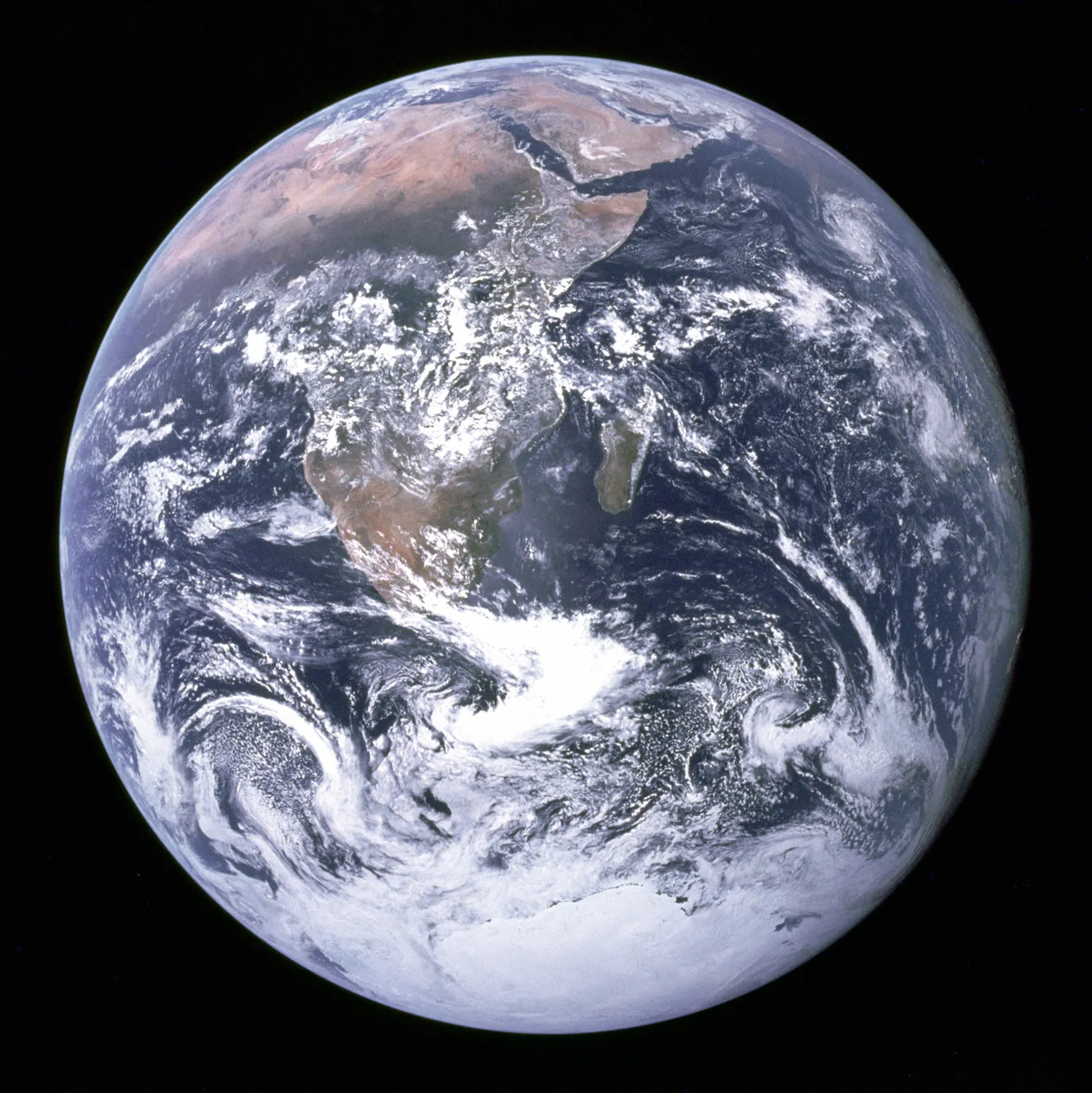
"The Earth seen from Apollo 17" by NASA/Apollo 17 crew; taken by either Harrison Schmitt or Ron Evans/ a Source: Wikimedia Commons (Public domain).
Earth is the only planet in our solar system known to support life. Its unique combination of size, position, and physical systems creates the conditions needed for living things to survive and thrive. Scientists study Earth’s characteristics to understand what makes it special and why life exists here but not on other planets. Earth’s diameter measures about 12,742 kilometers, and its mass is used as the standard for measuring other planets. It orbits the Sun at a distance of 1 astronomical unit (AU), which is about 150 million kilometers, and completes one orbit in 365.25 days. Earth rotates once every 24 hours, creating day and night.
Earth's Systems and Life-Supporting Features The surface of Earth is covered by 71% water and 29% land, forming continents, oceans, mountains, and valleys. The atmosphere is made up of 78% nitrogen, 21% oxygen, and 1% other gases, including carbon dioxide and water vapor. This mixture is essential for life, as it supports breathing and helps regulate temperature through the greenhouse effect. The greenhouse effect is a natural process where certain gases trap heat from the Sun, keeping Earth’s average temperature around 15°C. Without it, the planet would be too cold for most life forms. Earth’s position in the Goldilocks zone, not too close and not too far from the Sun, allows liquid water to exist. This water is found in oceans, ice caps, and freshwater lakes and rivers. The water cycle moves water between the surface and the atmosphere, supporting all forms of life.
Dynamic Processes and Protection Earth is geologically active because of plate tectonics. The surface is divided into large plates that move slowly, causing continents to shift, mountains to rise, and volcanoes and earthquakes to occur. This constant movement recycles nutrients and shapes the planet’s surface over millions of years. Another key feature is Earth’s magnetic field, which is generated by movements in the iron-rich outer core. The magnetic field shields the planet from harmful solar wind and cosmic radiation. Earth’s thick atmosphere also protects living things by blocking most dangerous radiation and burning up small meteors before they reach the surface.
Earth's Place in the Solar System One large moon orbits Earth and helps stabilize the planet’s axial tilt at 23.5°. This tilt, along with Earth’s orbit, causes the seasons. The right combination of size, distance from the Sun, active geology, protective atmosphere, and liquid water creates a unique environment where life can develop and evolve. Earth is also home to millions of species and diverse ecosystems. Our planet is rare, and so far, it is the only place in the universe where life is known to exist.
Protecting Earth is our responsibility because it is our only home. Understanding how Earth’s systems interact helps us make better decisions for the future of all life.
Interesting Fact: Earth’s magnetic field reverses direction every several hundred thousand years—a process called geomagnetic reversal.
What percentage of Earth's surface is covered by water?
71%50%29%90%
What is the main function of Earth's magnetic field?
To create seasonsTo protect Earth from solar wind and radiationTo support plate tectonicsTo make water cycle possible
Which gas makes up the largest part of Earth's atmosphere?
OxygenCarbon dioxideNitrogenWater vapor
In the passage, what does the 'Goldilocks zone' refer to?
The coldest place in the solar systemThe region where water can exist as a liquidThe brightest part of the atmosphereThe area with the most earthquakes
What causes Earth's seasons?
The greenhouse effectThe movement of tectonic platesEarth's axial tilt and its orbit around the SunThe water cycle
What is the greenhouse effect?
When the Moon blocks the Sun’s lightWhen gases trap heat from the Sun and warm the Earth’s surfaceWhen plates move and create mountainsWhen water evaporates from oceans
Why is plate tectonics important for life on Earth?
It creates oxygen for breathingIt keeps Earth's temperature stableIt recycles nutrients and shapes the planet’s surfaceIt makes the Moon orbit the Earth
True or False: Earth is the only known planet with plate tectonics.
TrueFalse
True or False: Earth's magnetic field is created by moving iron in the outer core.
TrueFalse
If Earth were not in the Goldilocks zone, what would most likely happen?
Earth’s magnetic field would disappearLiquid water could not exist and life might not surviveThe Moon would have a stronger pullThe length of Earth’s day would change
Perfect For:
👩🏫 Teachers
• Reading comprehension practice
• Auto-graded assessments
• Literacy skill development
👨👩👧👦 Parents
• Reading practice at home
• Comprehension improvement
• Educational reading time
🏠 Homeschoolers
• Reading curriculum support
• Independent reading practice
• Progress monitoring
Reading Features:
📖
Reading Passage
Engaging fiction or nonfiction text
❓
Comprehension Quiz
Auto-graded questions
📊
Instant Feedback
Immediate results and scoring
📄
Printable Version
Download for offline reading
🔊
Read Aloud
Voice-over with word highlighting
Reviews & Ratings
No reviews yet. Be the first to share your experience!
Related Content
Comets
This middle school science passage explores the fascinating world of comets, commonly known as 'dirty snowballs.' Studen...
MS-ESS1-2
Mercury: Closest to the Sun
This comprehensive, standards-aligned passage explores Mercury—the smallest and closest planet to the Sun. Students in g...
MS-ESS1-2MS-ESS1-3
Venus: Earth's Twin?
This comprehensive science passage for grades 6-8 examines Venus—often called Earth's twin—by exploring its similarities...
MS-ESS1-2MS-ESS1-3
Mars: The Red Planet
This middle school science passage explores Mars, the Red Planet, providing students in grades 6-8 with a comprehensive ...
MS-ESS1-2MS-ESS1-3
What Is Gravity?
This comprehensive middle school science reading passage explores the concept of gravity, aligning with NGSS standards M...
MS-ESS1-2MS-PS2-4
Kepler's Laws of Planetary Motion
This comprehensive middle school science passage explores Kepler's Laws of Planetary Motion, meeting NGSS Standard MS-ES...
MS-ESS1-2
Tides and Tidal Forces
This middle school science passage explores the mechanisms of tides and tidal forces, aligning with NGSS standards MS-ES...
MS-ESS1-1MS-ESS1-2
Escape Velocity and Space Travel
This middle school science passage introduces students to the concept of escape velocity—the minimum speed required to b...
MS-ESS1-2MS-PS2-4
Weightlessness and Microgravity
This science reading passage for middle school students explores the phenomenon of weightlessness and microgravity. Alig...
MS-PS2-4MS-ESS1-2
Orbits and Orbital Motion
This middle school science passage, aligned with NGSS MS-ESS1-2 and MS-PS2-4, explores the science of orbits and orbital...
MS-ESS1-2MS-PS2-4
What Is the Solar System?
This passage provides a comprehensive overview of the solar system for grades 6-8, aligned with NGSS standards MS-ESS1-2...
MS-ESS1-2MS-ESS1-3
Structure of the Solar System
This comprehensive science reading passage introduces middle school students (grades 6-8) to the structure of the solar ...
MS-ESS1-2MS-ESS1-3
Moons of the Solar System
This comprehensive passage, designed for grades 6-8 and aligned to NGSS standard MS-ESS1-2, delves into the fascinating ...
MS-ESS1-2
Defining Life: What Are We Looking For?
This informational science passage for middle school students explores the question: What is life, and how do we define ...
MS-LS1-1MS-ESS1-2
Astronomy
This comprehensive reading passage introduces middle school students to the science of astronomy, which is the study of ...
MS-ESS1-2MS-ESS1-3MS-PS4-2MS-ETS1-1
The Solar System
This middle school science passage introduces students to the solar system, aligning with NGSS standards MS-ESS1-2 and M...
MS-ESS1-2MS-ESS1-3
Gravity and Orbits
This comprehensive passage for grades 6-8 explains the science of gravity and orbits, aligning with NGSS standard MS-ESS...
MS-ESS1-2
The Inner Planets
This comprehensive science passage for grades 6-8 explores the inner (terrestrial) planets of our solar system—Mercury, ...
MS-ESS1-2MS-ESS1-3
The Outer Planets
This engaging science passage for grades 6-8 introduces students to the outer planets—Jupiter, Saturn, Uranus, and Neptu...