This learning resource is available in interactive and printable formats. The interactive worksheet can be played online and assigned to students. The Printable PDF version can be downloaded and printed for completion by hand.
This middle school science passage, aligned with NGSS standard MS-ESS1-1, focuses on Earth's rotation—how Earth spins on its tilted axis, the mechanisms driving the cycle of day and night, and the observable effects on our daily lives. Students will learn the difference between a sidereal and solar day, the concept of an axis, and how Earth's constant, counterclockwise rotation is proven through scientific evidence like the Foucault pendulum and the Coriolis effect. The passage integrates academic vocabulary and demonstrates the interconnectedness of Earth's rotation with natural phenomena, while also exploring how Earth's rotation is gradually slowing due to tidal friction with the Moon. With audio integration, a differentiated version for struggling readers, and Spanish translations, this resource supports diverse learners and reinforces key science concepts through interactive quizzes, writing activities, and graphic organizers.
CONTENT PREVIEW
Expand content preview
Earth's Rotation
Earth’s rotation is the fundamental process that causes the cycle of day and night on our planet. Each day, Earth spins once around its axis—an imaginary line running from the North Pole to the South Pole. This spinning motion not only explains why we experience daylight and darkness but also influences how we observe the movement of the Sun, Moon, and stars across the sky. Understanding Earth’s rotation is essential for explaining many natural patterns we see every day.
How Earth Rotates
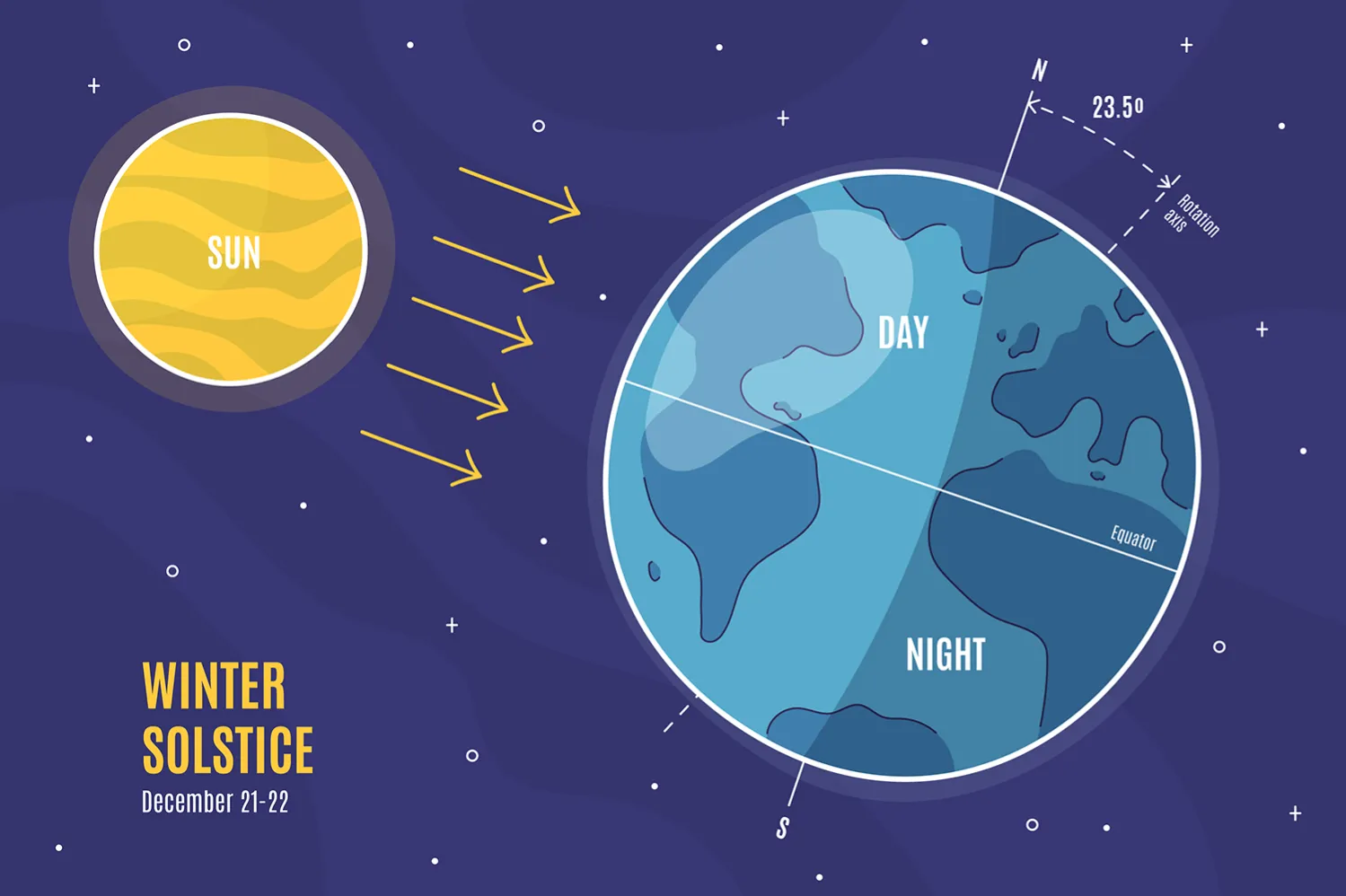
Earth completes one full rotation every 23 hours, 56 minutes, and 4 seconds—a period known as a sidereal day. However, our clocks use the 24-hour solar day, which is slightly longer due to Earth’s simultaneous orbit around the Sun. The axis is tilted 23.5° from being perpendicular to the orbital plane, which affects the length of days and seasons. Viewed from above the North Pole, Earth rotates in a counterclockwise direction, meaning it spins from west to east. This is why the Sun appears to rise in the east and set in the west. The side of Earth facing the Sun experiences day, while the opposite side is in darkness, creating night.
Observable Effects and Scientific Evidence
Earth’s rotation causes several observable phenomena. The most obvious is the regular change between day and night. It also makes the Sun and stars appear to move across the sky. However, we do not feel Earth spinning because its rotation is constant and smooth, and the atmosphere moves with the planet. Scientists have proven Earth’s rotation through experiments such as the Foucault pendulum, which swings in a fixed plane while Earth rotates beneath it. Another effect is the Coriolis effect, where moving air and water are deflected due to the planet’s rotation. Long-exposure photographs of the night sky also reveal star trails, showing circular paths caused by Earth’s spin.
Long-Term Changes and Broader Implications
Earth’s rotation is gradually slowing down. This happens because of tidal friction caused by the gravitational pull of the Moon, which acts like a brake. As a result, the length of a day increases by about two milliseconds per century. Billions of years ago, days on Earth were much shorter. Understanding Earth’s rotation helps scientists predict weather patterns, launch satellites, and study climate change. It also connects to larger scientific principles, showing how motion and forces interact in our solar system and affect life on our planet.
Interesting Fact: About 600 million years ago, a day on Earth lasted only about 21 hours!
What is the main reason Earth experiences day and night?
Earth’s rotation on its axisEarth’s revolution around the SunThe Moon’s orbit around EarthChanges in the atmosphere
How long does one full sidereal day last on Earth?
24 hours exactly23 hours, 56 minutes, and 4 seconds12 hours365 days
What causes the Sun to appear to rise in the east and set in the west?
Earth’s counterclockwise rotation from west to eastThe Moon blocking the SunThe Sun moving around EarthEarth’s axis being perpendicular
Which device demonstrates Earth's rotation by swinging in a fixed plane?
Foucault pendulumBarometerThermometerCompass
What is the Coriolis effect?
The deflection of moving air and water due to Earth’s rotationThe slowing of Earth’s rotation by the MoonThe movement of stars in the skyThe change from day to night
What does tidal friction do to Earth's rotation over time?
Speeds it upStops it completelyGradually slows it downHas no effect
In the passage, what are star trails?
Circular patterns made by stars in photos due to Earth’s spinMeteor showersComet pathsCloud formations
Which of the following is true about Earth's axis?
It is tilted 23.5° from perpendicular to the orbital planeIt is not tilted at allIt points directly at the SunIt causes earthquakes
True or False: We feel Earth’s rotation because it is very fast and bumpy.
TrueFalse
True or False: The length of a day on Earth has always been exactly 24 hours.
TrueFalse
Perfect For:
👩🏫 Teachers
• Reading comprehension practice
• Auto-graded assessments
• Literacy skill development
👨👩👧👦 Parents
• Reading practice at home
• Comprehension improvement
• Educational reading time
🏠 Homeschoolers
• Reading curriculum support
• Independent reading practice
• Progress monitoring
Reading Features:
📖
Reading Passage
Engaging fiction or nonfiction text
❓
Comprehension Quiz
Auto-graded questions
📊
Instant Feedback
Immediate results and scoring
📄
Printable Version
Download for offline reading
🔊
Read Aloud
Voice-over with word highlighting
Reviews & Ratings
No reviews yet. Be the first to share your experience!
Related Content
What is Solar Radiation
This NGSS-aligned science reading passage for middle school students explores the concept of solar radiation. Solar radi...
MS-ESS1-1
How Incoming Solar Radiation Changes with Latitude
This NGSS-aligned science reading passage helps middle school students understand how solar radiation, or insolation, ch...
MS-ESS1-1
Tides and Tidal Forces
This middle school science passage explores the mechanisms of tides and tidal forces, aligning with NGSS standards MS-ES...
MS-ESS1-1MS-ESS1-2
The Night Sky
This comprehensive science reading passage for grades 6-8 aligns with NGSS standard MS-ESS1-1 and explores the systems a...
MS-ESS1-1
Ancient Astronomy
This engaging passage for grades 6-8 explores the history of astronomy through the lens of ancient observations. Student...
MS-ESS1-1
Tools of Modern Astronomy
This passage introduces middle school students to modern astronomy, aligning with NGSS standard MS-ESS1-1. It explains h...
MS-ESS1-1
How Astronomy Became a Science
This passage explores the transformative period known as the Scientific Revolution, with a special focus on the history ...
MS-ESS1-1
Earth's Revolution
This middle school science passage explores the science behind Earth's revolution around the Sun, closely aligned with N...
MS-ESS1-1
Why We Have Seasons
This comprehensive middle school science reading passage explains the mechanisms behind Earth's seasons, directly addres...
MS-ESS1-1
Earth's Seasons
This comprehensive reading passage for grades 6-8 explains why Earth has seasons, revealing the scientific mechanisms be...
MS-ESS1-1
Phases of the Moon
This comprehensive middle school science passage explains the phases of the Moon, focusing on the mechanisms behind the ...
MS-ESS1-1
Tides
This comprehensive middle school science reading passage explores the phenomenon of ocean tides, aligned to NGSS standar...
MS-ESS1-1MS-ESS1-2
Eclipses
This comprehensive passage for grades 6-8 explores the science behind eclipses, including solar and lunar eclipses, thei...
MS-ESS1-1
The Moon's Characteristics
This comprehensive science reading passage for grades 6-8 examines the Moon's physical characteristics, including its si...
MS-ESS1-1MS-ESS1-2
Lunar Eclipses
This passage introduces middle school students to the phenomenon of lunar eclipses, connecting observable events to the ...
MS-ESS1-1
The Sun's Characteristics
This engaging science passage introduces middle school students to the Sun’s key characteristics, such as its classifica...
MS-ESS1-1MS-ESS1-2
What Is a Galaxy?
This comprehensive middle school science passage answers the question: What is a galaxy? Aligned to NGSS standard MS-ESS...
MS-ESS1-1
The Milky Way: Our Home Galaxy
This comprehensive science passage introduces middle school students to the Milky Way, the barred spiral galaxy that is ...
MS-ESS1-1
Types of Galaxies
This comprehensive middle school science passage introduces students to the classification and characteristics of galaxi...