This learning resource is available in interactive and printable formats. The interactive worksheet can be played online and assigned to students. The Printable PDF version can be downloaded and printed for completion by hand.
This middle school science reading passage introduces the concept of half-life, aligning with the NGSS MS-PS1-4 standard. Students learn how half-life measures the time it takes for half of a radioactive substance to decay, why this rate is constant for each isotope, and how factors like temperature or pressure do not affect it. The passage illustrates the concept with examples such as carbon-14, uranium-238, and iodine-131, and includes basic calculations and graphs. It also explains the importance of half-life in radioactive dating, which helps scientists determine the age of fossils and artifacts. Glossary terms, Spanish translations, and differentiated versions support diverse learners. Audio integration and graphic organizers enhance student understanding while reinforcing academic vocabulary and scientific thinking.
CONTENT PREVIEW
Expand content preview
Half-Life: Understanding Radioactive Decay
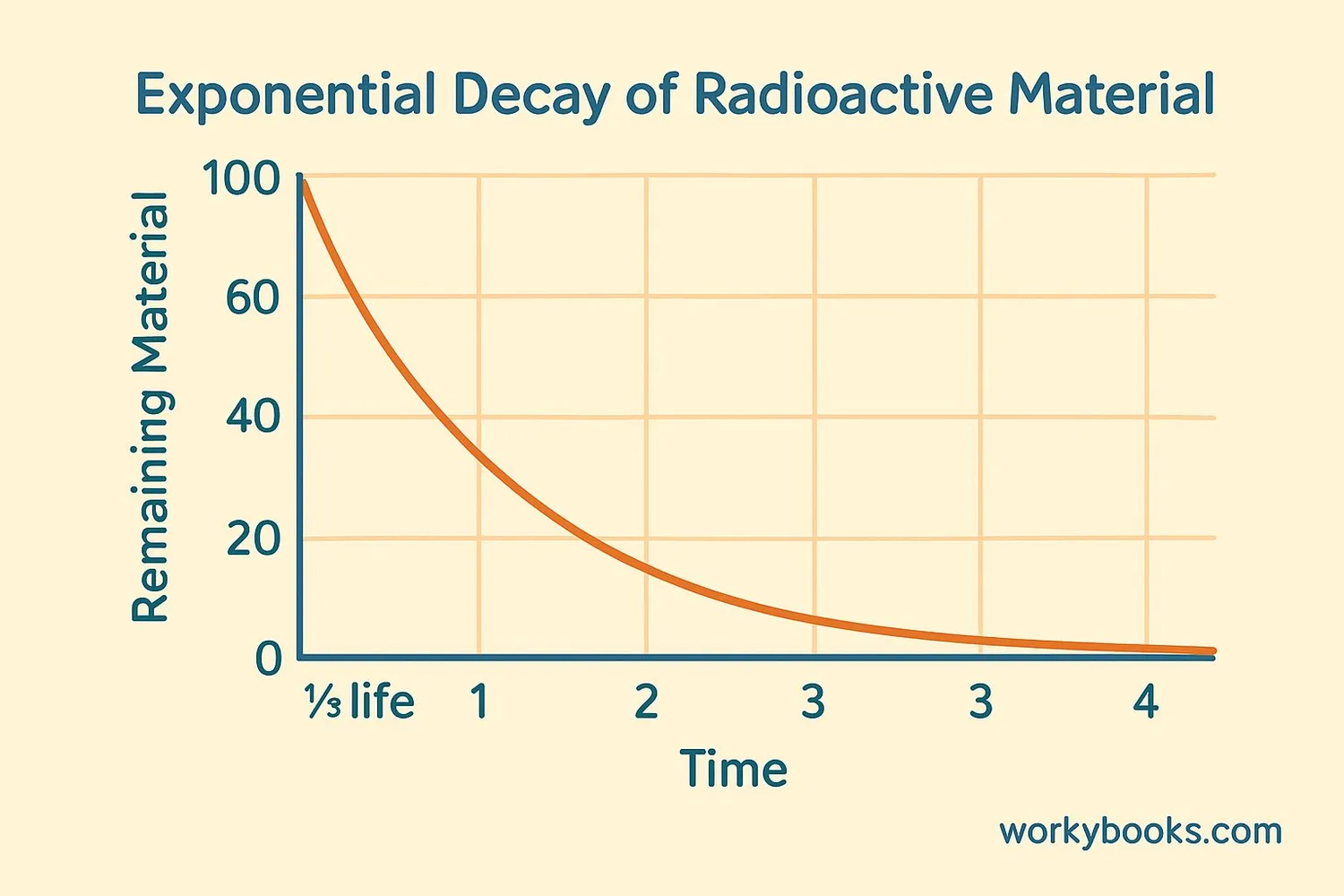
Radioactive decay is a natural process that changes one type of atom into another over time. Scientists use the concept of half-life to measure how quickly this change happens. Half-life is the amount of time it takes for half of a radioactive substance to decay into a different element. This predictable rate helps scientists understand everything from the age of ancient fossils to the safety of medical treatments.
How Half-Life Works
Each radioactive isotope has a unique and unchanging half-life. For example, carbon-14 has a half-life of about 5,730 years. That means after 5,730 years, only half of the original carbon-14 atoms remain in a sample; the rest have decayed. After another 5,730 years, only one-quarter of the carbon-14 is left. This process continues until nearly all the atoms have changed. The half-life does not depend on outside factors like temperature or pressure. Instead, it is determined by the structure of the atom's nucleus and the forces inside it.
Examples and Calculations
Other isotopes have very different half-lives. Uranium-238 has a half-life of about 4.5 billion years, making it useful for dating rocks as old as the Earth itself. In contrast, iodine-131 has a half-life of just 8 days, so it is used in medical imaging and treatments where quick decay is needed. Scientists often use graphs to show how much of a radioactive substance remains after each half-life. For example, if you start with 100 grams of iodine-131, after 8 days only 50 grams are left. After 16 days, just 25 grams remain. This pattern follows a mathematical decay curve, which always halves the amount with each interval.
Real-World Applications and Connections
The concept of half-life is crucial for radioactive dating. By measuring how much of a radioactive isotope remains in a rock or fossil, scientists can estimate its age. This helps researchers build timelines for Earth's history and evolution. Half-lives are also important for nuclear power, waste management, and medicine. Understanding half-life allows people to handle radioactive materials safely and predict how long they will remain dangerous or useful. These scientific principles show how the structure of atoms and the forces inside them shape our world, linking chemistry, physics, and earth science.
Half-life is a powerful tool that lets us measure time in ways not possible with clocks or calendars. It helps us unlock ancient secrets, advance technology, and protect our health.
Interesting Fact: Some radioactive isotopes used in smoke detectors, such as americium-241, have half-lives of over 400 years, making them both useful and long-lasting in safety devices.
What does the term 'half-life' mean?
The time it takes for half of a radioactive substance to decay.The amount of time an isotope remains stable.The time it takes for all atoms to disappear.The lifespan of a living organism.
Which factor does NOT affect the half-life of an isotope?
TemperatureThe structure of the atom's nucleusPressureChemical reactions outside the atom
What is the half-life of carbon-14?
8 days4.5 billion years5,730 years400 years
Why is uranium-238 useful for dating ancient rocks?
It is safe to handle.It has a very short half-life.It has a very long half-life, lasting billions of years.It turns into carbon-14 quickly.
In the passage, which isotope is described as having a half-life of only 8 days?
Carbon-14Uranium-238Iodine-131Americium-241
What is 'radioactive dating' used for?
To find out how old rocks or fossils are.To make new medicines.To change the half-life of isotopes.To increase radioactive decay speed.
Based on the passage, what happens to the amount of a radioactive substance after two half-lives?
One quarter of the original amount remains.All of the substance disappears.The substance becomes more radioactive.It doubles in amount.
True or False: The half-life of an isotope can change if you increase the temperature.
TrueFalse
True or False: After three half-lives, about one-eighth of the original radioactive substance is left.
TrueFalse
Which of the following best describes the importance of understanding half-life in society?
It helps us use radioactive materials safely in medicine, energy, and research.It makes atoms live longer.It lets us change the structure of atoms easily.It is only important for making clocks.
Perfect For:
👩🏫 Teachers
• Reading comprehension practice
• Auto-graded assessments
• Literacy skill development
👨👩👧👦 Parents
• Reading practice at home
• Comprehension improvement
• Educational reading time
🏠 Homeschoolers
• Reading curriculum support
• Independent reading practice
• Progress monitoring
Reading Features:
📖
Reading Passage
Engaging fiction or nonfiction text
❓
Comprehension Quiz
Auto-graded questions
📊
Instant Feedback
Immediate results and scoring
📄
Printable Version
Download for offline reading
🔊
Read Aloud
Voice-over with word highlighting
Reviews & Ratings
No reviews yet. Be the first to share your experience!
Related Content
The Melting Point of Substances
This middle school science reading passage, titled 'The Melting Point of Substances', explores the physical property kno...
5-PS1MS-PS1-4RI.6.3RI.7.1
The Melting Point of Steel
This engaging science passage, 'The Melting Point of Steel,' explains a key physical property of steel—its melting point...
5-PS1MS-PS1-4RI.6.3RI.7.1
The Melting Point of Aluminum
This science reading passage, 'The Melting Point of Aluminum,' introduces middle school students to the physical propert...
5-PS1MS-PS1-4RI.6.3RI.7.1
The Melting Point of Copper
This reading passage, 'The Melting Point of Copper,' introduces middle school students to an important physical property...
5-PS1MS-PS1-4RI.6.3RI.7.1
The Boiling Point of Water
This passage, 'The Boiling Point of Water,' introduces students to the physical property of boiling point through one of...
5-PS1MS-PS1-4RI.6.3RI.7.1
Is Sublimation Endothermic or Exothermic?
This NGSS-aligned science passage for middle school explains the thermodynamic nature of sublimation, showing how a soli...
MS-PS1-4HS-PS1
How Many Valence Electrons Does Oxygen Have?
This NGSS-aligned science reading passage teaches middle school students about the number of valence electrons in oxygen...
MS-PS1-2MS-PS1-4
How Many Valence Electrons Does Chlorine Have?
This NGSS-aligned science reading passage explains how many valence electrons chlorine has and why that makes it such a ...
MS-PS1-2MS-PS1-4
What Is Vapor Pressure?
This NGSS-aligned science passage explains the concept of vapor pressure in an age-appropriate, engaging way for middle ...
MS-PS1-4MS-LS1-2
What is Freezing Point Depression
This passage, 'Freezing Point Depression,' introduces students to the physical science concept of how adding substances ...
5-PS1MS-PS1-4RI.6.3RI.7.1
Solids, Liquids, and Gases
This comprehensive middle school science passage explains the scientific concepts behind the three common states of matt...
MS-PS1-4
Behavior of Gases
This comprehensive reading passage explores the behavior of gases for middle school students, aligned with NGSS standard...
MS-PS1-4
Evaporation as Physical Change
This middle school science passage examines the process of evaporation, a fundamental physical change where a liquid tur...
MS-PS1-4
Physical Changes: Condensation
This middle school science passage explores the process of condensation, the physical change where a gas becomes a liqui...
MS-PS1-4
Sublimation as Physical Change
This educational passage for grades 6-8 explores the science of sublimation—a physical change where a solid transforms d...
MS-PS1-4
Physical Changes: Deposition
This middle school science passage explores the concept of deposition, a type of physical change where matter transition...
MS-PS1-4
Scientific Investigations
This passage, aligned with NGSS standards for grades 6-8, introduces students to the process of scientific investigation...
MS-ETS1-1MS-ETS1-2MS-ETS1-3MS-ETS1-4
Scientific Theories
This reading passage for grades 6-8 introduces students to the concept of scientific theories, emphasizing that these ar...
MS-PS1-1MS-PS1-4MS-PS3-4SCIENCE AND ENGINEERING PRACTICES
Particle Model of Matter
This comprehensive science reading passage for grades 6-8 explores the particle model of matter, aligning with NGSS stan...
MS-PS1-1MS-PS1-4
Kinetic Theory of Matter
This middle school science reading passage introduces students to the kinetic theory of matter, aligning with NGSS MS-PS...