This learning resource is available in interactive and printable formats. The interactive worksheet can be played online and assigned to students. The Printable PDF version can be downloaded and printed for completion by hand.
This passage explores the origins, beliefs, and lasting impact of Hinduism, one of the world's oldest religions. Students will learn about key concepts such as Brahman, dharma, karma, and reincarnation, and how these ideas shaped ancient Indian civilization and daily life. The text references primary sources like the Vedas and archaeological discoveries such as ancient temples from the Indus Valley Civilization. Activities include a glossary, multiple-choice quiz, writing prompts, and graphic organizers, helping students analyze historical cause-and-effect, connect beliefs to social structure, and understand change over time. The passage aligns with CA HSS 6.5 and TEKS 6.21 history standards, and ELA-Literacy.RI.6.1, RI.6.4, RI.6.7. A Spanish translation and read aloud audio are included, supporting multilingual and diverse learners. This resource is ideal for classrooms exploring ancient world religions and civilizations.
CONTENT PREVIEW
Expand content preview
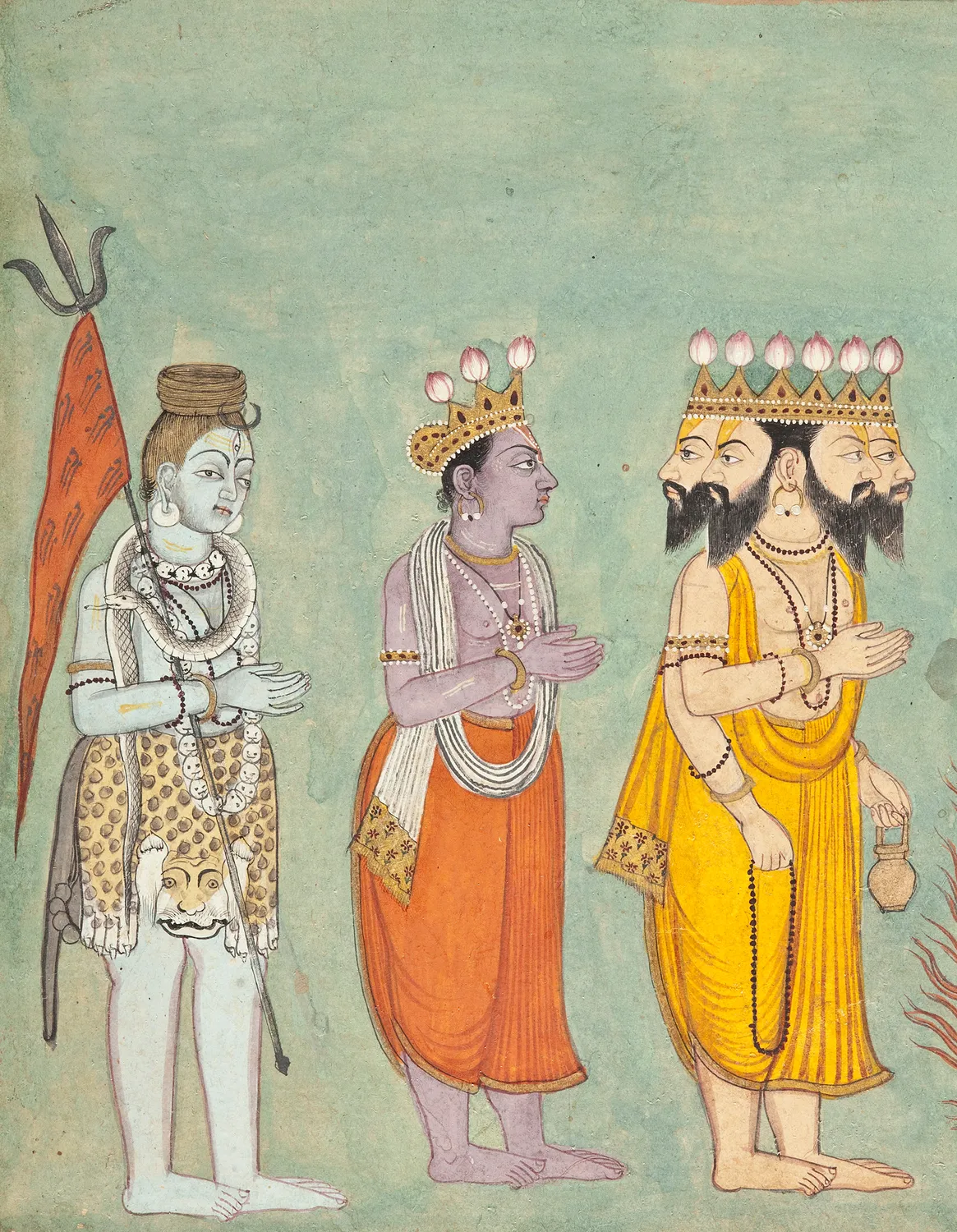
"Shiva, Vishnu, and Brahma Adoring Kali LACMA M.80.101 (2 of 7)" / Source: Wikimedia Commons (Public domain).
Hinduism is one of the oldest and most complex religions in the world, originating more than 3,500 years ago in ancient India. Unlike some religions that began with a single founder, Hinduism developed over centuries through a blend of local traditions and beliefs brought by the Indo-Aryans around 1500 BCE. Archaeological evidence from the Indus Valley Civilization (about 2500–1500 BCE), such as temple ruins and statues, suggests early forms of worship that influenced later Hindu practices.
At the heart of Hinduism is the idea of Brahman, the ultimate spiritual reality or world soul. Hindus believe that all gods and goddesses, such as Vishnu, Shiva, and Devi, are different forms or expressions of Brahman. This belief is described in the ancient sacred texts called the Vedas, composed in Sanskrit between 1500 and 500 BCE. The Vedas include hymns, rituals, and philosophical ideas that guide Hindu life. The Rig Veda, the oldest of these texts, contains hymns that praise many gods but also suggest the unity of all existence.
Hindu society was organized around a system of dharma, or duty, which meant following rules and responsibilities based on one's place in society. Dharma was closely connected to karma—the idea that every action has consequences, either in this life or a future one. Hindus believed in reincarnation, the cycle of birth, death, and rebirth. If a person followed their dharma and acted with good karma, they might be reborn into a higher social class, while bad actions could result in a lower rebirth. This system influenced daily life and social organization, shaping the caste system and people's roles in ancient India.
Over time, Hindu beliefs and practices evolved. By 500 BCE, new religious ideas, including the importance of meditation and devotion, appeared in texts like the Upanishads. Temples and elaborate rituals became more common, and festivals celebrated the many gods and goddesses. Hinduism spread across South Asia and became deeply tied to art, music, and literature. Today, its influence can still be seen in Indian culture and beyond, showing both continuity and change over thousands of years.
Hinduism's flexible approach, allowing for many gods and different ways of worship, helped it survive and adapt over time. This diversity made it possible for people from different regions and backgrounds to find meaning in its teachings, uniting them under the concept of Brahman.
The study of Hinduism helps historians understand not only the religious beliefs of ancient India but also how religion shaped social hierarchies, daily routines, and the development of civilization in South Asia and the wider ancient world.
Interesting Fact: The ancient city of Mohenjo-daro, part of the Indus Valley Civilization, had a Great Bath that some historians believe was used for early religious rituals, possibly linked to later Hindu ideas of purification.
Where did Hinduism begin?
Ancient IndiaAncient EgyptChinaGreece
What is Brahman in Hinduism?
The world soulA riverA cityA king
Which ancient texts outline Hindu beliefs?
VedasBibleQuranOdyssey
How did karma affect reincarnation?
It decided future rebirthsIt built templesIt wrote the VedasIt chose the king
Why did Hinduism survive for so long?
It adapted and included many beliefsIt stayed the same alwaysIt had one god onlyIt banned rituals
What was a major effect of the caste system?
Shaped daily life and rolesCreated new templesEnded all ritualsStarted the Indus Valley
Hindus believe in many gods. True or false?
TrueFalse
What does 'dharma' mean?
Duty or right way to liveA cityA riverA god
Perfect For:
👩🏫 Teachers
• Reading comprehension practice
• Auto-graded assessments
• Literacy skill development
👨👩👧👦 Parents
• Reading practice at home
• Comprehension improvement
• Educational reading time
🏠 Homeschoolers
• Reading curriculum support
• Independent reading practice
• Progress monitoring
Reading Features:
📖
Reading Passage
Engaging fiction or nonfiction text
❓
Comprehension Quiz
Auto-graded questions
📊
Instant Feedback
Immediate results and scoring
📄
Printable Version
Download for offline reading
🔊
Read Aloud
Voice-over with word highlighting
Reviews & Ratings
No reviews yet. Be the first to share your experience!
Related Content
Ancient Civilizations and the Environment
This engaging history reading passage explores how ancient civilizations such as Mesopotamia, Egypt, and the Maya adapte...
Gender Roles in Ancient Civilizations
This engaging history reading passage explores the roles of men and women in various ancient civilizations, including Me...
Writing Prompts Ancient Civilizations
Step into the shoes of an archaeologist with this engaging worksheet focused on ancient civilizations. Students will be ...
W.5.2.A-2W.5.1.CW.5.1.D
Power and Authority in Ancient Civilizations
This passage explores the roles of men in positions of power within ancient civilizations, focusing on their authority i...
Evidence in Ancient History
This engaging history reading passage investigates how archaeologists and historians discover clues about how ancient pe...
Ancient Monarchy
This reading passage explores the concept of monarchy in ancient civilizations, focusing on the origins, structure, and ...
Ancient Theocracy
This engaging history reading passage explores the concept of theocracy in ancient civilizations, where priests and reli...
Ancient Mathematics
This passage explores the essential role of mathematics in ancient civilizations, including Mesopotamia, Egypt, Greece, ...
Ancient Canaan
This educational passage explores the land of Canaan, the historical homeland of the ancient Israelites. Students will l...
Ancient Money Barter
This passage explores the fascinating evolution from barter to the earliest coins in ancient civilizations, focusing on ...
Ancient Science and Medicine
This comprehensive reading passage explores the development of science and medicine in ancient civilizations, including ...
Ancient Literature
This passage explores the importance of ancient stories and poems from civilizations such as Greece, India, and Israel. ...
Ancient Agriculture Farming
This passage explores the transformative impact of farming on ancient societies, examining how the Neolithic Revolution ...
Ancient Writing Systems
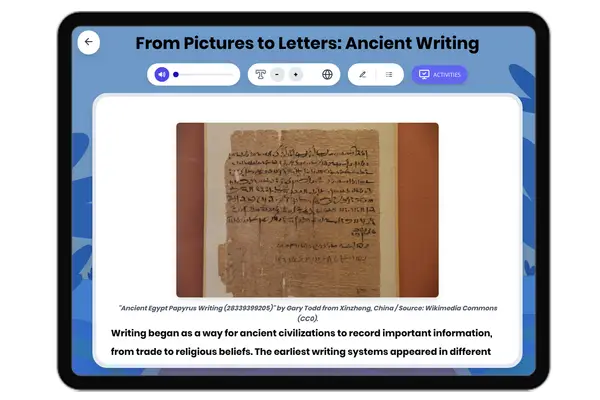
This engaging history reading passage explores the origins and evolution of ancient writing systems, including cuneiform...
Geography of Ancient Israel
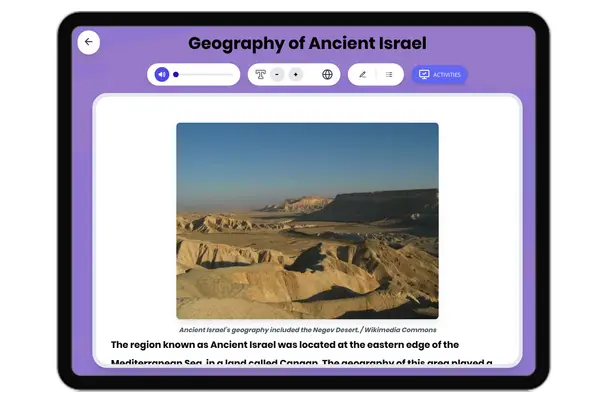
This passage explores the rich geography of Ancient Israel, focusing on how landforms, climate, and natural resources sh...
Slavery Across Civilizations
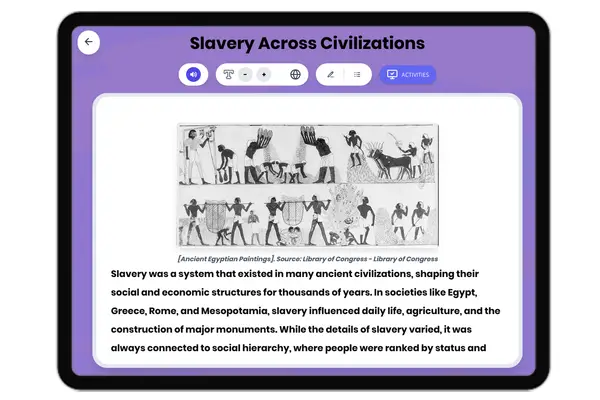
This detailed history reading passage explores the role and impact of slavery across several ancient civilizations, incl...
Social Classes in Ancient Societies
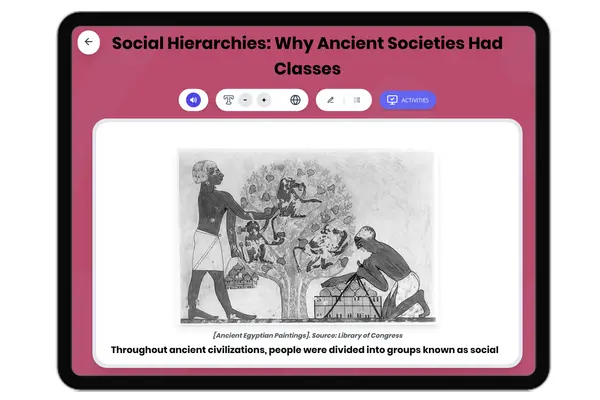
This passage explores the concept of social hierarchies in ancient civilizations, focusing on why societies such as Meso...
Social structures in Ancient World
This passage explores the organization and significance of family life in ancient societies, focusing on how extended fa...
Polytheism and Monotheism in Ancient Times
This passage explores the religious beliefs of ancient civilizations, focusing on the differences and similarities betwe...
Women in Ancient Societies
This reading passage explores the complex roles of women in the ancient world, focusing on civilizations such as Mesopot...