How Did Islam Spread
Interactive passage with audio narration, comprehension questions, and printable PDF.
By completing this purchase you agree to our Terms of Use and Privacy Policy. Your subscription renews automatically until you cancel. You can cancel anytime from your account settings. All sales are final and non-refundable. Digital content is available for download in your account immediately upon purchase.
What's included
How Did Islam Spread preview and details
About this printable How Did Islam Spread reading passage (Grades 5-8)
Sample passage and quiz from How Did Islam Spread
Reading passage and comprehension quiz preview
How Did Islam Spread
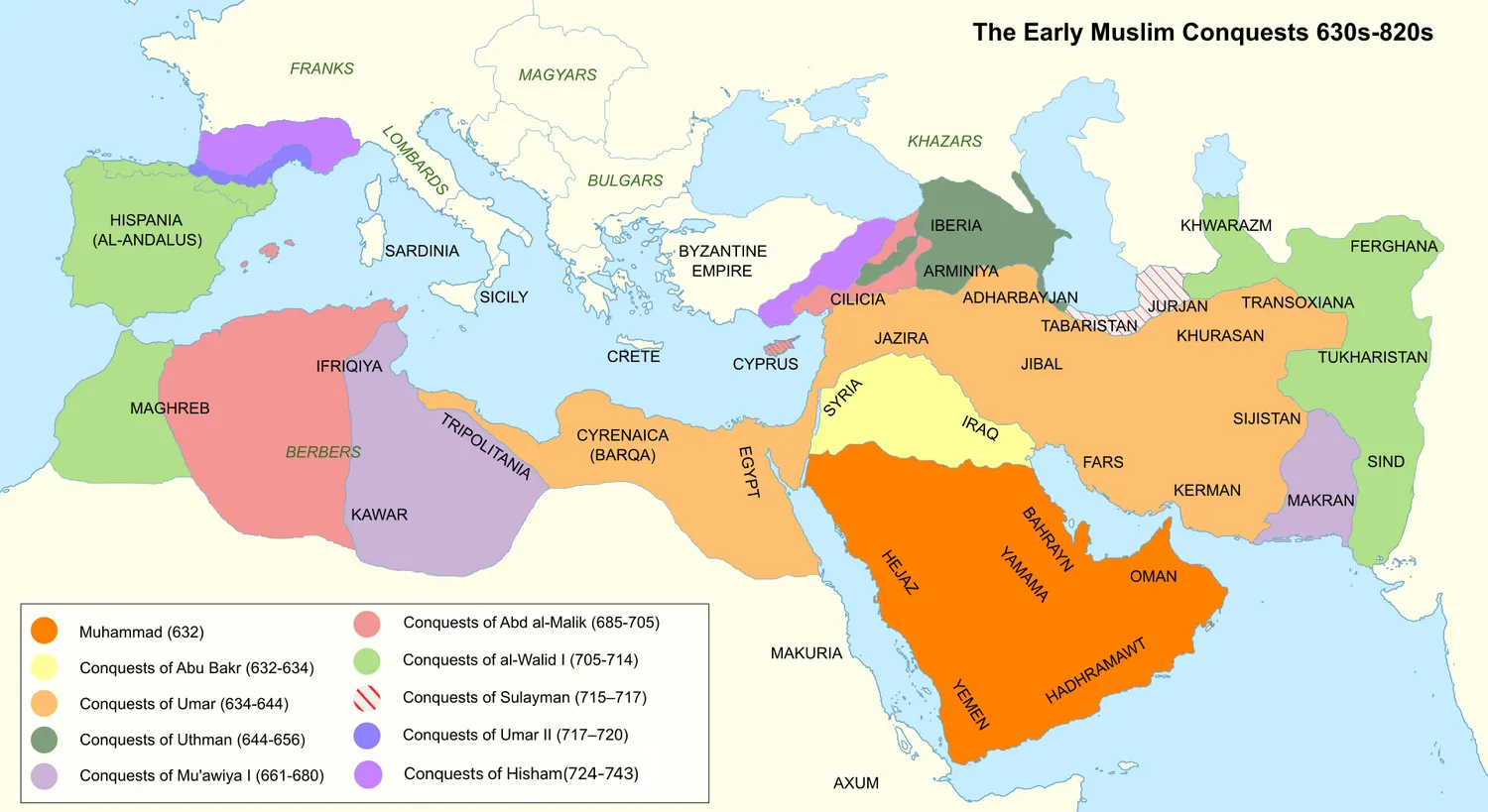
"Islamic Expansion per caliph" by Dr.Sami Salamah / Wikimedia Commons (CC0).
The expansion of Islam from its birthplace in the Arabian Peninsula dramatically shaped the ancient world. Beginning in the 7th century CE, Islam spread rapidly across parts of Asia, Africa, and Europe, influencing diverse societies and cultures. This transformation was possible through a combination of trade networks, military campaigns, and cultural exchange. The spread of Islam is a key example of how religion, geography, and human decisions intersect in history.
After the Prophet Muhammad’s death in 632 CE, his followers, known as Muslims, began to spread Islam beyond Arabia. The first four caliphs, or leaders, were called the “Rightly Guided Caliphs.” Under their leadership, Muslim armies conquered regions such as Syria (636 CE) and Egypt (641 CE). These conquests expanded the territory under Muslim rule and connected distant peoples. Archaeological evidence, like early mosques built in Damascus and Cairo, shows how Islamic architecture and religious practices took root in new lands.
Trade routes played a crucial role in Islam’s spread. Merchants traveled across the Silk Road, North African caravan paths, and the Mediterranean Sea, carrying not just goods but also ideas and beliefs. In cities like Timbuktu and Cordoba, Islam blended with local traditions, creating vibrant centers of learning and culture. The famous traveler Ibn Battuta documented how Islam united people from Mali in West Africa to the Indian subcontinent. Coins, pottery, and written records from these regions provide primary sources about daily life and the growth of Islamic civilization.
The Umayyad and Abbasid dynasties built powerful empires that stretched from Spain to India. They established administrative systems, supported scholars, and encouraged the translation of important texts into Arabic. Islam’s principles of charity, law, and community helped shape social hierarchy and daily routines. However, the spread of Islam was not always peaceful—there were conflicts, but also periods of tolerance and cooperation with Christians, Jews, and others. Over centuries, the religion’s influence continued to grow, adapting to new environments and shaping the history of three continents.
The spread of Islam across Asia, Africa, and Europe shows how geography, leadership, and cultural exchange can change the world. By connecting distant societies, Islam contributed to the development of science, art, and trade. The legacy of this expansion remains visible in the languages, buildings, and customs of many countries today.
This story connects to larger course themes about how belief systems spread, how societies influence one another, and the ways people adapt to new ideas and environments.
Interesting Fact: The Great Mosque of Córdoba in Spain, built during the Umayyad dynasty, was once the world’s second-largest mosque and is now a UNESCO World Heritage Site.
Comprehension quiz (8 questions)
1. Who were the first four leaders after Muhammad?
2. Which city is famous for its Great Mosque?
3. What role did trade routes play?
4. How did Islam influence daily life?
5. What is a caliph?
6. Why are archaeological finds important?
7. Islam spread peacefully everywhere. True or false?
8. What does 'dynasty' mean?
Perfect for the way you teach
- Build comprehension skills
- Auto-graded quiz
- Differentiated reading
- Read together at home
- Improve fluency
- Quiet reading time
- Reading curriculum support
- Independent practice
- Track Lexile growth