How Surplus Food Created Kingdoms — Reading Comprehension
Rate this
Premium Resource
Present
Present in classroom. No work saved
Assign
Classroom with student accounts, Track progress
Quick Play
No student accounts, assign with a link
Grades
6
7
8
PRINT+DIGITAL RESOURCE
This learning resource is available in interactive and printable formats. The interactive worksheet can be played online and assigned to students. The Printable PDF version can be downloaded and printed for completion by hand.
This history reading passage explores how surplus food enabled the rise of ancient civilizations and kingdoms. Students will discover how agricultural advances in regions like Mesopotamia, Egypt, and the Indus Valley made it possible for cities to grow, governments to form, and social hierarchies to develop. The content aligns with CA HSS 6.2.1 and CCSS RH.6-8.2, providing opportunities to analyze cause and effect, use evidence, and understand historical significance. Activities include a multiple-choice quiz, writing prompts, graphic organizers, a timeline, and a glossary. The passage is available with read aloud audio and a Spanish translation to support all learners. By examining archaeological and primary sources, students gain insight into the relationship between food production, urbanization, and the rise of complex societies.
CONTENT PREVIEW
Expand content preview
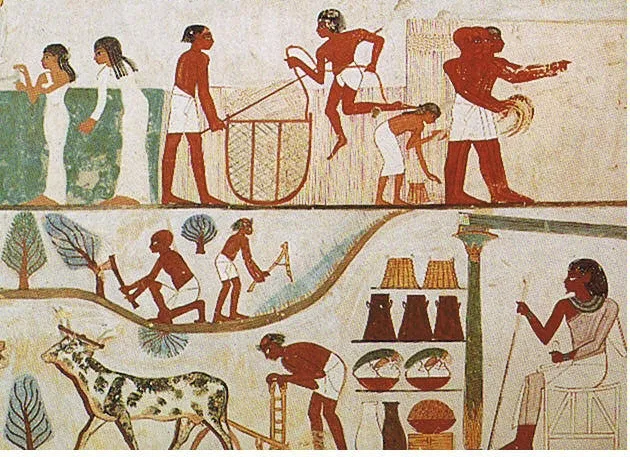
"Tomb of Nakht Harvest" by Norman de Garis Davies, Nina Davies (2-dimensional 1 to 1 Copy of an 15th century BC Picture) / Source: Wikimedia Commons (Public domain).
Throughout ancient history, the development of surplus food was a turning point that changed the world. When people first learned to farm, around 10,000 BCE, they no longer had to move constantly to find food. Groups settled near rivers like the Tigris and Euphrates in Mesopotamia, the Nile in Egypt, and the Indus River in South Asia. The steady production of food allowed communities to grow larger than ever before and paved the way for the first civilizations.
A surplus means producing more food than is immediately needed. In Mesopotamia, for example, farmers used irrigation systems as early as 6000 BCE to bring water from rivers to their fields. Archaeologists have found clay tablets from ancient Sumer (c. 3000 BCE) with records of food storage and distribution, showing how important surplus was to city life. The extra grain and crops could be stored in granaries for later use, traded with neighbors, or used to feed workers building temples and city walls.
Surplus food changed how societies were organized. Not everyone had to farm; some people became artisans, priests, or rulers. This led to the rise of social hierarchy, with different classes of people performing different jobs. In ancient Egypt, for instance, workers who built the pyramids were often paid in bread and beer from state granaries. Written records from the Indus Valley show standardized weights and measures, which archaeologists believe helped control the distribution of surplus goods. The government, often led by kings or dynasties, managed these resources and protected their people, giving rise to the earliest kingdoms.
The ability to store and control surplus food also allowed cities to expand and populations to grow. Large cities like Uruk in Mesopotamia or Memphis in Egypt became centers of culture, trade, and power. Surplus food supported armies, enabled long-distance trade, and allowed rulers to build monuments that still stand today. However, control of surplus could also create conflict and inequality. Archaeological evidence reveals that as kingdoms grew, so did competition for land and resources, which sometimes led to war.
In summary, surplus food was the foundation of ancient civilizations. It made it possible to build cities, develop governments, and support complex societies. By understanding how surplus changed daily life and social structures, we can see why food production is one of the most important developments in human history. This connects to the larger study of how geography and technology shape societies.
Interesting Fact: The world’s oldest known recipe, found in ancient Mesopotamian cuneiform tablets, is for bread made from surplus barley!
What does surplus food mean?
Extra food after needs are metFood eaten immediatelyFood from animals onlyFood cooked over fire
Where did early civilizations often settle?
Near riversIn desertsOn mountainsIn forests
Which job became possible because of surplus?
ArtisanHunterGathererNomad
How did irrigation help farmers?
Brought water to cropsMade toolsBuilt templesHunted animals
What did kings or dynasties do with surplus?
Managed and protected resourcesIgnored itDestroyed itSold it all
What effect did surplus food have?
Allowed cities to growEnded farmingCreated desertsStopped trade
Surplus food led to cities growing. True or false?
TrueFalse
What is a granary?
A place to store grainA templeA riverA type of tool
Perfect For:
👩🏫 Teachers
• Reading comprehension practice
• Auto-graded assessments
• Literacy skill development
👨👩👧👦 Parents
• Reading practice at home
• Comprehension improvement
• Educational reading time
🏠 Homeschoolers
• Reading curriculum support
• Independent reading practice
• Progress monitoring
Reading Features:
📖
Reading Passage
Engaging fiction or nonfiction text
❓
Comprehension Quiz
Auto-graded questions
📊
Instant Feedback
Immediate results and scoring
📄
Printable Version
Download for offline reading
🔊
Read Aloud
Voice-over with word highlighting
Reviews & Ratings
No reviews yet. Be the first to share your experience!
Related Content
Ancient Civilizations and the Environment
This engaging history reading passage explores how ancient civilizations such as Mesopotamia, Egypt, and the Maya adapte...
Gender Roles in Ancient Civilizations
This engaging history reading passage explores the roles of men and women in various ancient civilizations, including Me...
Writing Prompts Ancient Civilizations
Step into the shoes of an archaeologist with this engaging worksheet focused on ancient civilizations. Students will be ...
W.5.2.A-2W.5.1.CW.5.1.D
Power and Authority in Ancient Civilizations
This passage explores the roles of men in positions of power within ancient civilizations, focusing on their authority i...
Ancient Monarchy
This reading passage explores the concept of monarchy in ancient civilizations, focusing on the origins, structure, and ...
Evidence in Ancient History
This engaging history reading passage investigates how archaeologists and historians discover clues about how ancient pe...
Ancient Theocracy
This engaging history reading passage explores the concept of theocracy in ancient civilizations, where priests and reli...
Ancient Mathematics
This passage explores the essential role of mathematics in ancient civilizations, including Mesopotamia, Egypt, Greece, ...
Ancient Canaan
This educational passage explores the land of Canaan, the historical homeland of the ancient Israelites. Students will l...
Ancient Money Barter
This passage explores the fascinating evolution from barter to the earliest coins in ancient civilizations, focusing on ...
Ancient Science and Medicine
This comprehensive reading passage explores the development of science and medicine in ancient civilizations, including ...
Ancient Literature
This passage explores the importance of ancient stories and poems from civilizations such as Greece, India, and Israel. ...
Ancient Agriculture Farming
This passage explores the transformative impact of farming on ancient societies, examining how the Neolithic Revolution ...
Ancient Writing Systems
This engaging history reading passage explores the origins and evolution of ancient writing systems, including cuneiform...
Geography of Ancient Israel
This passage explores the rich geography of Ancient Israel, focusing on how landforms, climate, and natural resources sh...
Slavery Across Civilizations
This detailed history reading passage explores the role and impact of slavery across several ancient civilizations, incl...
Social Classes in Ancient Societies
This passage explores the concept of social hierarchies in ancient civilizations, focusing on why societies such as Meso...
Social structures in Ancient World
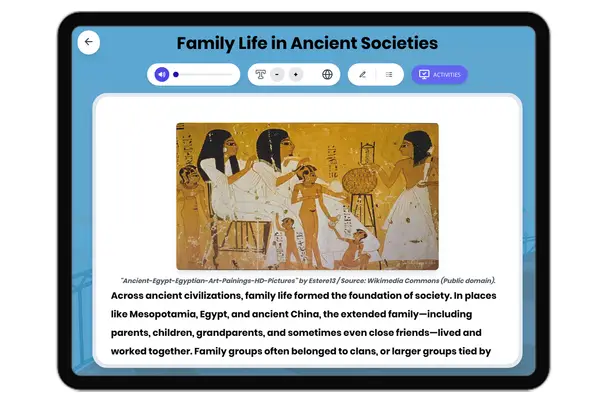
This passage explores the organization and significance of family life in ancient societies, focusing on how extended fa...
Polytheism and Monotheism in Ancient Times
This passage explores the religious beliefs of ancient civilizations, focusing on the differences and similarities betwe...
Women in Ancient Societies
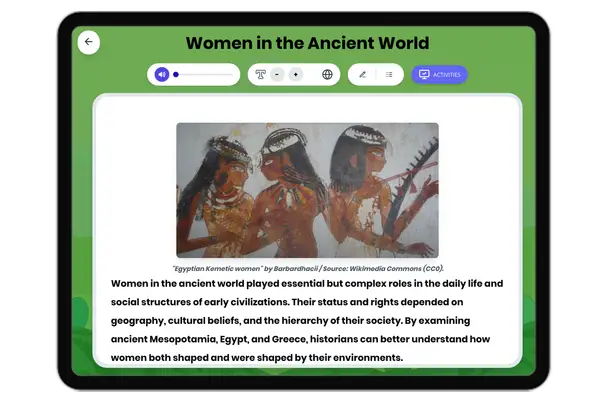
This reading passage explores the complex roles of women in the ancient world, focusing on civilizations such as Mesopot...