How the Barreleye Fish Sees — Reading Comprehension
Rate this
Premium Resource
Present
Present in classroom. No work saved
Assign
Classroom with student accounts, Track progress
Quick Play
No student accounts, assign with a link
Grades
6
PRINT+DIGITAL RESOURCE
This learning resource is available in interactive and printable formats. The interactive worksheet can be played online and assigned to students. The Printable PDF version can be downloaded and printed for completion by hand.
Dive into the fascinating world of the barreleye fish and discover its extraordinary eyes. This passage, designed for Grade 6 students, explains how this deep-sea creature's unique eye structure is a perfect adaptation for gathering light and detecting prey in the dark ocean depths. It aligns with NGSS standard LS1.A: Structure and Function, highlighting how an organism's physical traits help it survive. Students will learn about the challenges of deep-sea environments, the barreleye's tubular eyes, and its incredible vision. The included activities, such as multiple-choice questions, a glossary, and short answer prompts, reinforce comprehension and vocabulary. All content is audio integrated for enhanced learning.
CONTENT PREVIEW
Expand content preview
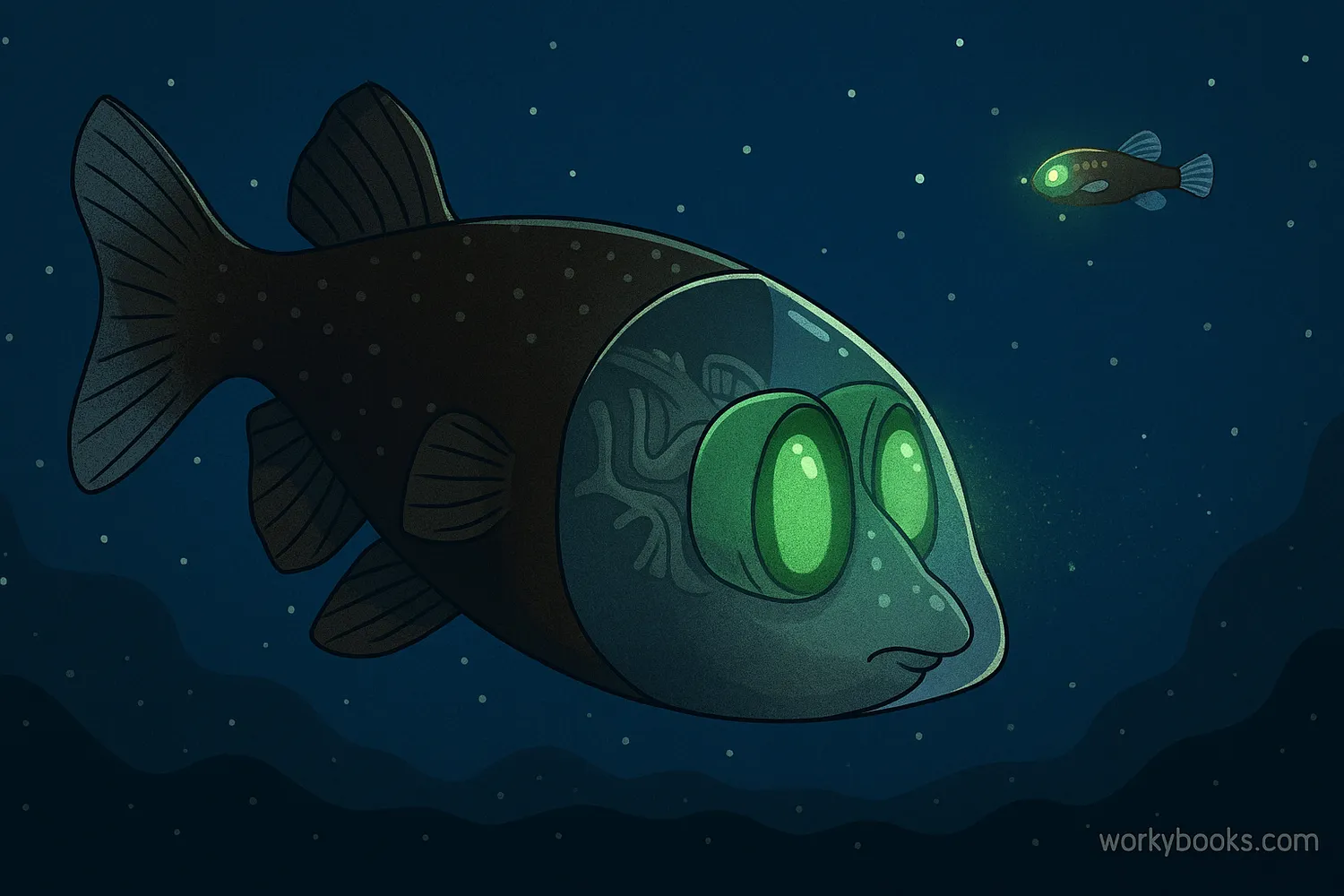
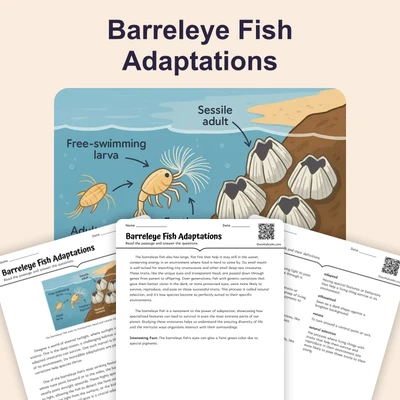
Barreleye fish uses rotating tubular eyes to spot bioluminescent prey in deep ocean darkness.
Imagine living in a world where the sun never shines, a place of complete and total darkness. This is the reality for many creatures in the deep sea, a vast and mysterious part of our oceans. One of these incredible creatures is the barreleye fish (Macropinna microstoma), a truly unique marine animal with an astonishing secret: its eyes. Its unique eye structure is a perfect example of how animals adapt to their environment to survive, a concept known as structure and function.
Unlike most fish, the barreleye fish has two large, tubular eyes that are typically aimed upwards. These eyes are not on the sides of its head; instead, they are inside its head, protected by a transparent, fluid-filled dome. This dome, which covers the top of its head, is actually what scientists first mistook for its eyes! Its real eyes, those green, glowing tubes, are usually looking straight up. This upward gaze is crucial for spotting the faint outlines of prey or the tiny flashes of bioluminescence from other creatures swimming above it in the perpetual twilight zone of the deep ocean. Bioluminescence is the light produced by living organisms, like fireflies or some deep-sea animals.
The barreleye's tubular eyes are incredibly sensitive to light. Because very little sunlight reaches the deep sea, these eyes are specially designed to gather even the faintest glimmer. Think of them like super-powered telescopes, able to collect every available photon of light. This adaptation allows the barreleye fish to detect prey from a distance, giving it an advantage in the hunt for food in its challenging deep-sea environment. Scientists have also discovered that these amazing eyes can rotate! This means the barreleye can switch its gaze from looking upwards to looking forwards when it's ready to feed, allowing it to accurately target its meal.
The barreleye fish usually hangs motionless in the water, waiting for its next meal to drift by. When it spots something, it can quickly turn its eyes forward to get a clear view of its target before striking. This incredible ability to switch its vision from wide-angle upward scanning to focused forward viewing highlights the effectiveness of its specialized eye structure. It's a prime example of how different animal structures help animals function and survive in their unique habitats, especially in the extreme conditions of the deep sea. The barreleye fish's eyes are truly a marvel of natural engineering, perfectly suited for life in the ocean's dark depths.
Interesting Fact: The transparent dome over the barreleye fish's head can sometimes be damaged during capture, making its true eye structure difficult to observe in studies outside its natural habitat.
Where does the barreleye fish live?
Shallow riversDeep seaCoral reefsCoastal waters
What color are the barreleye fish's real eyes?
BlueRedGreenYellow
Why are the barreleye's eyes usually aimed upwards?
To avoid predatorsTo see sunlightTo spot prey aboveTo navigate currents
What is the transparent dome on its head made of?
BoneMuscleFluidSkin
The barreleye fish's eyes are called tubular. What does 'tubular' mean in this context?
Square shapedLike a tubeVery smallBrightly colored
How do the barreleye's eyes help it survive in the deep sea?
Swim fasterGather faint lightHide from enemiesCommunicate with others
If a barreleye fish lived in shallow waters, its upward-pointing tubular eyes would likely be a disadvantage.
TrueFalse
Why is the barreleye's ability to rotate its eyes important?
To change colorTo find a mateTo target preyTo swim backwards
A fish with small, forward-facing eyes would likely struggle to survive in the deep sea because:
Can't see predatorsLimited light gatheringNo deep-sea preyToo much pressure
What does 'bioluminescence' refer to?
Sound in waterLight from organismsHeat from volcanosOcean currents
Perfect For:
👩🏫 Teachers
• Reading comprehension practice
• Auto-graded assessments
• Literacy skill development
👨👩👧👦 Parents
• Reading practice at home
• Comprehension improvement
• Educational reading time
🏠 Homeschoolers
• Reading curriculum support
• Independent reading practice
• Progress monitoring
Reading Features:
📖
Reading Passage
Engaging fiction or nonfiction text
❓
Comprehension Quiz
Auto-graded questions
📊
Instant Feedback
Immediate results and scoring
📄
Printable Version
Download for offline reading
🔊
Read Aloud
Voice-over with word highlighting
Reviews & Ratings
No reviews yet. Be the first to share your experience!
Related Content
The Nature of Life Science
This passage, aligned with NGSS MS-LS1-1, introduces students in grades 6-8 to the foundational concepts of life science...
MS-LS1-1
Aerobic Organisms
This engaging, audio-integrated reading passage, titled 'Aerobic Organisms: The Breath of Life,' introduces students to ...
From Cells to Organisms
This educational passage, "From Cells to Organisms," explores the fundamental concept of how living things are built, st...
Using Dichotomous Keys to Identify Organisms
This audio-integrated passage, 'Using Dichotomous Keys to Identify Organisms,' introduces 6th-grade students to a fundam...
Science Vocabulary
This worksheet on domain-specific words will help students learn some science vocabulary. Students will be asked to matc...
L.3.6L.3.4.A
The Aorta: Molecules to Organisms of the Body's Largest Artery
This educational content features a fascinating reading passage, audio integrated for an enhanced learning experience, a...
Tools and Technology for Life Scientists
This informational passage for grades 6-8 explores the essential tools and technology used by life scientists, aligned t...
MS-LS1-1MS-LS1.A
Simple Machines Science Report
This science writing task requires students to clearly explain how three simple machines work using precise domain-speci...
W.5.4
Cryptobiosis: Pausing Life to Survive
This engaging, audio-integrated reading passage explores the amazing biological process of cryptobiosis, where organisms...
From Senses to Actions
This Grade 4-5 science passage, 'From Senses to Actions,' explores how our senses work together with the brain and body ...
The Science of Hibernation
This educational module, featuring an audio-integrated reading passage titled 'The Science of Hibernation,' is designed ...
The Life Cycle of a Giant Panda
This engaging, audio-integrated reading passage, titled "The Life Cycle of a Giant Panda," explores the fascinating stag...
How Bats Use Sound to See
This Grade 4-5 science passage, 'How Bats Use Sound to See,' explores the fascinating process of echolocation in bats. S...
Citizen Science and Ecological Monitoring
This engaging passage for grades 6-8 introduces the concept of citizen science and its critical role in ecological monit...
MS-LS2-1
The Pumpkin Life Cycle
This informational worksheet explores the pumpkin lifecycle, guiding students through procedural steps in a scientific t...
RI.2.3RI.2.10
Life Cycle Stages
This comprehensive word sort activity helps Grade 3 students understand the universal stages of life cycles as outlined ...
What Is Earth Science?
This engaging middle school science passage introduces students to the field of Earth science, aligning with NGSS standa...
MS-ESS1MS-ESS2MS-ESS3SEP
Life Makers
This engaging word sort activity helps elementary students understand the diverse methods of reproduction in living orga...
Growth and Development of Organisms
This middle school science passage, aligned with NGSS standards MS-LS1-4 and MS-LS1-5, provides an in-depth look at the ...
MS-LS1-4MS-LS1-5
Barnacles and Biofouling
This engaging, audio-integrated reading passage, 'Barnacles and Biofouling,' delves into the fascinating world of how ti...