This learning resource is available in interactive and printable formats. The interactive worksheet can be played online and assigned to students. The Printable PDF version can be downloaded and printed for completion by hand.
This engaging history passage explores the life and legacy of King David, focusing on his rise as a warrior king and his establishment of Jerusalem as the capital of ancient Israel. Students will learn about David's early years, his famous battle with Goliath, his political and military leadership, and his lasting impact on religion, culture, and history. The passage uses academic vocabulary and references primary sources, such as archaeological findings and biblical texts. Activities include a reading comprehension quiz, writing prompts, graphic organizers, and a timeline. This resource is ideal for students studying ancient civilizations and aligns with CA HSS 6.2 and CCSS RI.6.1, RI.6.3, W.6.2. The passage is available in English and Spanish, with a simplified version for differentiated instruction and a read aloud audio feature. Students are challenged to analyze cause and effect, use evidence, and connect King David's story to broader historical themes.
CONTENT PREVIEW
Expand content preview
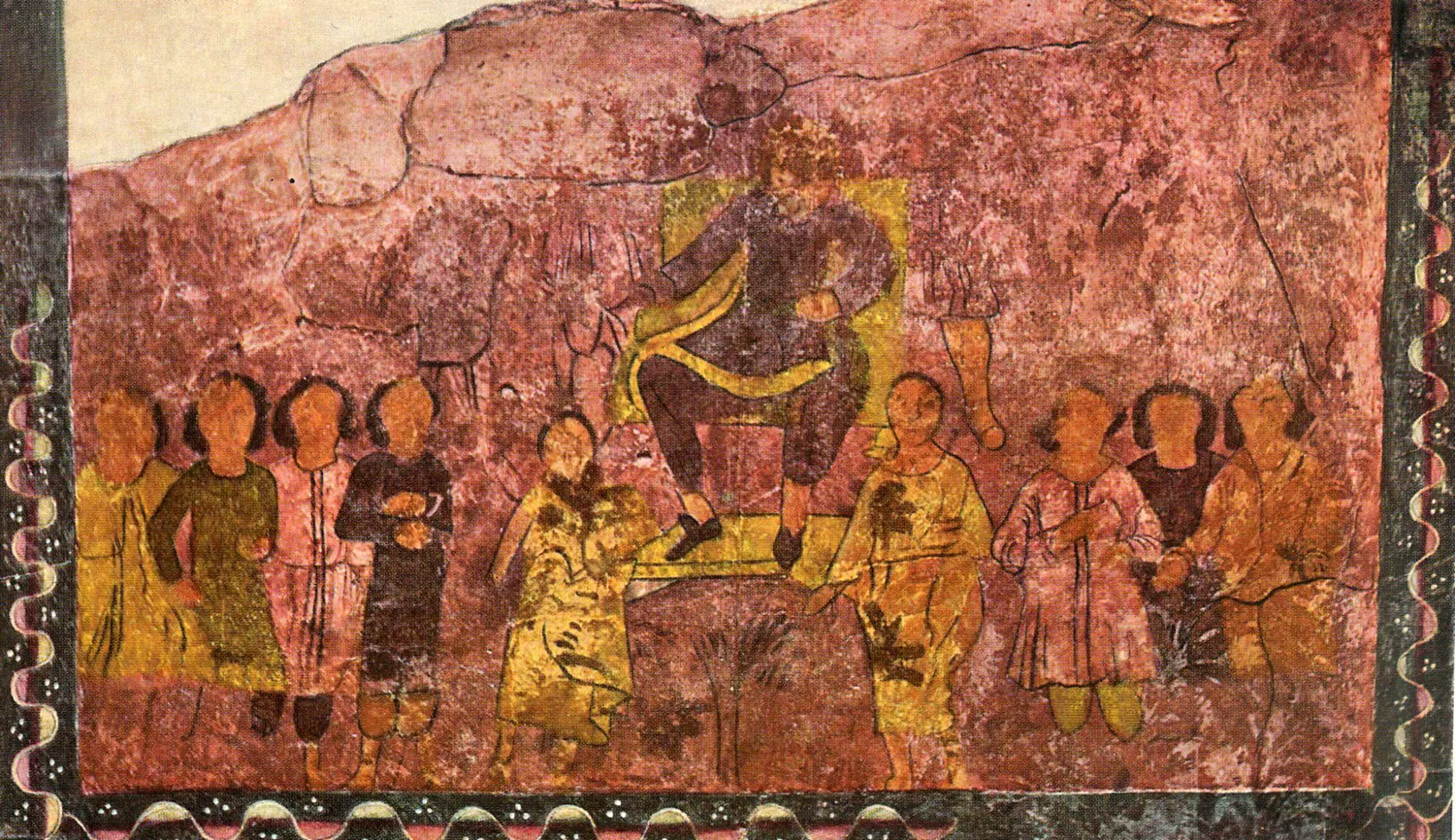
Dura Europos fresco on the West wall : David King of Israel by Gillman slide collection. / Wikimedia Commons
King David is one of the most famous rulers in the history of ancient Israel. He is remembered as a warrior, a poet, and the leader who made Jerusalem the capital city of his kingdom. King David lived around 1000 BCE, during a time when many small tribes and city-states fought for control of the land we now call Israel and Palestine.
David was born in Bethlehem and was the youngest son in his family. According to the Hebrew Bible, David first became known when he defeated the giant Goliath with only a slingshot, showing his courage and skill. Archaeological excavations at Khirbet Qeiyafa, near the Valley of Elah, have revealed ancient fortifications that some scholars believe may relate to the time of David, supporting the idea of a strong leader uniting the tribes. Over time, David gained the trust of the Israelite people and became king after the death of Saul, Israel’s first king.
As king, David faced many challenges. He united the twelve tribes of Israel into a single kingdom. One of his greatest achievements was conquering the fortress of Jerusalem, which was then controlled by the Jebusites. He made Jerusalem the political and religious center of his kingdom. This decision changed the geography of power in the region and had lasting effects on the history of the Middle East. Archaeologists have found ancient structures in Jerusalem, such as stepped stone walls, that may date to David’s era, although scholars continue to debate their exact origins.
David also established a dynasty, as his descendants continued to rule after him. He is credited with expanding the kingdom’s borders and creating a more organized system of government. However, his reign was not without conflict. David faced rebellion within his own family and challenges from neighboring peoples like the Philistines. Despite these problems, many sources describe his rule as a time of greater unity and cultural growth.
King David’s impact is still felt today. He is an important figure in Judaism, Christianity, and Islam. His story connects to themes of leadership, faith, and the complexities of power. The decision to make Jerusalem his capital not only unified his people but also set the stage for the city’s future significance. David’s life shows how individuals can shape history and how power, religion, and geography are often deeply linked.
This story of King David links to broader themes in ancient history, such as the rise of kingdoms, the importance of geography, and the role of leaders in shaping civilizations.
Interesting Fact: According to tradition, King David was also a talented musician and poet, credited with writing many of the Psalms found in the Hebrew Bible.
Who made Jerusalem the capital?
King DavidKing SaulGoliathThe Jebusites
What was David's first famous victory?
Defeating GoliathConquering EgyptBuilding a templeUniting the Greeks
Who controlled Jerusalem before David?
The JebusitesThe PhilistinesThe EgyptiansThe Greeks
What did David use to defeat Goliath?
A slingshotA swordA spearA shield
Why was making Jerusalem the capital important?
It unified the tribesIt made David richIt ended all warsIt was close to the sea
What evidence do archaeologists find in Jerusalem?
Ancient stone wallsGold coinsStatues of DavidModern buildings
King David wrote many Psalms. True or false?
TrueFalse
What is a dynasty?
Rulers from one familyA type of cityA battleA stone wall
Perfect For:
👩🏫 Teachers
• Reading comprehension practice
• Auto-graded assessments
• Literacy skill development
👨👩👧👦 Parents
• Reading practice at home
• Comprehension improvement
• Educational reading time
🏠 Homeschoolers
• Reading curriculum support
• Independent reading practice
• Progress monitoring
Reading Features:
📖
Reading Passage
Engaging fiction or nonfiction text
❓
Comprehension Quiz
Auto-graded questions
📊
Instant Feedback
Immediate results and scoring
📄
Printable Version
Download for offline reading
🔊
Read Aloud
Voice-over with word highlighting
Reviews & Ratings
No reviews yet. Be the first to share your experience!
Related Content
Ancient Civilizations and the Environment
This engaging history reading passage explores how ancient civilizations such as Mesopotamia, Egypt, and the Maya adapte...
Gender Roles in Ancient Civilizations
This engaging history reading passage explores the roles of men and women in various ancient civilizations, including Me...
Writing Prompts Ancient Civilizations
Step into the shoes of an archaeologist with this engaging worksheet focused on ancient civilizations. Students will be ...
W.5.2.A-2W.5.1.CW.5.1.D
Power and Authority in Ancient Civilizations
This passage explores the roles of men in positions of power within ancient civilizations, focusing on their authority i...
Evidence in Ancient History
This engaging history reading passage investigates how archaeologists and historians discover clues about how ancient pe...
Ancient Monarchy
This reading passage explores the concept of monarchy in ancient civilizations, focusing on the origins, structure, and ...
Ancient Theocracy
This engaging history reading passage explores the concept of theocracy in ancient civilizations, where priests and reli...
Ancient Mathematics
This passage explores the essential role of mathematics in ancient civilizations, including Mesopotamia, Egypt, Greece, ...
Ancient Canaan
This educational passage explores the land of Canaan, the historical homeland of the ancient Israelites. Students will l...
Ancient Money Barter
This passage explores the fascinating evolution from barter to the earliest coins in ancient civilizations, focusing on ...
Ancient Science and Medicine
This comprehensive reading passage explores the development of science and medicine in ancient civilizations, including ...
Ancient Literature
This passage explores the importance of ancient stories and poems from civilizations such as Greece, India, and Israel. ...
Ancient Agriculture Farming
This passage explores the transformative impact of farming on ancient societies, examining how the Neolithic Revolution ...
Ancient Writing Systems
This engaging history reading passage explores the origins and evolution of ancient writing systems, including cuneiform...
Geography of Ancient Israel
This passage explores the rich geography of Ancient Israel, focusing on how landforms, climate, and natural resources sh...
Slavery Across Civilizations
This detailed history reading passage explores the role and impact of slavery across several ancient civilizations, incl...
Social Classes in Ancient Societies
This passage explores the concept of social hierarchies in ancient civilizations, focusing on why societies such as Meso...
Social structures in Ancient World
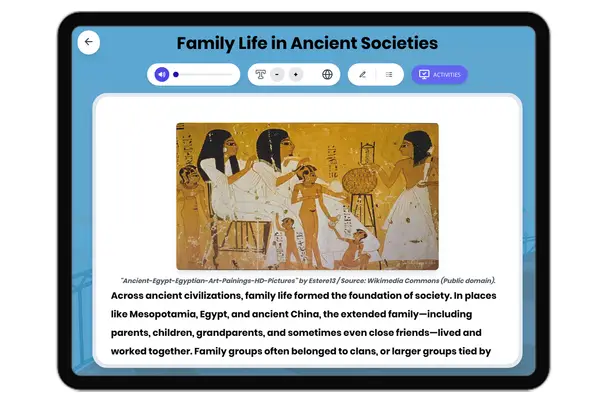
This passage explores the organization and significance of family life in ancient societies, focusing on how extended fa...
Polytheism and Monotheism in Ancient Times
This passage explores the religious beliefs of ancient civilizations, focusing on the differences and similarities betwe...
Women in Ancient Societies
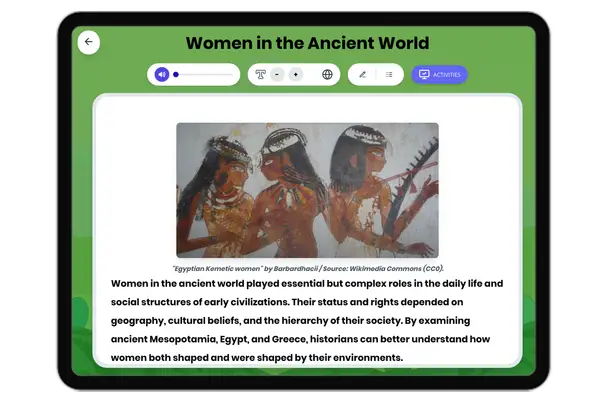
This reading passage explores the complex roles of women in the ancient world, focusing on civilizations such as Mesopot...