Horace Mann and Free Public Education
Interactive passage with audio narration, comprehension questions, and printable PDF.
By completing this purchase you agree to our Terms of Use and Privacy Policy. Your subscription renews automatically until you cancel. You can cancel anytime from your account settings. All sales are final and non-refundable. Digital content is available for download in your account immediately upon purchase.
What's included
Horace Mann and Free Public Education preview and details
About this printable Horace Mann and Free Public Education reading passage (Grades 6-8)
Sample passage and quiz from Horace Mann and Free Public Education
Reading passage and comprehension quiz preview
Horace Mann and Free Public Education
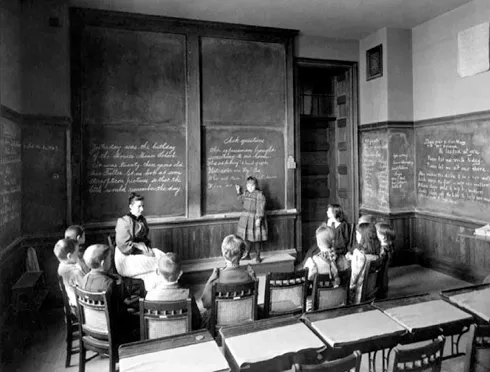
1893 Horace Mann School for the Deaf, Miss Fuller and Her Class by A H Folsom Boston PublicLibrary
Wikimedia Commons (Public domain).
The movement for public education in the United States changed the lives of millions of children. In the early 1800s, many American children did not attend school, especially if their families could not afford to pay. Schools were often run by religious groups or private individuals, and there was no standardized way of teaching. Most teachers did not have formal training. This system left many students behind, particularly those from poor or rural backgrounds.
Horace Mann, born in Massachusetts in 1796, believed that education was essential for a successful democracy. As secretary of the Massachusetts Board of Education, Mann saw that the lack of quality schools was a serious problem. He argued that education reform was needed to provide every child with equal opportunities. Mann advocated for compulsory attendance, meaning that children would be required by law to go to school. He also pushed for longer school years to give students more time to learn.
Mann’s reforms included the creation of normal schools, which were special institutions to train teachers. Before this, many teachers had little knowledge of how to teach or develop a curriculum. Mann believed that well-trained teachers were important for student success. He also promoted the use of a uniform curriculum, so that students everywhere would learn similar subjects and skills. This idea helped make education more fair and consistent across the state.
However, not everyone agreed with Mann’s vision. Some people feared that compulsory education would take away parents’ rights to decide how their children learned. Others did not want to pay taxes to fund public schools. Despite these challenges, Mann used evidence and reason to persuade lawmakers and communities. He wrote annual reports that described the problems with the current system and offered practical solutions. His reports influenced education leaders in other states to adopt similar reforms.
By the time Mann left his position in 1848, Massachusetts had established the model for free, tax-supported public schools in America. His ideas quickly spread to other states, especially in the North, creating what became known as the common school movement. This was one of the most important social reforms before the Civil War. Mann’s legacy continues today, as free public education remains a central part of American society. Although challenges like unequal funding and debates about curriculum still exist, Mann’s work showed the importance of education for all.
Interesting Fact: Horace Mann once called education “the great equalizer of the conditions of men,” believing it could help reduce inequality and promote democracy.
Comprehension quiz (8 questions)
1. Who led the push for public education?
2. Where did Mann start his reforms?
3. When did Mann leave his education position?
4. Why did some people oppose Mann's ideas?
5. What was the purpose of normal schools?
6. How did Mann spread his ideas?
7. Public education is free for all children.
8. What does 'compulsory' mean?
Perfect for the way you teach
- Build comprehension skills
- Auto-graded quiz
- Differentiated reading
- Read together at home
- Improve fluency
- Quiet reading time
- Reading curriculum support
- Independent practice
- Track Lexile growth