This learning resource is available in interactive and printable formats. The interactive worksheet can be played online and assigned to students. The Printable PDF version can be downloaded and printed for completion by hand.
This U.S. history reading passage explores the inspiring story of the passage of the 19th Amendment, which granted women the right to vote. Students will learn how brave women and their supporters worked for many years to win this important change in American democracy. The passage uses simple language and a clear cause-and-effect structure to explain the key events, people, and challenges in the women’s suffrage movement. Students will also discover primary source quotes and an interesting historical fact at the end. The passage is aligned with the C3 Framework and Common Core standards and is designed to help students build reading comprehension and vocabulary skills. Activities include a multiple-choice quiz, writing prompts, and a timeline of major events. Read aloud audio and a full Spanish translation are included to support all learners.
CONTENT PREVIEW
Expand content preview
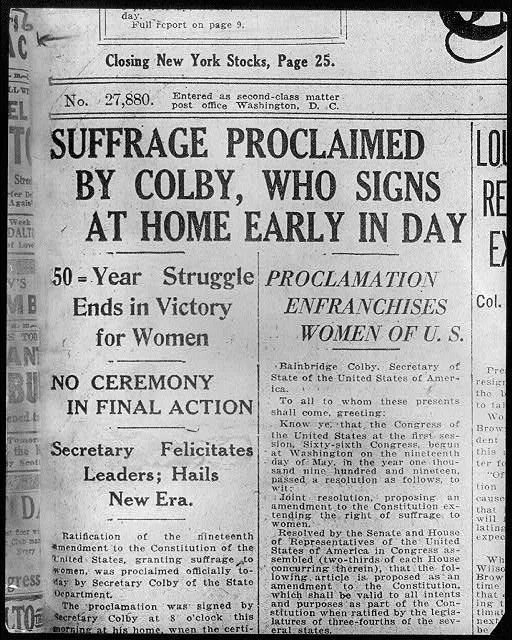
[Headline of Washington Evening Star, August 26, 1920: "Suffrage proclaimed by [Bainbridge] Colby [Sec'y of State]...50-year struggle ends in victory for women"] Source: Library of Congress - Library of Congress
The 19th Amendment to the United States Constitution changed the nation in 1920. Before this law, many American women could not vote. Only men had the right to vote in most states. This meant that women had little say in the laws and leaders that shaped their lives.
The fight for women’s voting rights, called suffrage, began in the mid-1800s. Women like Susan B. Anthony and Elizabeth Cady Stanton became leaders of the movement. They gave speeches, wrote articles, and organized marches. Many people did not agree with them. Some believed only men should vote. Still, the suffragists did not give up.
In 1848, the first women’s rights meeting took place at Seneca Falls, New York. There, women and men signed a document asking for equal rights, including the right to vote. Over the next 70 years, suffragists worked hard to change people’s minds. They faced many obstacles, such as unfair laws and angry crowds. Some were arrested for their protests.
During World War I, women took on new jobs to help the country. They worked in factories, offices, and even as nurses near the battlefields. Their hard work showed that women were just as important as men to the nation. This helped more Americans see that women deserved equal rights, including voting.
In 1919, Congress voted to approve the 19th Amendment. The next year, enough states agreed. On August 18, 1920, the 19th Amendment became law. The words said, “The right of citizens...to vote shall not be denied...on account of sex.”
This law doubled the number of American voters overnight. It made the country’s democracy stronger by including all adults, no matter their gender. Women could finally help choose leaders and make decisions for the future.
Equality was now a part of American voting. The 19th Amendment was a victory for fairness and for the women who never stopped fighting for their rights.
Interesting Fact: The first woman to vote after the 19th Amendment was a teacher named Marie Ruoff Byrum. She voted just minutes after the law passed!
When did the 19th Amendment become law?
1920186519191776
Who were two leaders for women's suffrage?
Susan B. Anthony and Elizabeth Cady StantonGeorge Washington and John AdamsAbraham Lincoln and Frederick DouglassHarriet Tubman and Rosa Parks
What event started in 1848?
Seneca Falls ConventionWorld War ICivil WarBoston Tea Party
Why did women work in new jobs during World War I?
To help the countryTo earn more moneyTo protest the warBecause men asked them to
How did the 19th Amendment change democracy?
It doubled the number of votersIt ended the Civil WarIt started a new governmentIt changed the flag
What happened after the 19th Amendment passed?
Women could voteMen lost the right to voteThe war startedSlavery ended
Only men could vote before 1920. True or false?
TrueFalse
What does 'suffrage' mean?
The right to voteA kind of foodA law for schoolsA parade for peace
Perfect For:
👩🏫 Teachers
• Reading comprehension practice
• Auto-graded assessments
• Literacy skill development
👨👩👧👦 Parents
• Reading practice at home
• Comprehension improvement
• Educational reading time
🏠 Homeschoolers
• Reading curriculum support
• Independent reading practice
• Progress monitoring
Reading Features:
📖
Reading Passage
Engaging fiction or nonfiction text
❓
Comprehension Quiz
Auto-graded questions
📊
Instant Feedback
Immediate results and scoring
📄
Printable Version
Download for offline reading
🔊
Read Aloud
Voice-over with word highlighting
Reviews & Ratings
No reviews yet. Be the first to share your experience!
Related Content
Trade and Trading Routes Between Tribes
This engaging history reading passage explores the important role of trade and trading routes between Native American tr...
D2.HIS.1-4.3-5RI.4.1RI.4.3RI.4.4
The 13 Original Colonies: An Overview
This engaging U.S. history reading passage introduces students to the 13 original colonies. It presents the story of how...
D2.HIS.1-4.3-5RI.4.3RI.4.4RI.4.10
The French and Indian War
This educational history reading passage explores the French and Indian War, a major conflict in North America before th...
D2.HIS.1-4.3-5RI.4.1RI.4.3RI.4.4
Unfair Taxes and the Stamp Act
This engaging U.S. history reading passage explores the story of the Stamp Act and unfair taxes in colonial America. Ali...
D2.HIS.1-4.3-5RI.4.1RI.4.3
Paul Revere's Midnight Ride
This U.S. History reading passage explores the famous Midnight Ride of Paul Revere, a key event in the American Revoluti...
D2.HIS.1-4.3-5RI.4.3RI.4.4RI.4.10
The Declaration of Independence and Thomas Jefferson
This engaging passage teaches students about the Declaration of Independence and Thomas Jefferson, one of America's Foun...
D2.HIS.1-4.3-5RI.4.1RI.4.2RI.4.3
Soldiers at Valley Forge in Winter
Explore the inspiring story of the Continental Army at Valley Forge during the harsh winter of 1777-1778. This history r...
D2.HIS.1-4.3-5RI.4.3RI.4.4RI.5.3
The Treaty of Paris 1783
This passage introduces students to the Treaty of Paris 1783, the important agreement that officially ended the American...
D2.HIS.1-4.3-5RI.4.3RI.4.4RI.4.10
The Star-Spangled Banner and War
This reading passage explores the inspiring story of 'The Star-Spangled Banner' and its origins during the War of 1812. ...
D2.HIS.1-4.3-5RI.4.1RI.4.3RI.4.4
Thomas Jefferson and the Louisiana Purchase
This engaging U.S. history reading passage teaches students about Thomas Jefferson and the Louisiana Purchase, one of th...
D2.HIS.1-4.3-5RI.4.3RI.5.3
James Madison and the War of 1812
This engaging U.S. history reading passage focuses on James Madison and the War of 1812. Students learn about key events...
D2.HIS.1-4.3-5RI.4.1RI.4.3RI.4.4
The First Political Parties Form
This engaging passage explores the formation of America's first political parties, highlighting the Federalists and Demo...
D2.HIS.1-4.3-5RI.4.3RI.4.4
James Monroe and the Monroe Doctrine
This engaging U.S. history reading passage introduces students to President James Monroe and the Monroe Doctrine, a key ...
D2.HIS.1-4.3-5RI.4.1RI.4.2RI.4.3
Americans Move West: The Oregon Trail
This engaging history passage explores the Oregon Trail and the westward movement of Americans in the 1800s. Students wi...
D2.HIS.1-4.3-5RI.4.3RI.4.4RI.5.3
Cowboys and Cattle Drives
This engaging U.S. History reading passage introduces students to the world of cowboys and cattle drives, a key part of ...
D2.HIS.1-4.3-5RI.4.3RI.4.4RI.5.3
Life in a Frontier Town
This passage explores the daily life and challenges faced by people living in a frontier town in the early United States...
D2.HIS.1-4.3-5RI.4.3RI.4.4W.4.2
Homestead Act: Free Land for Settlers
This engaging history reading passage explores the Homestead Act and its impact on American settlers moving west. Studen...
D2.HIS.1-4.3-5RI.4.3RI.4.4
Dangers on the Oregon Trail
This reading passage explores the many dangers faced by pioneers on the Oregon Trail, one of the most significant journe...
D2.HIS.1-4.3-5RI.4.1RI.4.3RI.4.4
Native Americans Lose Their Lands: The Trail of Tears
This reading passage explores the story of the Trail of Tears, focusing on the experiences of Native Americans as they l...
D2.HIS.1-4.3-5RI.4.3RI.4.4RI.4.7
Sherman's March to the Sea
This U.S. history reading passage explores Sherman's March to the Sea, a turning point during the Civil War. Students wi...