19th Amendment 1920: Women Win Voting Rights
Interactive passage with audio narration, comprehension questions, and printable PDF.
By completing this purchase you agree to our Terms of Use and Privacy Policy. Your subscription renews automatically until you cancel. You can cancel anytime from your account settings. All sales are final and non-refundable. Digital content is available for download in your account immediately upon purchase.
What's included
19th Amendment 1920: Women Win Voting Rights preview and details
About this printable 19th Amendment 1920: Women Win Voting Rights reading passage (Grades 6-8)
Sample passage and quiz from 19th Amendment 1920: Women Win Voting Rights
Reading passage and comprehension quiz preview
19th Amendment
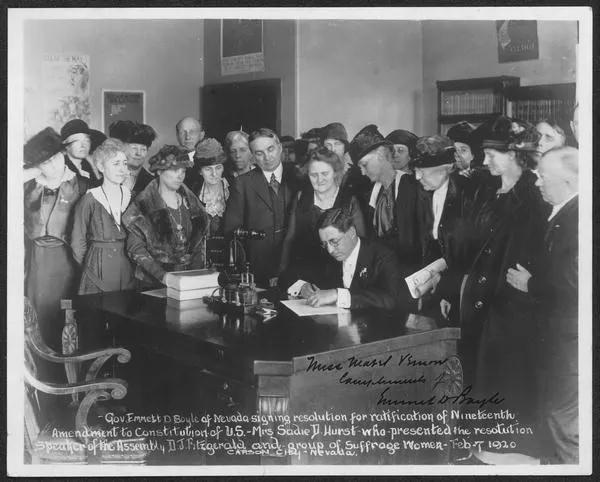
"Governor Ernest D. Boyle signs the ratification bill for the 19th amendment on February 7, 1920" by Unknown authorUnknown author.
Source: Wikimedia Commons (Public domain).
The 19th Amendment to the United States Constitution, ratified in 1920, granted women the right to vote. Before this significant change, American women had no national suffrage, or legal right to participate in elections. For decades, women and their allies engaged in organized activism, facing powerful opposition, legal barriers, and social resistance. The path to ratification was long and difficult, involving a variety of strategies and leaders.
The women’s suffrage movement began gaining momentum in the mid-1800s. The 1848 Seneca Falls Convention marked a turning point, as activists like Elizabeth Cady Stanton and Lucretia Mott publicly demanded equal voting rights for women. Despite growing support, most Americans and lawmakers continued to reject the idea, arguing that women’s roles belonged in the home, not the ballot box. This debate revealed deep divides in American society about gender, citizenship, and democracy.
Throughout the late 19th and early 20th centuries, suffragists used different tactics to achieve their goals. Some organizations, such as the National American Woman Suffrage Association (NAWSA), pursued a state-by-state approach. By 1917, several western states had already granted women the vote. However, progress was slow and uneven. Other groups, like the National Woman’s Party, adopted more confrontational methods, including marches, protests, and even hunger strikes. Their efforts often met with hostility, arrests, and violence, but they succeeded in drawing national attention to the issue.
The Progressive Era brought increased focus on reform and social justice, creating new opportunities for the suffrage movement. World War I also played a crucial role. As women contributed to the war effort in factories, offices, and as volunteers, their claim to equal citizenship gained legitimacy. President Woodrow Wilson, who had once opposed women’s suffrage, eventually supported the amendment, recognizing the importance of women’s contributions to the nation.
Securing passage of the 19th Amendment required overcoming significant political obstacles. The amendment had to be approved by two-thirds of both houses of Congress and then by three-fourths of the states. The final vote came down to Tennessee, where one legislator changed his vote after receiving a letter from his mother. On August 18, 1920, Tennessee’s ratification provided the last needed approval, and the amendment became law.
The adoption of the 19th Amendment doubled the American electorate, expanding democracy and setting a precedent for future civil rights movements. However, its impact was not immediate or equal for all women. Many African American, Native American, and Asian American women continued to face discrimination and barriers to voting for decades after 1920. The struggle for true equality in voting rights would continue well into the 20th century.
Today, the story of the 19th Amendment reminds us that democracy is shaped through collective action and persistent advocacy. Understanding the complexities and conflicts of the suffrage movement helps us appreciate both the progress made and the continuing challenges in achieving full participation for all citizens.
Interesting Fact: The yellow rose became a symbol of support for women’s suffrage during the final vote in Tennessee. Legislators who wore yellow roses supported the amendment, while opponents wore red.
Comprehension quiz (8 questions)
1. When was the 19th Amendment ratified?
2. What was the Seneca Falls Convention?
3. Which state was last to ratify?
4. Why did World War I help suffrage?
5. What did the 19th Amendment do?
6. Who changed his vote after a letter?
7. The 19th Amendment doubled the electorate. True or false?
8. What does 'ratification' mean?
Common Core standards for 19th Amendment 1920: Women Win Voting Rights
Explain events, procedures, ideas, or concepts in a historical, scientific, or technical text, including what happened and why, based on specific information in the text.
Determine the meaning of general academic and domain-specific words or phrases in a text relevant to a grade 4 topic or subject area.
Write informative/explanatory texts to examine a topic and convey ideas and information clearly.
Perfect for the way you teach
- Build comprehension skills
- Auto-graded quiz
- Differentiated reading
- Read together at home
- Improve fluency
- Quiet reading time
- Reading curriculum support
- Independent practice
- Track Lexile growth