Mesopotamia and Egypt: Social Classes — Reading Comprehension
Rate this
Premium Resource
Present
Present in classroom. No work saved
Assign
Classroom with student accounts, Track progress
Quick Play
No student accounts, assign with a link
Grades
6
7
8
PRINT+DIGITAL RESOURCE
This learning resource is available in interactive and printable formats. The interactive worksheet can be played online and assigned to students. The Printable PDF version can be downloaded and printed for completion by hand.
This engaging history reading passage explores the pyramid structure of ancient societies, focusing on the roles of kings, priests, and farmers. Students will learn how these groups shaped civilizations such as Mesopotamia and Egypt, including evidence from primary sources like the Stele of Hammurabi and Egyptian tomb paintings. The passage explains cause-and-effect relationships, continuity and change over time, and the impact of geography on social hierarchies. Activities include a multiple-choice quiz, writing prompts, graphic organizers, and a chronological timeline, all aligned with CA HSS 6.2.2 and CCSS RI.6.3 standards. Read aloud audio and a full Spanish translation are included to support diverse learners. This resource helps students think like historians and develop critical reading skills while deepening their understanding of ancient history.
CONTENT PREVIEW
Expand content preview
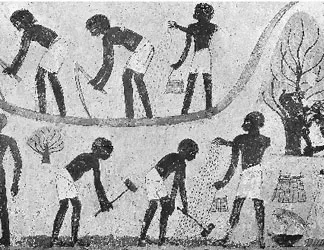
"EgyptianFarmer" by Theduke007 / Source: Wikimedia Commons (Public domain).
Throughout ancient history, societies were often organized in a pyramid-shaped hierarchy with groups holding different levels of power and responsibility. At the top were the kings, who claimed authority over the land and its people. Beneath them, priests played a vital role in religious and daily life. At the base were farmers, who produced food for everyone. This social structure shaped daily life and influenced how civilizations developed.
In ancient Mesopotamia, the city-state of Babylon was ruled by King Hammurabi around 1792 BCE. The Stele of Hammurabi, a tall stone monument, recorded laws that organized society. Kings claimed their power was given by the gods, making them both political and religious leaders. Priests in Mesopotamia managed temples and communicated with the gods through rituals. They also controlled large tracts of land and collected surplus crops as offerings, showing their economic influence. Farmers formed the largest part of the population, working the fields along rivers like the Tigris and Euphrates. Their labor supported the city’s wealth and allowed others to pursue crafts or government work.
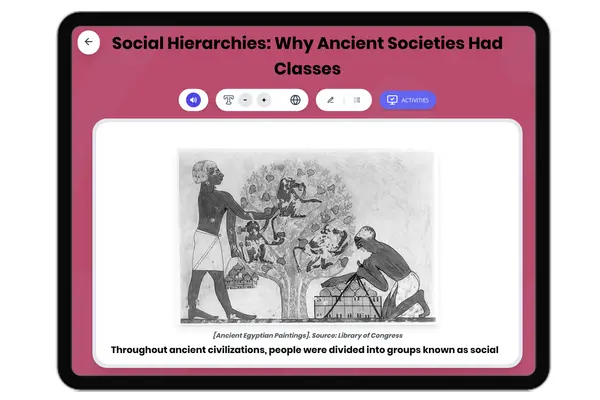
Ancient Egypt had a similar system. Pharaohs, believed to be living gods, sat at the top of the hierarchy. Tomb paintings from the New Kingdom (1550-1070 BCE) depict priests leading ceremonies and farmers working along the Nile. Priests preserved religious knowledge and organized festivals. Farmers used the predictable flooding of the Nile to grow wheat, barley, and vegetables. Their work made it possible to build great monuments like pyramids. Archaeologists have uncovered records of grain stores and lists of workers, revealing the importance of farmers in society’s survival.
The division of society into classes had important effects. Kings and priests could focus on governing, religion, and building projects because farmers provided food. However, this system created inequality. Most farmers had little power, and their lives were shaped by the needs of those above them. Over centuries, some societies saw changes, such as the rise of merchant classes or expansion of rights for common people. Yet, the pyramid-shaped structure remained in many places for thousands of years.
Understanding how kings, priests, and farmers interacted helps us see how geography, religion, and economy shaped ancient civilizations. These roles influenced government, culture, and the daily lives of millions, leaving a legacy that historians continue to study.
Interesting Fact: The ancient Sumerians were among the first to use written records to keep track of farm harvests, showing the close link between farming and the development of writing. Learning about ancient social structures connects to our study of how societies organize power, resources, and culture throughout history.
Who ruled Babylon around 1792 BCE?
King HammurabiPharaoh RamsesPriest SumerKing Tutankhamun
What did farmers provide for society?
FoodLawsTemplesJewelry
Who managed temples in Mesopotamia?
PriestsKingsFarmersMerchants
Why could kings focus on governing?
Farmers supplied foodPriests built citiesMerchants ruledSoldiers farmed
What effect did the social pyramid have?
Created inequalityEnded farmingStopped religionMade everyone king
Why were priests important in Egypt?
Led ceremoniesFarmed fieldsBuilt pyramidsWrote laws
The Stele of Hammurabi is a law code. True or False?
TrueFalse
What does 'hierarchy' mean?
Order of ranksA farm toolA famous kingFlooded river
Perfect For:
👩🏫 Teachers
• Reading comprehension practice
• Auto-graded assessments
• Literacy skill development
👨👩👧👦 Parents
• Reading practice at home
• Comprehension improvement
• Educational reading time
🏠 Homeschoolers
• Reading curriculum support
• Independent reading practice
• Progress monitoring
Reading Features:
📖
Reading Passage
Engaging fiction or nonfiction text
❓
Comprehension Quiz
Auto-graded questions
📊
Instant Feedback
Immediate results and scoring
📄
Printable Version
Download for offline reading
🔊
Read Aloud
Voice-over with word highlighting
Reviews & Ratings
No reviews yet. Be the first to share your experience!
Related Content
Ancient Civilizations and the Environment
This engaging history reading passage explores how ancient civilizations such as Mesopotamia, Egypt, and the Maya adapte...
Gender Roles in Ancient Civilizations
This engaging history reading passage explores the roles of men and women in various ancient civilizations, including Me...
Writing Prompts Ancient Civilizations
Step into the shoes of an archaeologist with this engaging worksheet focused on ancient civilizations. Students will be ...
W.5.2.A-2W.5.1.CW.5.1.D
Power and Authority in Ancient Civilizations
This passage explores the roles of men in positions of power within ancient civilizations, focusing on their authority i...
Evidence in Ancient History
This engaging history reading passage investigates how archaeologists and historians discover clues about how ancient pe...
Ancient Monarchy
This reading passage explores the concept of monarchy in ancient civilizations, focusing on the origins, structure, and ...
Ancient Theocracy
This engaging history reading passage explores the concept of theocracy in ancient civilizations, where priests and reli...
Ancient Mathematics
This passage explores the essential role of mathematics in ancient civilizations, including Mesopotamia, Egypt, Greece, ...
Ancient Canaan
This educational passage explores the land of Canaan, the historical homeland of the ancient Israelites. Students will l...
Ancient Money Barter
This passage explores the fascinating evolution from barter to the earliest coins in ancient civilizations, focusing on ...
Ancient Science and Medicine
This comprehensive reading passage explores the development of science and medicine in ancient civilizations, including ...
Ancient Literature
This passage explores the importance of ancient stories and poems from civilizations such as Greece, India, and Israel. ...
Ancient Agriculture Farming
This passage explores the transformative impact of farming on ancient societies, examining how the Neolithic Revolution ...
Ancient Writing Systems
This engaging history reading passage explores the origins and evolution of ancient writing systems, including cuneiform...
Geography of Ancient Israel
This passage explores the rich geography of Ancient Israel, focusing on how landforms, climate, and natural resources sh...
Slavery Across Civilizations
This detailed history reading passage explores the role and impact of slavery across several ancient civilizations, incl...
Social Classes in Ancient Societies
This passage explores the concept of social hierarchies in ancient civilizations, focusing on why societies such as Meso...
Social structures in Ancient World
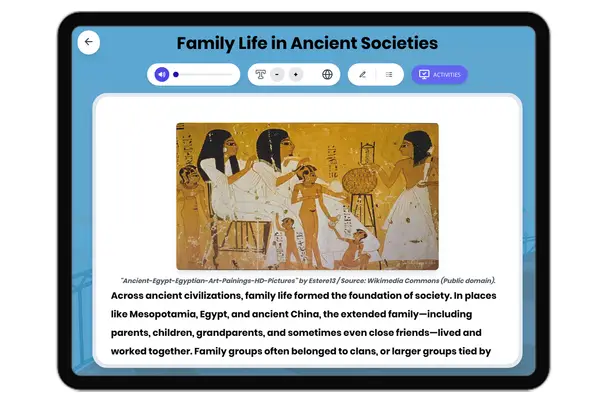
This passage explores the organization and significance of family life in ancient societies, focusing on how extended fa...
Polytheism and Monotheism in Ancient Times
This passage explores the religious beliefs of ancient civilizations, focusing on the differences and similarities betwe...
Women in Ancient Societies
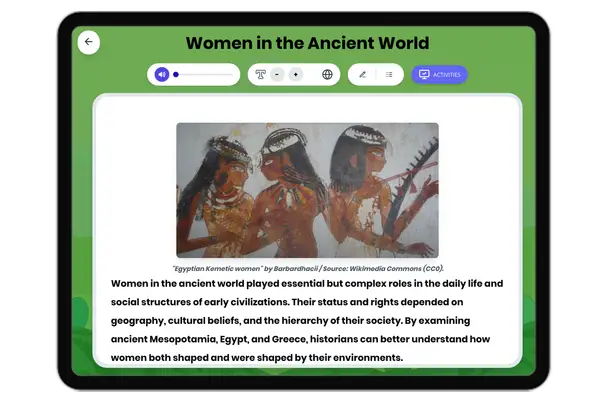
This reading passage explores the complex roles of women in the ancient world, focusing on civilizations such as Mesopot...