Pompeii: A City Frozen in Time β Reading Comprehension
Rate this
Premium Resource
Present
Present in classroom. No work saved
Assign
Classroom with student accounts, Track progress
Quick Play
No student accounts, assign with a link
Grades
5
6
7
8
PRINT+DIGITAL RESOURCE
This learning resource is available in interactive and printable formats. The interactive worksheet can be played online and assigned to students. The Printable PDF version can be downloaded and printed for completion by hand.
This engaging passage explores the ancient Roman city of Pompeii, which was buried by the eruption of Mount Vesuvius in 79 CE. Students will learn about the city's daily life, the sudden disaster, archaeological discoveries, and what these finds reveal about Roman society. The text integrates key vocabulary and aligns with CA HSS 6.1 and CCSS RH.6-8.2 standards. Supporting activities include a multiple-choice quiz, explanatory writing prompts, a cause-and-effect organizer, and a chronological development table. The passage features a glossary, timeline, and Spanish translation, making it accessible for a diverse classroom. A relevant public domain image is provided, along with a prompt for generating a simple coloring page. This resource is ideal for teaching world history, ancient civilizations, and the significance of archaeology in understanding the past.
CONTENT PREVIEW
Expand content preview
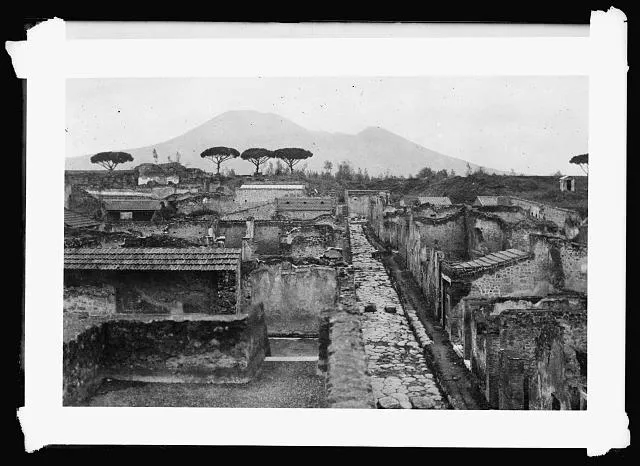
Building Methods in Christ's Time. A view of the resurrected city of Pompeii, showing the solid construction methods used in building the homes of those ancient times. Note the remnants of slate roof construction, which shows very little difference from the methods employed today. Distributing relief in this district, American Red Cross workers have found several families who have taken refuge in the ruins of this centuries old city. Some of them have made themselves quite comfortable under the shelter of roofs and walls that were buried for a thousand years. In the background can be seen Mt. Vesuvius the eruption of which buried Pompeii in volcanic ash. Source: Library of Congress
Pompeii was an ancient Roman city located near the Bay of Naples in Italy. In the year 79 CE, the city was suddenly buried when Mount Vesuvius erupted, covering Pompeii in volcanic ash and pumice. This disaster preserved the city almost exactly as it was, providing modern archaeologists with a unique opportunity to study daily life in the Roman Empire.
Pompeii was a thriving urban center with a population of around 11,000 people. Its economy depended on trade, agriculture, and crafts. Archaeological excavations have revealed mosaics, frescoes, and everyday objects such as pottery and tools. The city was organized with a clear social hierarchy. Wealthy families lived in large, decorated houses, while poorer citizens and slaves occupied smaller, simpler homes. Public spaces, including baths, markets, and theaters, were central to community life. Inscriptions on walls, known as graffiti, show what people thought, advertised, and joked about.
On August 24, 79 CE, Mount Vesuvius erupted violently. Eyewitness accounts, like that of Pliny the Younger, describe darkness, falling ash, and chaos. The thick layers of ash killed thousands and sealed the city for centuries. Buildings, artworks, and even food were preserved under the ash. Over time, Pompeii was forgotten, its location hidden until rediscovery in 1748. Early excavations were conducted by explorers seeking treasure, but by the 19th century, more scientific methods were used. Archaeologists carefully uncovered streets, homes, and temples, mapping the city's layout and collecting artifacts for study.
Modern techniques, such as casting the shapes of bodies, have revealed how people died and what they were doing at the moment of disaster. For example, some casts show people trying to escape, while others were sheltering in their homes. These findings help historians understand Roman society, technology, and culture. The preserved buildings and art provide evidence of religious beliefs, social customs, and family life. Despite the tragedy, Pompeii's preservation has given us a detailed snapshot of a Roman city frozen in time.
Pompeii is significant because it connects us directly to the past. Its ruins and artifacts allow us to reconstruct ancient life with exceptional detail. The site continues to teach us about human adaptation, disaster, and cultural continuity. Studying Pompeii highlights the importance of geography, as the city's location near Vesuvius brought both prosperity and destruction. The ongoing work at Pompeii illustrates how archaeology helps us answer historical questions and understand change over time.
Interesting Fact: Some ancient loaves of bread were found in the ovens of Pompeii, perfectly preserved by volcanic ash for nearly 2,000 years.
What caused Pompeii's destruction?
A volcanic eruptionA floodAn earthquakeA war
When did Mount Vesuvius erupt?
79 CE174844 BCE1000 CE
Who wrote about the eruption?
Pliny the YoungerJulius CaesarAugustusCicero
How do archaeologists learn about Pompeii's people?
Studying artifacts and castsReading novelsWatching moviesGuessing
Why is Pompeii important to historians?
It gives a detailed snapshotIt was the first Roman cityIt started the Roman EmpireIt was the largest city
What did graffiti show about Pompeii?
People's thoughts and jokesCity lawsVolcano warningsReligious rituals
Pompeii was forgotten until 1748. True or false?
TrueFalse
What is a mosaic?
Art made from small piecesA Roman leaderA type of volcanoA bread recipe