Underwater Archaeology: Discovering Shipwrecks
Interactive passage with audio narration, comprehension questions, and printable PDF.
By completing this purchase you agree to our Terms of Use and Privacy Policy. Your subscription renews automatically until you cancel. You can cancel anytime from your account settings. All sales are final and non-refundable. Digital content is available for download in your account immediately upon purchase.
What's included
Part of this bundle

Underwater Archaeology: Discovering Shipwrecks preview and details
About this printable Underwater Archaeology: Discovering Shipwrecks reading passage (Grades 5-8)
Sample passage and quiz from Underwater Archaeology: Discovering Shipwrecks
Reading passage and comprehension quiz preview
Underwater Archaeology
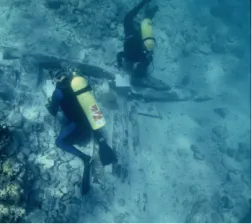
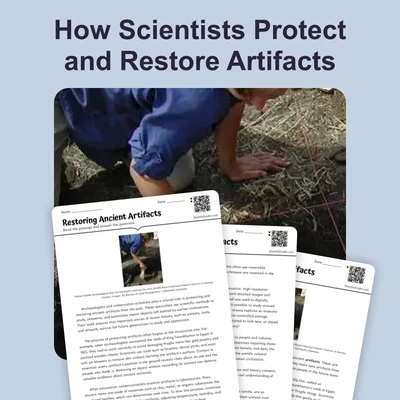
Navy archaeologists map an early 19th century shipwreck. From Underwater Archaeology Branch, Naval History & Heritage Command, Wikimedia Commons
Underwater archaeology is a branch of science that focuses on studying human history through remains found beneath lakes, rivers, and oceans. Shipwrecks, the remains of ancient ships lost at sea, are among the most important discoveries for underwater archaeologists. By exploring shipwrecks, researchers can uncover evidence of trade, daily life, and technological advances from thousands of years ago.
Many shipwrecks have been discovered in the Mediterranean Sea, a region where civilizations like Egypt, Greece, and Rome sailed and traded. The Uluburun shipwreck, found off the coast of Turkey and dated to the late 14th century BCE, is one of the oldest known shipwrecks. Archaeologists used excavation techniques and advanced scuba equipment to carefully recover cargo such as copper ingots, pottery, and ivory. These artifacts provide direct evidence of international trade networks that connected distant cultures.
Underwater archaeology requires special methods because working underwater is very different from excavating on land. Divers use waterproof notebooks, underwater cameras, and grid systems to document the exact location of each object. The Antikythera shipwreck, discovered by sponge divers in 1900 near Greece, contained luxury items, coins, and the mysterious Antikythera Mechanism—a complex gear device considered the world's oldest known computer. The discovery of this shipwreck has given historians clues about ancient technology, social hierarchy, and the trade of luxury goods.
Studying shipwrecks also reveals the dangers faced by ancient sailors. Many ships sank in storms or due to navigation errors. By analyzing the remains, archaeologists can learn how shipbuilding techniques changed over time and how trade routes shifted based on political and environmental changes. Sometimes, shipwrecks are discovered with cargo still intact, offering a unique snapshot into the past that rarely survives on land.
Underwater archaeology has transformed our understanding of ancient civilizations. Each new shipwreck helps historians reconstruct patterns of trade, daily life, and cultural exchange. The preservation of artifacts underwater often provides more complete evidence than what is found on land. As technology improves, archaeologists discover more shipwrecks, deepening our knowledge of the maritime world and highlighting humanity’s connection to water and exploration.
Studying underwater archaeology connects to broader history themes of technological development, human adaptation, and the movement of people and goods across regions.
Interesting Fact: The Antikythera Mechanism, found in a shipwreck, could predict eclipses and track the movements of planets over 2,000 years ago.
Comprehension quiz (8 questions)
1. Where was the Uluburun shipwreck found?
2. What is the Antikythera Mechanism?
3. Which sea has many ancient shipwrecks?
4. Why are artifacts from shipwrecks important?
5. How do archaeologists record object locations underwater?
6. What effect did storms have on ancient ships?
7. Shipwrecks are always found empty. True or false?
8. What does 'artifacts' mean?
Perfect for the way you teach
- Build comprehension skills
- Auto-graded quiz
- Differentiated reading
- Read together at home
- Improve fluency
- Quiet reading time
- Reading curriculum support
- Independent practice
- Track Lexile growth