Golgi Apparatus and Its Function — Reading Comprehension
Rate this
Premium Resource
Present
Present in classroom. No work saved
Assign
Classroom with student accounts, Track progress
Quick Play
No student accounts, assign with a link
Grades
3
4
5
6
7
Standards
MS-LS1-1
PRINT+DIGITAL RESOURCE
This learning resource is available in interactive and printable formats. The interactive worksheet can be played online and assigned to students. The Printable PDF version can be downloaded and printed for completion by hand.
This NGSS-aligned reading passage introduces middle school students to the structure and function of the Golgi apparatus. It explains how the Golgi body receives proteins from the endoplasmic reticulum, modifies and packages them, and ships them to their proper destinations inside or outside the cell. The text uses clear examples and comparisons, such as likening the Golgi to a post office, to make complex ideas easier to understand. This passage supports NGSS standard MS-LS1-1 by helping students explore the relationship between cell structure and function and builds science literacy with vocabulary, comprehension activities, and real-world connections.
CONTENT PREVIEW
Expand content preview
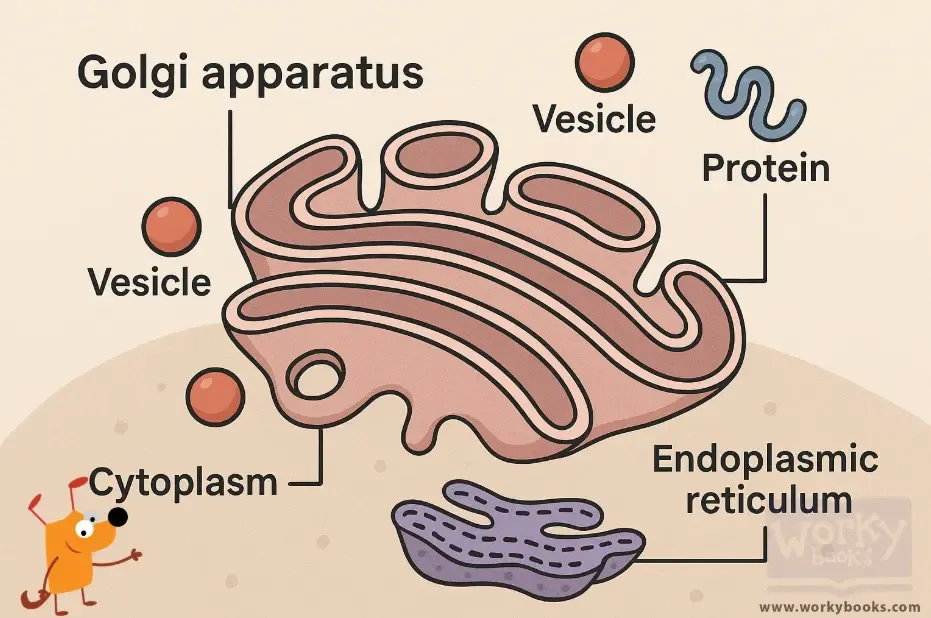
The Golgi apparatus, also known as the Golgi body or Golgi complex, is an important organelle found in most eukaryotic cells. Its main job is to sort, modify, and package proteins and other materials that the cell makes. Think of it as the cell’s post office—it prepares items to be sent to the right place, both inside and outside of the cell.
After ribosomes make proteins, and the endoplasmic reticulum helps move them, these proteins travel to the Golgi apparatus. The Golgi receives the proteins in small bubbles called vesicles. Once inside the Golgi, the proteins are processed. This may include adding small molecules like sugars or folding the proteins into their final shape.
After the proteins are modified, the Golgi packages them into new vesicles. Some are sent to other parts of the cell, while others are transported outside the cell to be used elsewhere in the body. This is especially important in cells that release hormones, enzymes, or mucus.
The Golgi apparatus is made of flat, stacked membranes that look like a pile of pancakes. Its structure helps it handle many materials at once and keep the cell organized. Without the Golgi, cells wouldn’t be able to deliver proteins where they’re needed, and important processes in the body would stop.
: The Golgi apparatus was first discovered in 1898 by scientist Camillo Golgi—and it was one of the first cell organelles ever seen under a microscope!
What is the main job of the Golgi apparatus?
Make energyPackage and ship proteinsStore DNABreak down waste
What is another name for the Golgi apparatus?
NucleusRough ERGolgi bodyCytoplasm
What carries proteins to the Golgi apparatus?
RibosomesVesiclesLipidsNucleus
What does the Golgi do to proteins?
Destroys themFreezes themModifies and folds themTurns them into sugars
What happens to proteins after they are processed in the Golgi?
They stay in the GolgiThey are sent to DNAThey are stored in the nucleusThey are packaged and sent to where they’re needed
What does the Golgi apparatus look like?
A jelly-like blobA pile of pancakesA round ballA long tube
What is the main idea of the passage?
The Golgi makes DNAThe Golgi stores sugarsThe Golgi processes and sends proteins in the cellThe Golgi helps break down food
Why is the Golgi important for hormone-releasing cells?
It gives the cell energyIt controls cell divisionIt packages hormones to send out of the cellIt holds the nucleus in place
Perfect For:
👩🏫 Teachers
• Reading comprehension practice
• Auto-graded assessments
• Literacy skill development
👨👩👧👦 Parents
• Reading practice at home
• Comprehension improvement
• Educational reading time
🏠 Homeschoolers
• Reading curriculum support
• Independent reading practice
• Progress monitoring
Reading Features:
📖
Reading Passage
Engaging fiction or nonfiction text
❓
Comprehension Quiz
Auto-graded questions
📊
Instant Feedback
Immediate results and scoring
📄
Printable Version
Download for offline reading
🔊
Read Aloud
Voice-over with word highlighting
Reviews & Ratings
No reviews yet. Be the first to share your experience!
Related Content
Antonie van Leeuwenhoek and the Discovery of Animalcules
This NGSS-aligned science passage explores the groundbreaking work of Antonie van Leeuwenhoek, a pioneer in microscopic ...
MS-LS1-1MS-LS1-2
Robert Hooke and the Naming of 'Cells'
This NGSS-aligned reading passage introduces middle school students to Robert Hooke's discovery and naming of 'cells' in...
MS-LS1-1MS-LS1-2
Rudolf Virchow and His Contribution to Cell Theory
This NGSS-aligned science reading passage introduces students to Rudolf Virchow, a key historical figure in cell biology...
MS-LS1-1MS-LS1-2
Matthias Schleiden and the Discovery That Plants Are Made of Cells
This NGSS-aligned science passage explains how Matthias Schleiden, a German scientist in the 1830s, discovered that all ...
MS-LS1-1MS-LS1-2
When Was the Microscope Invented?
This NGSS-aligned reading passage introduces students to the invention of the microscope, an essential scientific tool. ...
MS-LS1-1MS-LS1-2
What are Prokaryotic Cells?
This NGSS-aligned science reading passage explains prokaryotic cells, the simplest type of cells found in single-celled ...
MS-LS1-1MS-LS1-2
What are Eukaryotic Cells?
This NGSS-aligned reading passage introduces middle school students to eukaryotic cells, which are complex cells found i...
MS-LS1-1MS-LS1-2
Prokaryotic vs. Eukaryotic Cells
This NGSS-aligned reading passage helps middle school students compare prokaryotic and eukaryotic cells. Supporting stan...
MS-LS1-1MS-LS1-2
What is an Organelle?
This NGSS-aligned reading passage introduces middle school students to the concept of organelles. Supporting MS-LS1-
MS-LS1-1MS-LS1-2
Chromoplast: Nature's Color Palette
This passage details chromoplast functions in pigment production, ecological signaling, and nutrition. Aligned with NGSS...
MS-LS1-1MS-LS1-2MS-LS1-6LS1.C
Parts of the Cell
This informational science passage, aligned with NGSS standard MS-LS1-1, introduces students to the parts of the cell an...
MS-LS1-1MS-LS1-2
The Nucleolus and Its Function
This NGSS-aligned reading passage focuses on the nucleolus, a key structure inside the cell’s nucleus responsible for ma...
MS-LS1-1MS-LS1-2
Is a Platypus a Mammal?
This interactive science reading passage, titled "Is a Platypus a Mammal? The Monotreme Mystery!", delves into the uniqu...
MS-LS1-1
Where Do Platypus Live?
This engaging science reading passage, titled "Where Do Platypus Live? Finding Australia's Elusive Swimmer," explores th...
MS-LS1-1
The Amazing Red Panda
This engaging science reading passage, titled "The Amazing Red Panda: A Fluffy Tree Dweller," introduces students to one...
MS-LS1-1MS-LS4-D
Where Do Red Pandas Live?
This science reading passage, titled "Where Do Red Pandas Live? In the Mountain Forests," explores the specific habitat ...
MS-LS1-1
Przewalski's Horse
This engaging science reading passage, titled "Przewalski's Horse: A Wild Comeback Story," introduces students to the tr...
MS-LS4-DMS-LS1-1
The Quokka
This engaging science reading passage, titled "The Quokka: The Happiest Animal on Earth?", introduces students to one of...
MS-LS4-DMS-LS1-1
The Proboscis Monkey
This interactive science reading passage, titled "The Proboscis Monkey: A Monkey with a Mighty Nose!", introduces studen...