The Nucleolus and Its Function — Reading Comprehension
Rate this
Premium Resource
Present
Present in classroom. No work saved
Assign
Classroom with student accounts, Track progress
Quick Play
No student accounts, assign with a link
Grades
5
6
7
8
Standards
MS-LS1-1
MS-LS1-2
PRINT+DIGITAL RESOURCE
This learning resource is available in interactive and printable formats. The interactive worksheet can be played online and assigned to students. The Printable PDF version can be downloaded and printed for completion by hand.
This NGSS-aligned reading passage focuses on the nucleolus, a key structure inside the cell’s nucleus responsible for making ribosomes. Targeted to middle school students, the passage explains how the nucleolus produces ribosomal RNA (rRNA), which is essential for building ribosomes that make proteins. It also discusses why the size of the nucleolus varies between cell types and what happens to it during cell division. This reading supports NGSS standard MS-LS1-1 and helps students understand the relationship between structure and function in living cells. Designed for use in science classrooms to reinforce reading comprehension and life science content.
CONTENT PREVIEW
Expand content preview
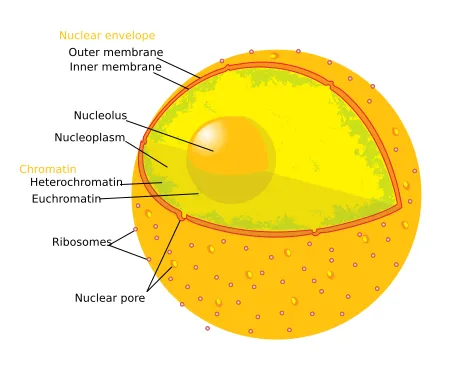
"Diagram human cell nucleus" by Mariana Ruiz LadyofHats / Wikimedia Commons.
Inside the nucleus of a cell, there is a small, dense structure called the nucleolus. Although it may seem like just a spot within the nucleus, the nucleolus plays a very important role in the life of a cell. It is responsible for making ribosomes, which are essential for building proteins. Proteins are needed for almost everything a cell does, from repairing damage to supporting cell growth and communication.
The nucleolus is not surrounded by a membrane like other organelles. Instead, it forms around specific regions of DNA called nucleolar organizing regions. These regions carry the instructions for making ribosomal RNA (rRNA), a key part of ribosomes. The nucleolus reads this DNA and uses it to produce rRNA, which then combines with proteins to build ribosome subunits. These subunits are later sent out of the nucleus into the cytoplasm, where they join together to form complete ribosomes.
The size and number of nucleoli in a cell can change depending on how active the cell is in making proteins. For example, cells that produce lots of proteins—like muscle cells or cells in the pancreas—usually have larger or multiple nucleoli. This shows how closely the nucleolus is linked to the cell’s activity and health.
Although small, the nucleolus is a key part of how cells grow and function. Without it, cells could not make the ribosomes needed to produce proteins, and life as we know it would not be possible.
Fun Fact: The nucleolus disappears when a cell is dividing and then reappears when the process is complete—like a temporary break during the cell's busy schedule!
Where is the nucleolus found?
In the cytoplasmInside the ribosomeInside the nucleusOn the cell membrane
What is the main function of the nucleolus?
Store DNAMake energyMake ribosomesControl cell division
What is produced in the nucleolus to help build ribosomes?
What happens to the nucleolus during cell division?
It gets largerIt disappears temporarilyIt moves to the cell membraneIt turns into ribosomes
Why might a muscle cell have a large nucleolus?
It divides quicklyIt needs to store energyIt makes a lot of proteinsIt digests food
What is the main idea of the passage?
The nucleolus controls the whole cellThe nucleolus helps cells reproduceThe nucleolus builds ribosomes needed for protein productionCells cannot survive without a membrane
If a cell couldn’t make rRNA, what might happen?
It would grow fasterIt would stop producing proteinsIt would store more DNAIt would make more mitochondria
Perfect For:
👩🏫 Teachers
• Reading comprehension practice
• Auto-graded assessments
• Literacy skill development
👨👩👧👦 Parents
• Reading practice at home
• Comprehension improvement
• Educational reading time
🏠 Homeschoolers
• Reading curriculum support
• Independent reading practice
• Progress monitoring
Reading Features:
📖
Reading Passage
Engaging fiction or nonfiction text
❓
Comprehension Quiz
Auto-graded questions
📊
Instant Feedback
Immediate results and scoring
📄
Printable Version
Download for offline reading
🔊
Read Aloud
Voice-over with word highlighting
Reviews & Ratings
No reviews yet. Be the first to share your experience!
Related Content
Antonie van Leeuwenhoek and the Discovery of Animalcules
This NGSS-aligned science passage explores the groundbreaking work of Antonie van Leeuwenhoek, a pioneer in microscopic ...
MS-LS1-1MS-LS1-2
Robert Hooke and the Naming of 'Cells'
This NGSS-aligned reading passage introduces middle school students to Robert Hooke's discovery and naming of 'cells' in...
MS-LS1-1MS-LS1-2
Rudolf Virchow and His Contribution to Cell Theory
This NGSS-aligned science reading passage introduces students to Rudolf Virchow, a key historical figure in cell biology...
MS-LS1-1MS-LS1-2
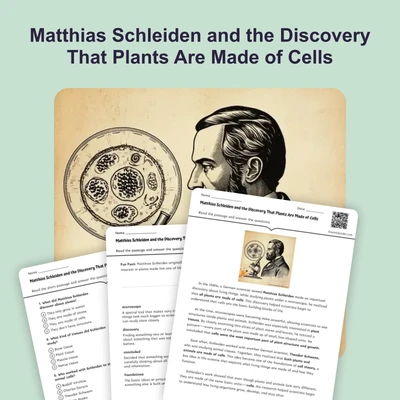
Matthias Schleiden and the Discovery That Plants Are Made of Cells
This NGSS-aligned science passage explains how Matthias Schleiden, a German scientist in the 1830s, discovered that all ...
MS-LS1-1MS-LS1-2
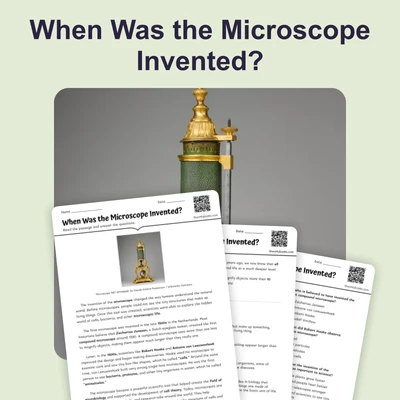
When Was the Microscope Invented?
This NGSS-aligned reading passage introduces students to the invention of the microscope, an essential scientific tool. ...
MS-LS1-1MS-LS1-2
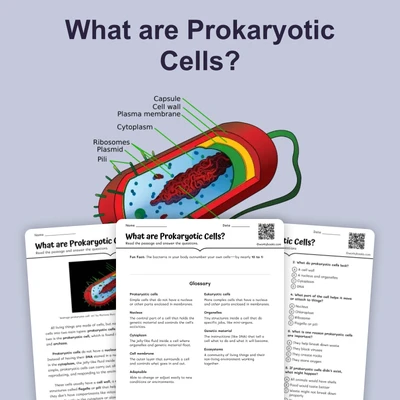
What are Prokaryotic Cells?
This NGSS-aligned science reading passage explains prokaryotic cells, the simplest type of cells found in single-celled ...
MS-LS1-1MS-LS1-2
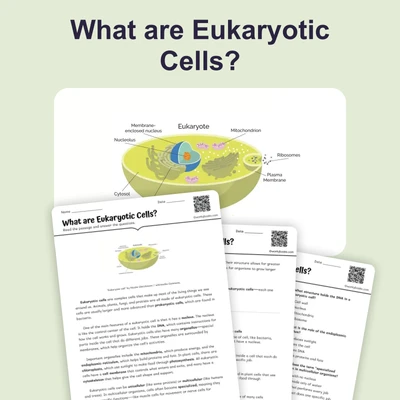
What are Eukaryotic Cells?
This NGSS-aligned reading passage introduces middle school students to eukaryotic cells, which are complex cells found i...
MS-LS1-1MS-LS1-2
Prokaryotic vs. Eukaryotic Cells
This NGSS-aligned reading passage helps middle school students compare prokaryotic and eukaryotic cells. Supporting stan...
MS-LS1-1MS-LS1-2
What is an Organelle?
This NGSS-aligned reading passage introduces middle school students to the concept of organelles. Supporting MS-LS1-
MS-LS1-1MS-LS1-2
Chromoplast: Nature's Color Palette
This passage details chromoplast functions in pigment production, ecological signaling, and nutrition. Aligned with NGSS...
MS-LS1-1MS-LS1-2MS-LS1-6LS1.C
Parts of the Cell
This informational science passage, aligned with NGSS standard MS-LS1-1, introduces students to the parts of the cell an...
MS-LS1-1MS-LS1-2
What Is Vapor Pressure?
This NGSS-aligned science passage explains the concept of vapor pressure in an age-appropriate, engaging way for middle ...
MS-PS1-4MS-LS1-2
Golgi Apparatus and Its Function
This NGSS-aligned reading passage introduces middle school students to the structure and function of the Golgi apparatus...
MS-LS1-1
Is a Platypus a Mammal?
This interactive science reading passage, titled "Is a Platypus a Mammal? The Monotreme Mystery!", delves into the uniqu...
MS-LS1-1
Where Do Platypus Live?
This engaging science reading passage, titled "Where Do Platypus Live? Finding Australia's Elusive Swimmer," explores th...
MS-LS1-1
The Amazing Red Panda
This engaging science reading passage, titled "The Amazing Red Panda: A Fluffy Tree Dweller," introduces students to one...
MS-LS1-1MS-LS4-D
Where Do Red Pandas Live?
This science reading passage, titled "Where Do Red Pandas Live? In the Mountain Forests," explores the specific habitat ...
MS-LS1-1
Przewalski's Horse
This engaging science reading passage, titled "Przewalski's Horse: A Wild Comeback Story," introduces students to the tr...
MS-LS4-DMS-LS1-1
The Quokka
This engaging science reading passage, titled "The Quokka: The Happiest Animal on Earth?", introduces students to one of...