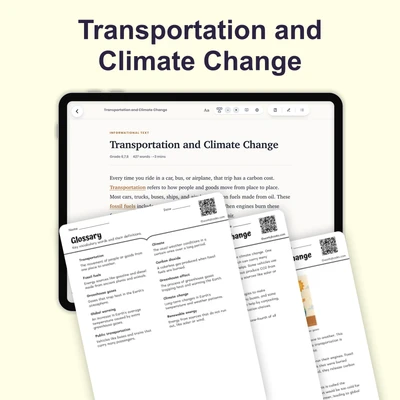
This 400-500 word reading passage examines the relationship between public transportation and climate change for middle school science students in grades 6-8. Aligned with NGSS Earth Science standards, the passage explains how buses, trains, subways, and light rail systems reduce greenhouse gas emissions by transporting multiple passengers simultaneously, lowering the carbon footprint per person compared to individual car travel. Students explore real-world data showing how a single train can replace hundreds of cars, reducing both climate impact and traffic congestion. The lesson connects to urban design principles and discusses how walking and biking for short trips further reduce emissions. Audio-integrated features support diverse learners. The passage includes vocabulary development with key terms like emissions, mass transit, carbon footprint, and sustainable transportation. Activities include reading comprehension questions, writing prompts, and graphic organizers that help students analyze cause-and-effect relationships and compare different transportation modes.
Written by Workybooks TeamPublished by Workybooks
Preview
Sample passage and quiz content
CONTENT PREVIEW
Expand content preview
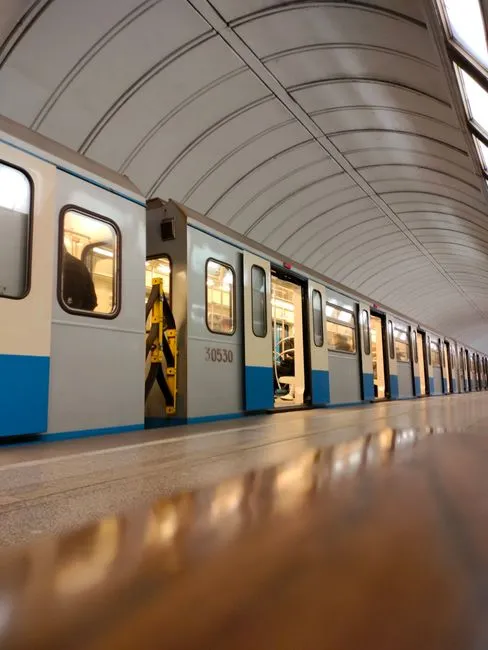
"A sleek subway train at a modern urban metro station showcasing public transportation." by Vika Glitter / Pexels.
How can public transportation help reduce climate change? The answer lies in moving more people while using less energy. Public transportation includes buses, trains, subways, and light rail systems that carry many passengers at once. Because these vehicles transport multiple people together, the emissions per person are much lower than if everyone drove alone in separate cars.
Scientists explain that transportation produces about one-quarter of global greenhouse gas emissions. When people choose mass transit instead of driving individual cars, they share the energy cost of the trip. A single city bus can carry 40 to 60 passengers, replacing dozens of cars on the road. A commuter train may transport hundreds of people at once, potentially replacing several hundred individual vehicles. This sharing of space and energy significantly reduces the carbon footprint of each traveler.
Evidence shows that public transit produces far fewer emissions per passenger mile than personal vehicles. In New York City, the subway system moves more than 5 million riders each weekday. If all those passengers drove cars instead, traffic would become impossible and emissions would increase dramatically. The subway runs on electricity, which can come from cleaner energy sources than gasoline, making it even more climate-friendly.
Public transportation works best when cities design neighborhoods so people can live near transit stops. Urban design that includes sidewalks, bike lanes, and mixed-use areas allows residents to walk or bike for short trips instead of driving. This approach creates communities where people may not need a car for every errand. When combined with electric buses and trains, public transit becomes an even more powerful tool against climate change.
The future of sustainable transportation combines several strategies. Cities can expand bus and rail networks, making transit more convenient. They can switch to electric vehicles for public fleets. Urban planners can design walkable neighborhoods with homes, shops, and offices close together. These changes work together to reduce transportation emissions while improving quality of life. Public transportation matters because it offers a practical way for millions of people to reduce their climate impact every single day.
Interesting Fact: A person who switches from driving alone to taking public transit can reduce their carbon dioxide emissions by up to 4,800 pounds per year, which equals the climate benefit of planting about 240 trees.
What percentage of global greenhouse gas emissions comes from transportation?
About one-quarterAbout one-halfAbout three-quartersNearly all of them
How many passengers can a single city bus typically carry?
10 to 20 passengers40 to 60 passengers100 to 120 passengers200 to 250 passengers
What does the term 'carbon footprint' mean in the context of this passage?
The physical size of a vehicleThe distance a person travels each dayThe total greenhouse gases produced by a person's activitiesThe amount of electricity used by public transit
According to the passage, what does 'mass transit' refer to?
Heavy vehicles like trucksTransportation systems that move large numbers of peopleElectric cars onlyLong-distance airplane travel
Why does public transportation produce fewer emissions per person than individual cars?
Public vehicles always use electric powerPublic vehicles travel shorter distancesMany passengers share the energy cost of the tripPublic vehicles move more slowly
How many riders does the New York City subway move each weekday?
More than 500,000More than 1 millionMore than 5 millionMore than 10 million
What is one benefit of urban design that includes sidewalks and bike lanes?
It makes cities largerIt allows people to walk or bike for short trips instead of drivingIt eliminates the need for public transportationIt increases traffic congestion
According to the passage, what can make public transit even more climate-friendly?
Making buses and trains largerRunning transit systems on electricity from cleaner energy sourcesReducing the number of passengersBuilding more parking lots
True or False: A single commuter train can potentially replace several hundred individual cars.
TrueFalse
True or False: Public transportation only works in large cities and cannot help reduce climate change in smaller communities.
TrueFalse
Who it's for
Perfect for the way you teach
Teachers
Build comprehension skills
Auto-graded quiz
Differentiated reading
Parents
Read together at home
Improve fluency
Quiet reading time
Homeschoolers
Reading curriculum support
Independent practice
Track Lexile growth
Topics
public transportationclimate changegreenhouse gas emissionssustainable transportationurban designmass transitcarbon footprintenergy efficiency
Reviews & Ratings
No reviews yet. Be the first to share your experience!
More reading you might love
19 more
What Is Earth Science?
This engaging middle school science passage introduces students to the field of Earth science, aligning with NGSS standa...
MS-ESS1MS-ESS2MS-ESS3SEP
Bird Migration and Climate Change
This engaging 400-500 word science passage explores how climate change affects bird migration patterns and populations, ...
MS-LS2-4: CONSTRUCT AN ARGUMENT SUPPORTED BY EMPIRICAL EVIDENCE THAT CHANGES TO PHYSICAL OR BIOLOGICAL COMPONENTS OF AN ECOSYSTEM AFFECT POPULATIONS.
Transportation and Climate Change
This engaging science passage for grades 6-8 explores the vital role that transportation plays in climate change. Studen...
Deforestation and Climate Change
This engaging science passage, aligned with NGSS standards, explains how deforestation contributes to climate change for...
Droughts and Climate Change
This 500-word informational science passage for grades 6-8 examines the relationship between droughts and climate change...
Wildfires and Climate Change
This comprehensive 400-500 word reading passage examines the connection between wildfires and climate change for middle ...
Tools and Technology in Earth Science
This middle school science reading passage explores the wide range of tools and technologies used in Earth science, from...
MS-ESS2-2MS-ESS3-2MS-ETS1-1MS-PS4-3
Habitat Loss and Climate Change
This engaging 500-word science passage explores how climate change drives habitat loss and threatens wildlife population...
MS-LS2-4: CONSTRUCT AN ARGUMENT SUPPORTED BY EMPIRICAL EVIDENCE THAT CHANGES TO PHYSICAL OR BIOLOGICAL COMPONENTS OF AN ECOSYSTEM AFFECT POPULATIONS.
Climate Change: Solutions and Mitigation
This passage explores scientific solutions and mitigation strategies for climate change, designed for middle school scie...
MS-ESS3-4MS-ESS3-5
Amazon Rainforest and Climate Change
This 400-500 word informational science passage for grades 6-8 explores the Amazon Rainforest and Climate Change, aligne...
Extreme Weather and Climate Change
This Grade 6-8 science passage, aligned to NGSS standards, explores the impact of climate change on extreme weather even...
Climate Change and Food Security
This comprehensive 400-500 word reading passage examines the critical relationship between climate change and food secur...
Climate Change: Causes
This comprehensive middle school science passage explores the causes of climate change by examining both natural and hum...
MS-ESS3-5MS-LS2-4
Effects of Climate Change
This comprehensive middle school science passage explores the effects of climate change on Earth's systems and life, ali...
MS-ESS3-5MS-LS4-4
Arctic Fox and Climate Change
This 400-500 word informational science passage examines how climate change threatens Arctic fox populations through mul...
Flooding and Climate Change
This comprehensive 500-word reading passage examines the relationship between flooding and climate change for middle sch...
Climate Change: Vulnerable Ecosystems
This middle school science passage, aligned with NGSS standards MS-ESS3-5 and MS-LS2-4, helps students understand how cl...
MS-ESS3-5MS-LS2-4
Climate Through Earth's History
This engaging passage for grades 6-8 explores how Earth's climate has naturally changed over millions of years, highligh...
MS-ESS1-4MS-ESS2-6
Climate Change and Water Scarcity
This 400-500 word informational science reading passage for grades 6-8 examines how climate change threatens freshwater ...