Amazon Rainforest and Climate Change
Interactive passage with audio narration, comprehension questions, and printable PDF.
By completing this purchase you agree to our Terms of Use and Privacy Policy. Your subscription renews automatically until you cancel. You can cancel anytime from your account settings. All sales are final and non-refundable. Digital content is available for download in your account immediately upon purchase.
What's included
Amazon Rainforest and Climate Change preview and details
About this printable Amazon Rainforest and Climate Change science reading passage, NGSS-aligned (Grades 5-8)
Sample passage and quiz from Amazon Rainforest and Climate Change
Reading passage and comprehension quiz preview
Amazon Rainforest and Climate Change
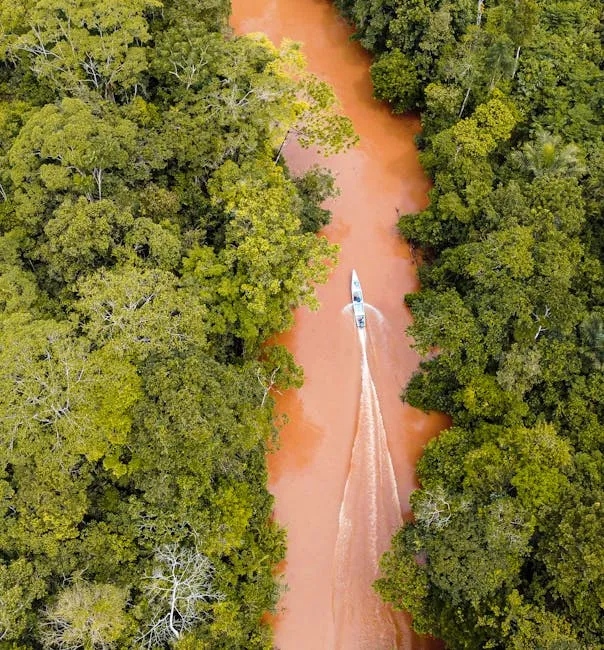
"Aerial view of a boat navigating a river surrounded by lush jungle in Putumayo, Colombia." by Andrés Ramírez / Pexels.
The Amazon is the world's largest rainforest. It covers an area about two-thirds the size of the United States. This massive forest holds roughly one in ten known species on Earth. The Amazon also stores enormous amounts of carbon in its trees. Scientists estimate the forest contains about 150 billion tons of carbon locked away in plant matter.
The Amazon has a remarkable ability to create its own weather. Trees pull water from the soil through their roots. They release this moisture into the air through tiny pores in their leaves. This process is called evapotranspiration. The water vapor rises and forms clouds. These clouds produce rain that falls back onto the forest. Winds carry the moisture-rich air across the forest. The same water can fall as rain multiple times as it moves from east to west. This self-watering system keeps the entire rainforest wet and healthy.
Climate change threatens this delicate cycle. Rising temperatures cause more water to evaporate from soil and plants. Deeper and longer droughts dry out the forest. Human deforestation removes trees that would normally release moisture. Evidence shows parts of the Amazon are already getting drier. Scientists observe that some areas now release more carbon than they absorb. This shift turns sections of the forest from a carbon sink into a carbon source.
Scientists warn the Amazon may reach a tipping point. This is a critical threshold where the forest can no longer sustain itself. If enough trees die or get cut down, the remaining forest may not produce enough rain. Without adequate rainfall, the rainforest could transform into grassland or dry woodland. Computer models suggest this shift could happen if 20 to 25 percent of the forest disappears. Some regions are already approaching this dangerous level.
The consequences of losing the Amazon would be severe. The forest currently absorbs about two billion tons of carbon dioxide each year. If the Amazon shifts to grassland, it would release 90 billion tons of carbon. This massive release would significantly accelerate global warming. The loss would also destroy habitat for millions of species. Regional weather patterns across South America would change dramatically. The Amazon's collapse would affect climate systems worldwide.
Understanding the Amazon's role in Earth's climate is essential. The rainforest functions as a vital part of the global carbon cycle. It regulates temperature and rainfall patterns far beyond its borders. Protecting the Amazon requires reducing greenhouse gas emissions globally. It also demands stopping deforestation in the region. Scientists emphasize that we may have limited time to prevent the Amazon from reaching its tipping point.
Interesting Fact: A single large tree in the Amazon can release up to 1,000 liters of water into the atmosphere each day through evapotranspiration. That's enough water to fill about five bathtubs!
Comprehension quiz (10 questions)
1. How much carbon does the Amazon rainforest currently store in its trees?
2. What is evapotranspiration?
3. According to the passage, what percentage of the Amazon would need to disappear to potentially trigger a tipping point?
4. What does it mean when the passage says some parts of the Amazon have shifted from a carbon sink to a carbon source?
5. How does climate change threaten the Amazon's self-watering system?
6. If the Amazon transformed from rainforest to grassland, what would be the impact on global climate?
7. Based on the passage, what role does wind play in the Amazon's water cycle?
8. The Amazon rainforest currently absorbs about two billion tons of carbon dioxide each year.
9. According to the passage, protecting the Amazon only requires stopping deforestation in the region.
10. What is a 'tipping point' as described in the passage?
Perfect for the way you teach
- Build comprehension skills
- Auto-graded quiz
- Differentiated reading
- Read together at home
- Improve fluency
- Quiet reading time
- Reading curriculum support
- Independent practice
- Track Lexile growth