Deforestation and Climate Change
Interactive passage with audio narration, comprehension questions, and printable PDF.
By completing this purchase you agree to our Terms of Use and Privacy Policy. Your subscription renews automatically until you cancel. You can cancel anytime from your account settings. All sales are final and non-refundable. Digital content is available for download in your account immediately upon purchase.
What's included
Deforestation and Climate Change preview and details
About this printable Deforestation and Climate Change science reading passage, NGSS-aligned (Grades 6-8)
Sample passage and quiz from Deforestation and Climate Change
Reading passage and comprehension quiz preview
How Deforestation Releases Carbon
Forests act as Earth's natural carbon storage systems. Trees pull carbon dioxide from the air through photosynthesis and lock it away in their wood, leaves, roots, and surrounding soil. Scientists estimate that forests store about 300 billion tons of carbon globally. When forests are cut down or burned, this stored carbon is released back into the atmosphere as carbon dioxide, a greenhouse gas that traps heat and contributes to climate change.
Deforestation impacts the climate in two significant ways. First, clearing forests releases stored carbon immediately. When trees are burned to clear land, the carbon in their tissues combines with oxygen and escapes as carbon dioxide. Even when trees are simply cut and left to decay, decomposition releases their stored carbon over time. Evidence shows that deforestation contributes about 10 percent of global carbon dioxide emissions each year. Second, removing forests eliminates their ability to absorb future carbon dioxide. Living trees continuously remove carbon from the air, but once they are gone, this natural cleanup system stops working.
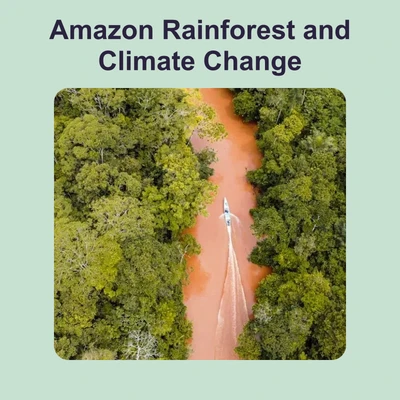
The Amazon rainforest provides a clear example of deforestation's impact. This vast forest stores approximately 150 billion tons of carbon. However, farmers and ranchers clear Amazon forests for cattle grazing and crop production. Between 2000 and 2020, the Amazon lost an area of forest larger than California. As these trees disappeared, billions of tons of carbon entered the atmosphere. The remaining forest also became less effective at absorbing carbon dioxide because there were fewer trees doing the work.
Understanding how deforestation releases carbon helps explain why protecting forests matters for Earth's climate. Forests are part of the carbon cycle, the natural process that moves carbon between the atmosphere, living things, and Earth's surface. When humans disrupt this cycle by removing forests, carbon dioxide levels in the atmosphere increase. This creates a feedback loop where more atmospheric carbon leads to warmer temperatures, which can stress remaining forests and reduce their ability to store carbon. Protecting existing forests and planting new ones can help address climate change by keeping carbon stored and maintaining Earth's natural carbon absorption systems.
Interesting Fact: A single large tree can absorb about 48 pounds of carbon dioxide per year and store over one ton of carbon by the time it reaches 40 years old.
Comprehension quiz (10 questions)
1. How much carbon do scientists estimate is stored in forests globally?
2. What percentage of global carbon dioxide emissions comes from deforestation each year?
3. What does the term 'photosynthesis' mean in the context of this passage?
4. Based on the passage, what is a 'greenhouse gas'?
5. Why does deforestation impact the climate in two ways?
6. What can be inferred about the relationship between forests and the carbon cycle?
7. How might protecting existing forests help address climate change?
8. If a farmer clears a forest for cattle grazing, what immediate effect occurs?
9. True or False: When trees are cut and left to decay, they still release their stored carbon over time.
10. True or False: The Amazon rainforest gained forest area between 2000 and 2020.
Perfect for the way you teach
- Build comprehension skills
- Auto-graded quiz
- Differentiated reading
- Read together at home
- Improve fluency
- Quiet reading time
- Reading curriculum support
- Independent practice
- Track Lexile growth