Sustainable Agriculture and Climate Solutions — Reading Comprehension
Rate this
Premium Resource
Present
Present in classroom. No work saved
Assign
Classroom with student accounts, Track progress
Quick Play
No student accounts, assign with a link
Grades
6
7
8
PRINT+DIGITAL RESOURCE
This learning resource is available in interactive and printable formats. The interactive worksheet can be played online and assigned to students. The Printable PDF version can be downloaded and printed for completion by hand.
This comprehensive passage introduces students in grades 6-8 to the concept of sustainable agriculture and its role in climate solutions, aligning with NGSS science standards. Students will explore how farming practices can protect the environment, reduce greenhouse gas emissions, and support healthy communities. Key scientific vocabulary is highlighted and defined, making complex ideas accessible. Real-world examples, such as crop rotation and using renewable energy on farms, show how these concepts are applied in everyday life. The passage is audio integrated, includes a glossary, a Spanish translation, and engaging activities such as a multiple-choice quiz and writing prompts. This resource helps students strengthen reading comprehension, expand science vocabulary, and make connections between science and real-world issues, all while supporting English and Spanish learners.
CONTENT PREVIEW
Expand content preview
Sustainable agriculture supports climate action.
Sustainable agriculture is a way of farming that protects the environment, supports communities, and helps fight climate change. It uses methods that keep the soil healthy, save water, and reduce pollution. Traditional farming can harm the environment by using too many chemicals and causing soil erosion, which is when soil gets washed or blown away.
One important goal of sustainable agriculture is to lower the amount of greenhouse gases released into the air. Greenhouse gases include carbon dioxide and methane. They trap heat in the Earth's atmosphere, causing climate change. Climate change can lead to extreme weather, rising sea levels, and harm to plants and animals.
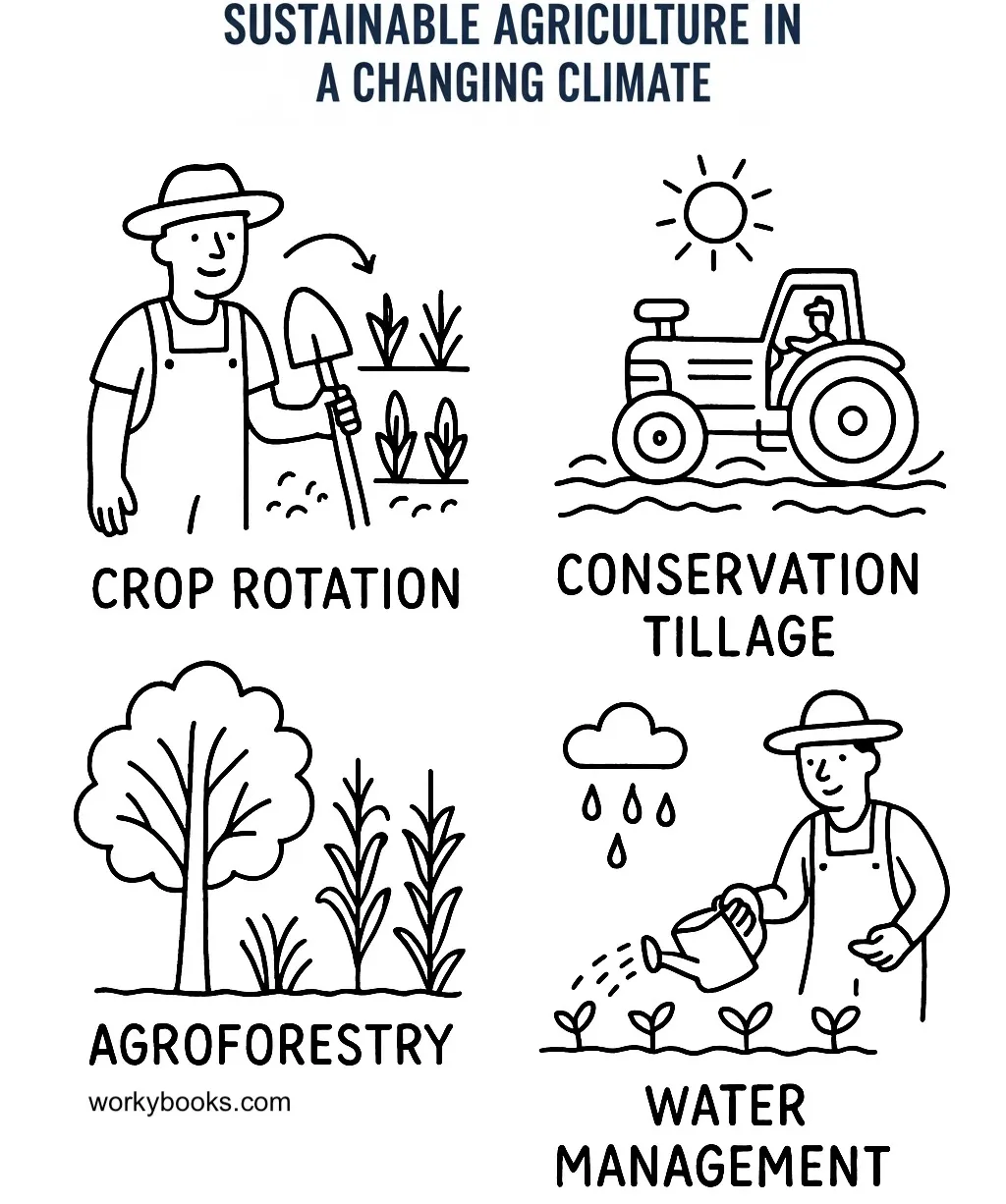
To help the planet, farmers can use crop rotation. This means planting different crops in the same field each year. Crop rotation keeps the soil rich in nutrients and prevents pests from taking over. Another method is using compost, which is made from food scraps and plant waste. Adding compost to soil makes it healthier without the need for chemical fertilizers.
Conservation tillage is another technique. Instead of plowing the soil deeply, farmers leave crop remains on the field. This helps keep moisture in the soil and stops erosion. Using less water is also important. Drip irrigation delivers water directly to the roots of plants, saving a lot of water compared to spraying fields.
Sustainable agriculture also uses renewable energy, like solar panels and wind turbines, to power farms. These energy sources do not pollute the air and help reduce greenhouse gases. Some farms raise animals in ways that are better for the environment, such as letting cows and chickens graze freely on grasslands.
People everywhere can help by buying food from local farmers who use sustainable practices. Eating more fruits, vegetables, and whole grains—and less meat—can also lower greenhouse gas emissions. When communities and farmers work together, they can make a big difference for the planet.
Interesting Fact: Some plants, like clover and beans, naturally add nitrogen to the soil, which helps other crops grow without extra fertilizer.
What is sustainable agriculture?
Farming that protects the environmentFarming that uses more chemicalsFarming that ignores soil healthFarming only with animals
Which gas traps heat in Earth's atmosphere?
OxygenCarbon dioxideHydrogenNitrogen
What does crop rotation help prevent?
Soil nutrients lossPests taking overBoth A and BNone of these
Why do farmers use drip irrigation?
To water leavesTo save waterTo spray fieldsTo use more water
How does conservation tillage help soil?
Removes all moistureKeeps moisture and prevents erosionAdds more chemicalsDamages the soil
Solar panels and wind turbines use renewable energy.
TrueFalse
Which is NOT a greenhouse gas?
MethaneOxygenCarbon dioxideNone of these
What does compost do for soil?
Makes it healthyRemoves nutrientsAdds chemicalsNone of these
Perfect For:
👩🏫 Teachers
• Reading comprehension practice
• Auto-graded assessments
• Literacy skill development
👨👩👧👦 Parents
• Reading practice at home
• Comprehension improvement
• Educational reading time
🏠 Homeschoolers
• Reading curriculum support
• Independent reading practice
• Progress monitoring
Reading Features:
📖
Reading Passage
Engaging fiction or nonfiction text
❓
Comprehension Quiz
Auto-graded questions
📊
Instant Feedback
Immediate results and scoring
📄
Printable Version
Download for offline reading
🔊
Read Aloud
Voice-over with word highlighting
Reviews & Ratings
No reviews yet. Be the first to share your experience!
Related Content
What Is Earth Science?
This engaging middle school science passage introduces students to the field of Earth science, aligning with NGSS standa...
MS-ESS1MS-ESS2MS-ESS3SEP
Transportation and Climate Change
This engaging science passage for grades 6-8 explores the vital role that transportation plays in climate change. Studen...
Tools and Technology in Earth Science
This middle school science reading passage explores the wide range of tools and technologies used in Earth science, from...
MS-ESS2-2MS-ESS3-2MS-ETS1-1MS-PS4-3
Climate Change: Solutions and Mitigation
This passage explores scientific solutions and mitigation strategies for climate change, designed for middle school scie...
MS-ESS3-4MS-ESS3-5
Extreme Weather and Climate Change
This Grade 6-8 science passage, aligned to NGSS standards, explores the impact of climate change on extreme weather even...
Climate Change: Causes
This comprehensive middle school science passage explores the causes of climate change by examining both natural and hum...
MS-ESS3-5MS-LS2-4
Effects of Climate Change
This comprehensive middle school science passage explores the effects of climate change on Earth's systems and life, ali...
MS-ESS3-5MS-LS4-4
Climate Change Bird Migration
This educational passage, audio integrated, explores how climate change affects bird migration patterns. Students will l...
MS-LS2-4: CONSTRUCT AN ARGUMENT SUPPORTED BY EMPIRICAL EVIDENCE THAT CHANGES TO PHYSICAL OR BIOLOGICAL COMPONENTS OF AN ECOSYSTEM AFFECT POPULATIONS.
Climate Through Earth's History
This engaging passage for grades 6-8 explores how Earth's climate has naturally changed over millions of years, highligh...
MS-ESS1-4MS-ESS2-6
Climate Change: Vulnerable Ecosystems
This middle school science passage, aligned with NGSS standards MS-ESS3-5 and MS-LS2-4, helps students understand how cl...
MS-ESS3-5MS-LS2-4
How Deforestation Contributes to Climate Change
This engaging science passage, aligned with NGSS standards, explains how deforestation contributes to climate change for...
Permafrost and Climate Change
This engaging, NGSS-aligned science passage for grades 6-8 explores how melting permafrost releases greenhouse gases, im...
Scientific Inquiry in Earth Science
This passage explores scientific inquiry in Earth science for grades 6-8, aligned with NGSS standards MS-ESS1-4, MS-ESS2...
MS-ESS1-4MS-ESS2-1MS-ESS3-5SEP
Impact of Climate Change on Water Resources
This engaging science passage for grades 6-8 explores the impact of climate change on water resources, aligning with NGS...
Heatwaves and Climate Change
This educational resource features an engaging, audio-integrated reading passage titled 'Heatwaves and Climate Change,' ...
How Climate Change Affects Food Security
This grade 6-8 science passage, aligned with the NGSS standards, explores how climate change affects food security aroun...
Addressing Climate Change
This middle school science passage, aligned with NGSS standards MS-ESS3-4 and MS-ESS3-5, explores the mechanisms and sol...
MS-ESS3-4MS-ESS3-5
What Is The Difference Between Global Warming And Climate Change?
This educational content, audio integrated, explores the crucial differences between global warming and climate change. ...
Climate Change: Species Responses
This middle school science passage explores how species respond to climate change, aligning with NGSS standards MS-LS4-4...
MS-LS4-4MS-LS4-6
Climate Refugees
This engaging science passage for grades 6-8 introduces students to the topic of climate refugees and human migration. A...