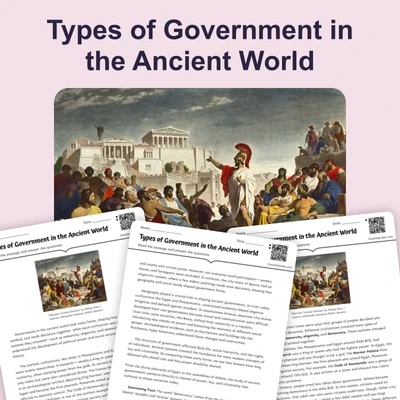
This learning resource is available in interactive and printable formats. The interactive worksheet can be played online and assigned to students. The Printable PDF version can be downloaded and printed for completion by hand.
This engaging passage explores the political system of the Roman Republic, focusing on how Roman citizens chose their leaders and the roles of the Senate, consuls, and elected officials. Students will learn about the complex structure of Roman government, the importance of civic participation, and how geography and social hierarchy shaped daily life in ancient Rome. The passage includes primary source evidence, cause-and-effect relationships, and connections to broader themes in world history. Activities include a reading comprehension quiz, writing prompts, graphic organizers, and a chronological timeline. The resource is aligned with CA HSS 6.7 and CCSS RH.6-8.2 standards. This history reading passage features an audio read aloud and a full Spanish translation, making it accessible for diverse learners. Key vocabulary is highlighted throughout, and students are encouraged to analyze history like a historian. Ideal for building literacy and historical thinking skills.
CONTENT PREVIEW
Expand content preview
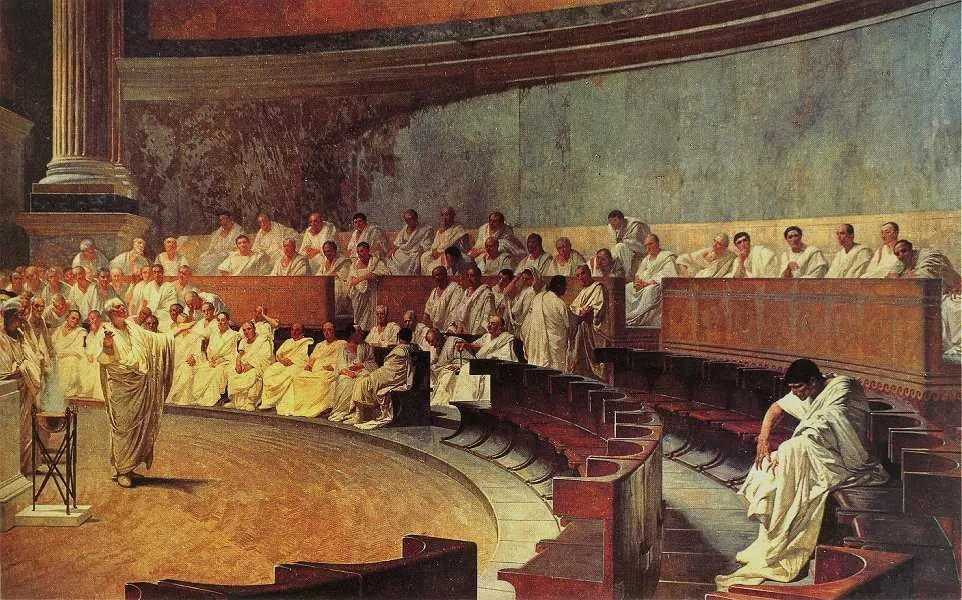
"Cicero Denounces Catiline in the Roman Senate by Cesare Maccari - 3" by Cesare Maccari / Wikimedia Commons
The Roman Republic developed a unique system for choosing its leaders. Instead of a single king, Romans created a government in which citizens could elect officials. This system began in 509 BCE, after Romans overthrew their last king, Tarquin the Proud. The new government was called a republic, which means “public affair” in Latin.
At the heart of the Roman Republic was the Senate. The Senate was a council of about 300 men, mostly from wealthy and noble families called patricians. Senators debated and made important decisions about laws, taxes, and foreign policy. The Senate had great influence, but it did not have all the power. Each year, Roman citizens elected two consuls to serve as the top officials. Consuls led the government and the army, but each consul could stop the other’s decision with a veto. This system prevented any one person from gaining too much power.
Roman citizens also elected other officials, such as praetors, who were judges, and quaestors, who managed finances. The most important assembly was the Comitia Centuriata, where citizens voted on laws and elected magistrates. However, most of the power remained with the patricians. Common people, called plebeians, had fewer rights at first, but over time, they fought for more equality. For example, in 494 BCE, plebeians protested by leaving the city in what became known as the “Conflict of the Orders.” This forced the patricians to allow plebeians to elect their own officials, called tribunes, who could protect their interests.
Archaeological evidence, such as inscribed bronze tablets, shows how laws were recorded and displayed in the Forum, so citizens could see them. Ancient writers like Cicero described debates in the Senate, providing historians with primary sources about Roman political life. The system of checks and balances, with multiple elected officials and public assemblies, was designed to keep the government stable and fair. However, only free men who were citizens could vote, leaving out women, slaves, and foreigners.
The Roman Republic’s method of choosing leaders influenced future governments, including that of the United States. Its ideas about elections, separation of powers, and civic duty still matter today. The Republic lasted nearly 500 years, until civil wars led to the rise of emperors.
This system of government connects to larger themes in history, such as the struggle for equality, the role of geography in shaping societies, and the impact of political institutions on daily life.
Interesting Fact: The word “senate” comes from the Latin “senex,” meaning “old man,” because senators were expected to be wise elders.
Who were the consuls?
Top elected officialsWealthy merchantsRoman slavesForeign ambassadors
What was the Senate?
Group of kingsCouncil of patriciansArmy leadersCommon people's assembly
When did the Republic begin?
44 BCE27 BCE509 BCE100 CE
What was a result of the Conflict of the Orders?
Patricians lost all powerSlaves could votePlebeians got tribunesSenate banned
Why did Romans have two consuls?
To balance powerFor more warsTo collect taxesTo write new laws
What is a veto?
Starting a warStopping a decisionVoting for consulPaying taxes
Only patricians could vote. True or false?
TrueFalse
What does 'republic' mean?
A king rulesGovernment by the peopleNo lawsOne family rules
Perfect For:
👩🏫 Teachers
• Reading comprehension practice
• Auto-graded assessments
• Literacy skill development
👨👩👧👦 Parents
• Reading practice at home
• Comprehension improvement
• Educational reading time
🏠 Homeschoolers
• Reading curriculum support
• Independent reading practice
• Progress monitoring
Reading Features:
📖
Reading Passage
Engaging fiction or nonfiction text
❓
Comprehension Quiz
Auto-graded questions
📊
Instant Feedback
Immediate results and scoring
📄
Printable Version
Download for offline reading
🔊
Read Aloud
Voice-over with word highlighting
Reviews & Ratings
No reviews yet. Be the first to share your experience!
Related Content
Ancient Civilizations and the Environment
This engaging history reading passage explores how ancient civilizations such as Mesopotamia, Egypt, and the Maya adapte...
Gender Roles in Ancient Civilizations
This engaging history reading passage explores the roles of men and women in various ancient civilizations, including Me...
Writing Prompts Ancient Civilizations
Step into the shoes of an archaeologist with this engaging worksheet focused on ancient civilizations. Students will be ...
W.5.2.A-2W.5.1.CW.5.1.D
Power and Authority in Ancient Civilizations
This passage explores the roles of men in positions of power within ancient civilizations, focusing on their authority i...
Evidence in Ancient History
This engaging history reading passage investigates how archaeologists and historians discover clues about how ancient pe...
Ancient Monarchy
This reading passage explores the concept of monarchy in ancient civilizations, focusing on the origins, structure, and ...
Ancient Theocracy
This engaging history reading passage explores the concept of theocracy in ancient civilizations, where priests and reli...
Ancient Mathematics
This passage explores the essential role of mathematics in ancient civilizations, including Mesopotamia, Egypt, Greece, ...
Ancient Canaan
This educational passage explores the land of Canaan, the historical homeland of the ancient Israelites. Students will l...
Ancient Money Barter
This passage explores the fascinating evolution from barter to the earliest coins in ancient civilizations, focusing on ...
Ancient Science and Medicine
This comprehensive reading passage explores the development of science and medicine in ancient civilizations, including ...
Ancient Literature
This passage explores the importance of ancient stories and poems from civilizations such as Greece, India, and Israel. ...
Ancient Agriculture Farming
This passage explores the transformative impact of farming on ancient societies, examining how the Neolithic Revolution ...
Ancient Writing Systems
This engaging history reading passage explores the origins and evolution of ancient writing systems, including cuneiform...
Geography of Ancient Israel
This passage explores the rich geography of Ancient Israel, focusing on how landforms, climate, and natural resources sh...
Slavery Across Civilizations
This detailed history reading passage explores the role and impact of slavery across several ancient civilizations, incl...
Social Classes in Ancient Societies
This passage explores the concept of social hierarchies in ancient civilizations, focusing on why societies such as Meso...
Social structures in Ancient World
This passage explores the organization and significance of family life in ancient societies, focusing on how extended fa...
Polytheism and Monotheism in Ancient Times
This passage explores the religious beliefs of ancient civilizations, focusing on the differences and similarities betwe...
Women in Ancient Societies
This reading passage explores the complex roles of women in the ancient world, focusing on civilizations such as Mesopot...