This learning resource is available in interactive and printable formats. The interactive worksheet can be played online and assigned to students. The Printable PDF version can be downloaded and printed for completion by hand.
This history reading passage examines the Safavid Empire in Persia, one of the great Gunpowder Empires, and its influence on world history. Students will explore the rise of the Safavids, their use of gunpowder technology, architectural and artistic achievements, religious impact, and daily life in the empire. The passage integrates primary source evidence and connects the Safavids to broader ancient civilization themes. Activities include multiple-choice questions, writing prompts, graphic organizers, and a timeline, supporting key history and ELA standards such as CA HSS 6.6 and CCSS RH.6-8.1. Read aloud audio and a full Spanish translation are included for accessibility. This resource helps students analyze historical cause and effect, change over time, and the role of geography in shaping civilizations.
CONTENT PREVIEW
Expand content preview
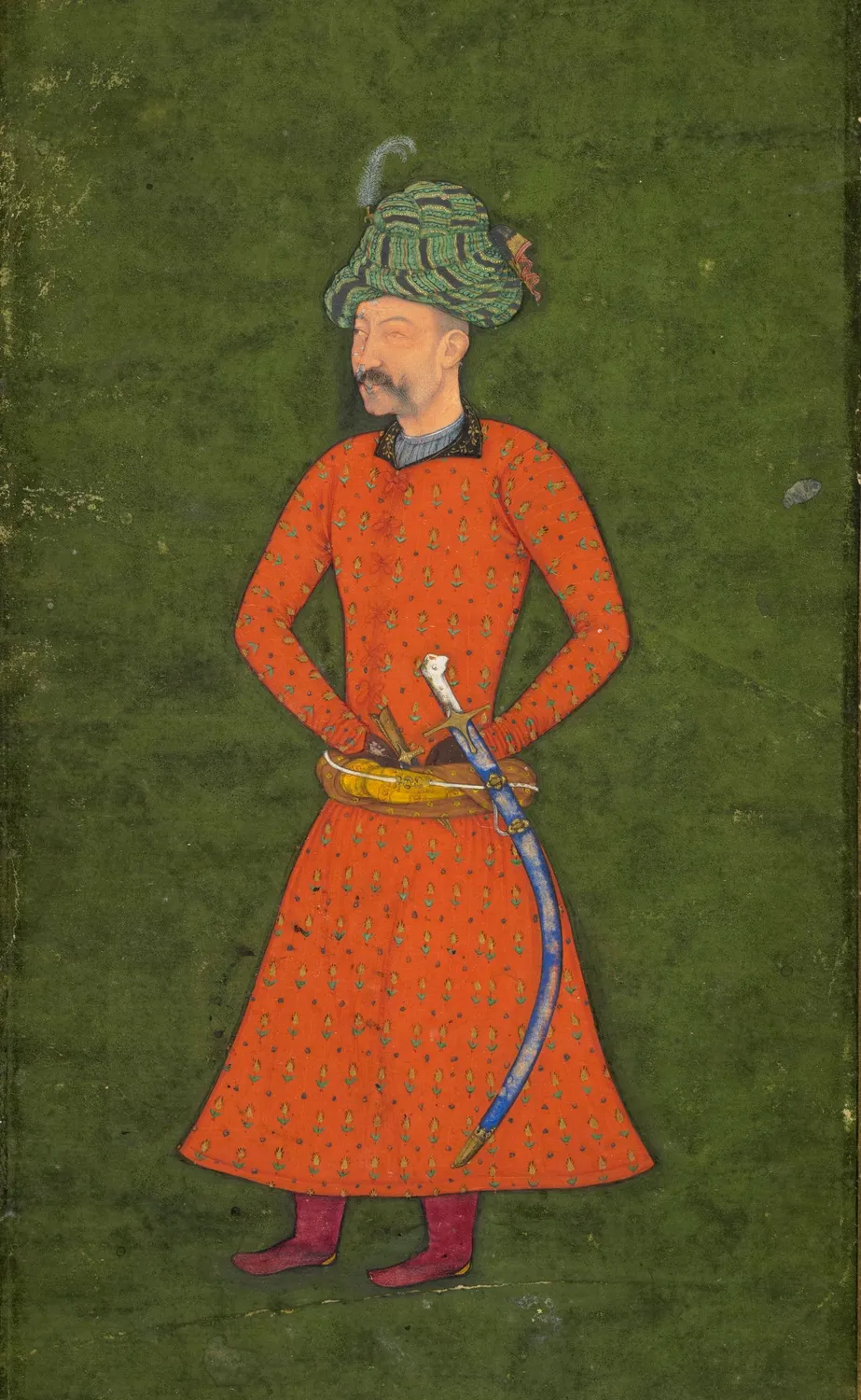
"Shah ʿAbbas I of Persia." by Bishn Dás (Probably by Bishan Das when with the Mughal Embassy to Persia from 1613-19.) / Wikimedia Commons
The Safavid Empire emerged in Persia in the early 1500s and quickly became one of the most powerful states in the region. Centered in present-day Iran, the Safavid dynasty controlled a vast territory stretching from the Caspian Sea in the north to the Persian Gulf in the south. The Safavids are celebrated for uniting Persia under a single government, advancing art and architecture, and establishing Shi'a Islam as the state religion.
One of the most significant figures in Safavid history was Shah Abbas I, who ruled from 1588 to 1629. Shah Abbas moved the capital to Isfahan, transforming it into a center of culture and trade. Under his leadership, the empire expanded its borders and strengthened its military with new gunpowder weapons. The Safavids used muskets and cannons, which allowed them to defend against rivals like the Ottoman Empire and the Uzbeks. Archaeological evidence from the city of Isfahan, including the Imam Mosque, shows the empire’s achievements in architecture and design. European travelers, such as Jean Chardin, described Isfahan as "half the world" because of its beauty and bustling markets.
The Safavid Empire was known for its religious policies and efforts to promote Shi'a Islam. Before the Safavids, Persia was mostly Sunni Muslim. By making Shi'a Islam the official faith, the Safavids created a distinct identity for Persia that set it apart from its Sunni neighbors. This change led to the construction of grand mosques, new religious schools, and the celebration of Shi'a festivals. However, the policy also caused tension with Sunni groups, sometimes leading to conflict. Primary sources, such as royal decrees and religious texts from the Safavid period, reveal the importance of religion in daily life and governance.
Trade and the Silk Road were vital to the Safavid economy. The empire’s location connected east and west, making Persia a crossroads for merchants from Asia, Europe, and Africa. Goods like silk, carpets, and ceramics were highly valued. The Safavids encouraged trade by building caravanserais—inns for travelers—along trade routes. The new capital, Isfahan, became a cosmopolitan city where people from many cultures met. Socially, society was organized into classes, with the Shah and his family at the top, followed by nobles, soldiers, merchants, and farmers. Artisans and craftsmen were respected for their skills, especially in weaving Persian rugs.
By the mid-1700s, the Safavid Empire weakened due to internal conflicts, invasions, and economic difficulties. Yet, the legacy of the Safavids remains strong in Iranian culture, religion, and art. Their introduction of Shi'a Islam shaped the region’s identity for centuries. The architecture, art, and traditions started by the Safavids continue to influence the world today.
The story of the Safavid Empire connects to broader themes of ancient civilizations, such as the impact of geography, the role of religion in society, and the rise and fall of powerful states.
Interesting Fact: The blue tiles of the Imam Mosque in Isfahan, built during the Safavid era, are made with a special glaze that still shines brightly after more than 400 years.
Who founded the Safavid Empire?
A Persian dynastyThe Ottoman EmpireJean ChardinThe Mongols
What was the Safavid capital under Shah Abbas?
BaghdadCairoIsfahanTehran
Which religion did the Safavids promote?
Sunni IslamZoroastrianismChristianityShi'a Islam
Why were gunpowder weapons important to the Safavids?
For building mosquesTo defeat rivalsTo trade with EuropeFor farming
How did the Safavid Empire change religion in Persia?
Made Islam illegalPromoted Shi'a IslamBanned all festivalsAdopted Christianity
What was a result of Safavid trade policies?
Fewer merchants visited PersiaIsfahan became a trade centerTrade with Asia stoppedFewer caravanserais were built
The Safavid Empire lasted until the 1700s. True or false?
TrueFalse
What is a 'dynasty'?
A trade routeA family of rulersA type of mosqueA group of merchants
Perfect For:
👩🏫 Teachers
• Reading comprehension practice
• Auto-graded assessments
• Literacy skill development
👨👩👧👦 Parents
• Reading practice at home
• Comprehension improvement
• Educational reading time
🏠 Homeschoolers
• Reading curriculum support
• Independent reading practice
• Progress monitoring
Reading Features:
📖
Reading Passage
Engaging fiction or nonfiction text
❓
Comprehension Quiz
Auto-graded questions
📊
Instant Feedback
Immediate results and scoring
📄
Printable Version
Download for offline reading
🔊
Read Aloud
Voice-over with word highlighting
Reviews & Ratings
No reviews yet. Be the first to share your experience!
Related Content
Ancient Civilizations and the Environment
This engaging history reading passage explores how ancient civilizations such as Mesopotamia, Egypt, and the Maya adapte...
Gender Roles in Ancient Civilizations
This engaging history reading passage explores the roles of men and women in various ancient civilizations, including Me...
Writing Prompts Ancient Civilizations
Step into the shoes of an archaeologist with this engaging worksheet focused on ancient civilizations. Students will be ...
W.5.2.A-2W.5.1.CW.5.1.D
Power and Authority in Ancient Civilizations
This passage explores the roles of men in positions of power within ancient civilizations, focusing on their authority i...
Evidence in Ancient History
This engaging history reading passage investigates how archaeologists and historians discover clues about how ancient pe...
Ancient Monarchy
This reading passage explores the concept of monarchy in ancient civilizations, focusing on the origins, structure, and ...
Ancient Theocracy
This engaging history reading passage explores the concept of theocracy in ancient civilizations, where priests and reli...
Ancient Mathematics
This passage explores the essential role of mathematics in ancient civilizations, including Mesopotamia, Egypt, Greece, ...
Ancient Canaan
This educational passage explores the land of Canaan, the historical homeland of the ancient Israelites. Students will l...
Ancient Money Barter
This passage explores the fascinating evolution from barter to the earliest coins in ancient civilizations, focusing on ...
Ancient Science and Medicine
This comprehensive reading passage explores the development of science and medicine in ancient civilizations, including ...
Ancient Literature
This passage explores the importance of ancient stories and poems from civilizations such as Greece, India, and Israel. ...
Ancient Agriculture Farming
This passage explores the transformative impact of farming on ancient societies, examining how the Neolithic Revolution ...
Ancient Writing Systems
This engaging history reading passage explores the origins and evolution of ancient writing systems, including cuneiform...
Geography of Ancient Israel
This passage explores the rich geography of Ancient Israel, focusing on how landforms, climate, and natural resources sh...
Social Classes in Ancient Societies
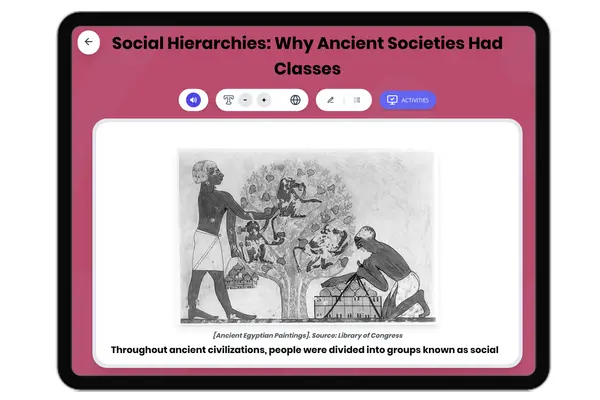
This passage explores the concept of social hierarchies in ancient civilizations, focusing on why societies such as Meso...
Slavery Across Civilizations
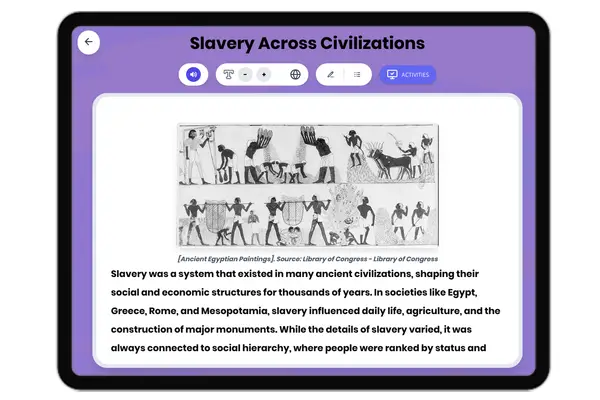
This detailed history reading passage explores the role and impact of slavery across several ancient civilizations, incl...
Social structures in Ancient World
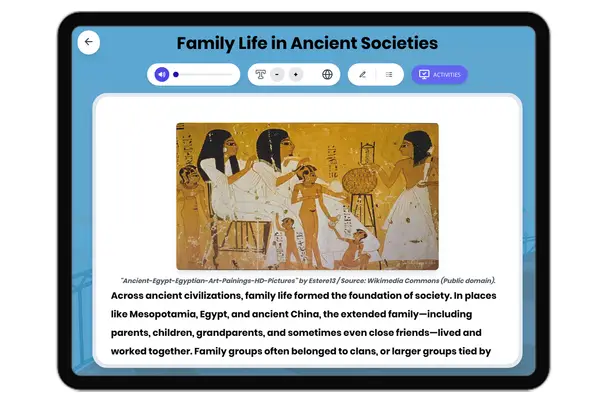
This passage explores the organization and significance of family life in ancient societies, focusing on how extended fa...
Polytheism and Monotheism in Ancient Times
This passage explores the religious beliefs of ancient civilizations, focusing on the differences and similarities betwe...
Women in Ancient Societies
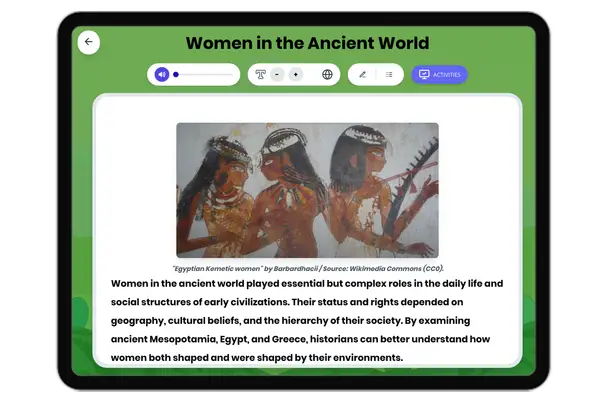
This reading passage explores the complex roles of women in the ancient world, focusing on civilizations such as Mesopot...