Maps and Their Uses
Interactive passage with audio narration, comprehension questions, and printable PDF.
By completing this purchase you agree to our Terms of Use and Privacy Policy. Your subscription renews automatically until you cancel. You can cancel anytime from your account settings. All sales are final and non-refundable. Digital content is available for download in your account immediately upon purchase.
What's included
Maps and Their Uses preview and details
About this printable Maps and Their Uses science reading passage, NGSS-aligned (Grades 5-8)
Sample passage and quiz from Maps and Their Uses
Reading passage and comprehension quiz preview
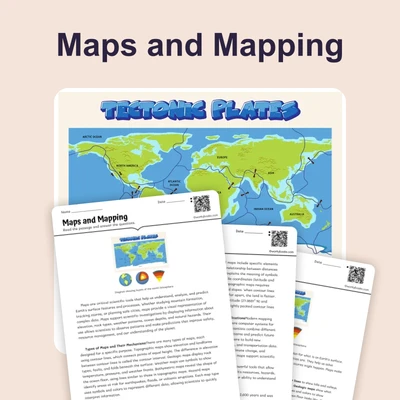
Maps and Their Uses
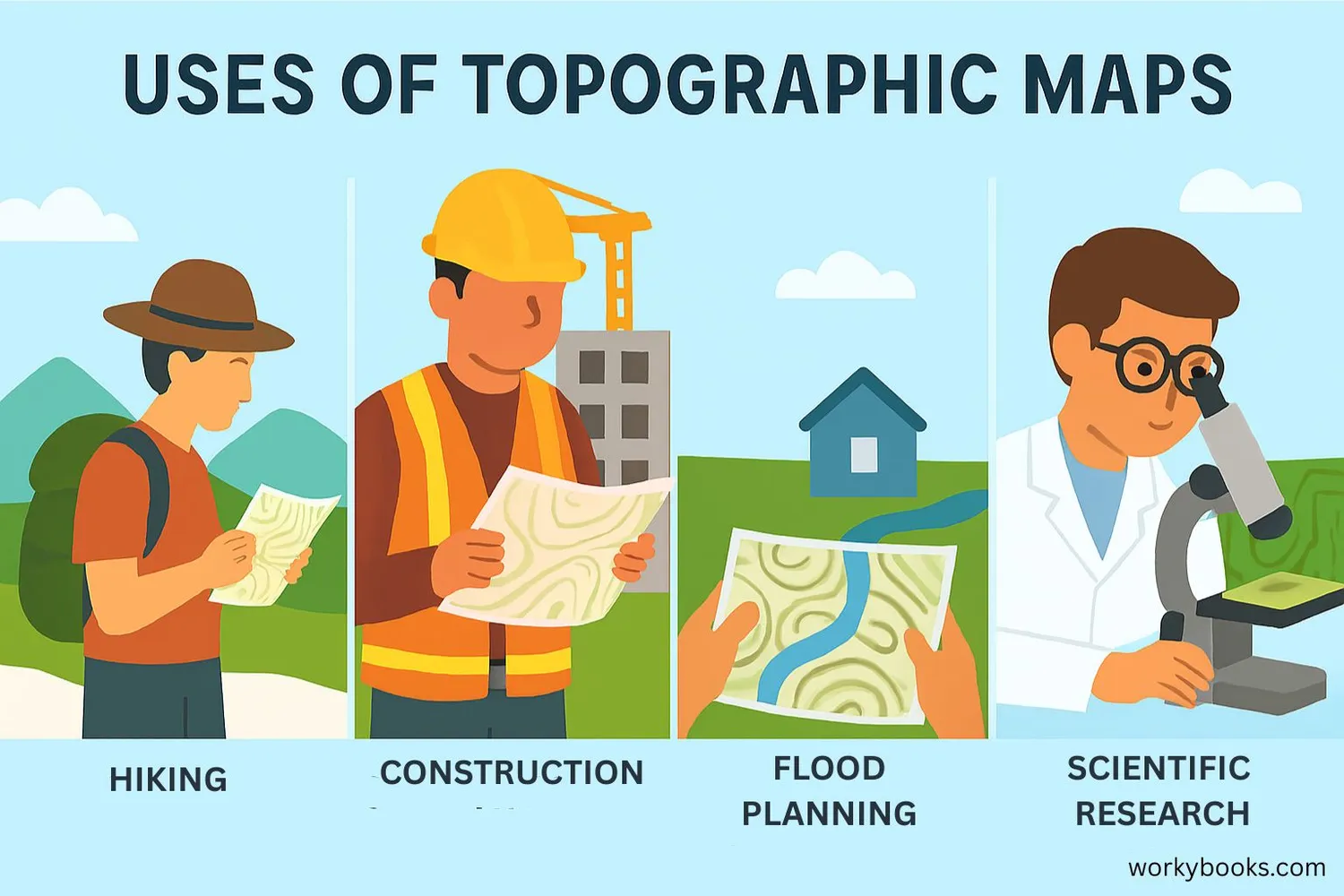
Maps serve as essential tools for representing features of Earth and helping people analyze information about the planet. Scientists, geographers, and everyday people rely on different types of maps to answer questions about the world’s systems and patterns. Understanding how and why different maps are used is crucial for making decisions about the environment, society, and technology.
Specialized Maps: Purposes and Mechanisms
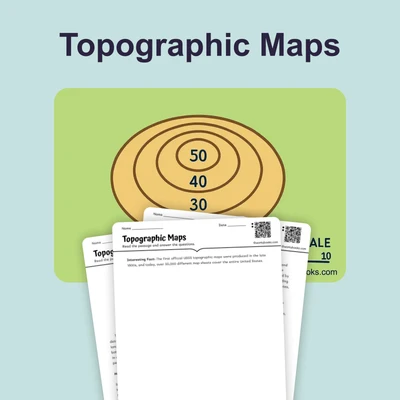
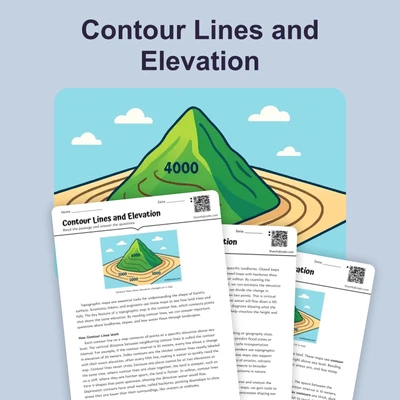
Each type of map is designed to display certain kinds of data. Political maps show boundaries, cities, and countries, helping people understand human organization and relationships. Physical maps focus on landforms like mountains, rivers, and deserts, often using shading and colors to represent elevation. Topographic maps provide detailed information about elevation using contour lines, which connect points of equal height. Geologic maps display rock types, ages, and structures, revealing how Earth's surface has changed over time. Bathymetric maps show the shape of the ocean floor, using depth contours similar to topographic maps. Each map’s design reflects its purpose—using symbols, colors, and scales to communicate specific information clearly.
Interacting Systems and Real-World Applications
Other specialized maps help us analyze dynamic Earth systems. Weather maps show atmospheric conditions such as temperature, air pressure, and fronts, helping meteorologists predict storms. Climate maps reveal long-term patterns, such as average rainfall or temperature, supporting research about climate change. Hazard maps identify zones at risk for earthquakes, floods, or volcanoes, which is essential for public safety and urban planning. Land use maps show how land is utilized—whether for farming, forests, or cities. Soil maps provide information about soil types and properties, critical for agriculture and construction. Scientists often use several map types together to analyze complex problems, such as how soil and climate affect farming or how elevation and geology relate to earthquake risk.
Map Projections, Digital Maps, and Choosing the Right Tool
Because Earth is a sphere, any flat map involves a map projection. Projections flatten the surface but always create some distortion—changing the true area, shape, distance, or direction. For example, the Mercator projection preserves direction but distorts size near the poles, while the Robinson projection tries to balance shape and area errors. Today, digital maps allow users to interact with many layers of information, customize views, and analyze data in real time. Scientists select map types and projections based on their research questions and the features they need to observe. The ability to interpret and choose among maps is fundamental for investigating Earth’s systems and making informed decisions about the environment.
Maps are more than just pictures—they are scientific models that help us see patterns, make predictions, and solve problems. As our technology improves, maps become even more powerful tools for understanding the complex systems that shape our world.
Interesting Fact:
Most of the ocean floor was mapped in more detail by satellites in the last 50 years than in all earlier human history combined!
Comprehension quiz (10 questions)
1. Which type of map uses contour lines to show elevation?
2. What feature do political maps show that physical maps do not?
3. Which map would a meteorologist use to track a thunderstorm?
4. What does the term 'map projection' describe in the passage?
5. What is the primary use of a bathymetric map?
6. What is one reason scientists use more than one map type for a problem?
7. Which term best describes a boundary between air masses?
8. A digital map allows users to:
9. True or False: Physical maps use colors to show natural landforms.
10. True or False: All maps show the Earth with no distortion.
Perfect for the way you teach
- Build comprehension skills
- Auto-graded quiz
- Differentiated reading
- Read together at home
- Improve fluency
- Quiet reading time
- Reading curriculum support
- Independent practice
- Track Lexile growth