Sense of Balance and Proprioception
Interactive passage with audio narration, comprehension questions, and printable PDF.
By completing this purchase you agree to our Terms of Use and Privacy Policy. Your subscription renews automatically until you cancel. You can cancel anytime from your account settings. All sales are final and non-refundable. Digital content is available for download in your account immediately upon purchase.
What's included
Sense of Balance and Proprioception preview and details
About this printable Sense of Balance and Proprioception science reading passage, NGSS-aligned (Grade 6)
Sample passage and quiz from Sense of Balance and Proprioception
Reading passage and comprehension quiz preview
Sense of Balance and Proprioception
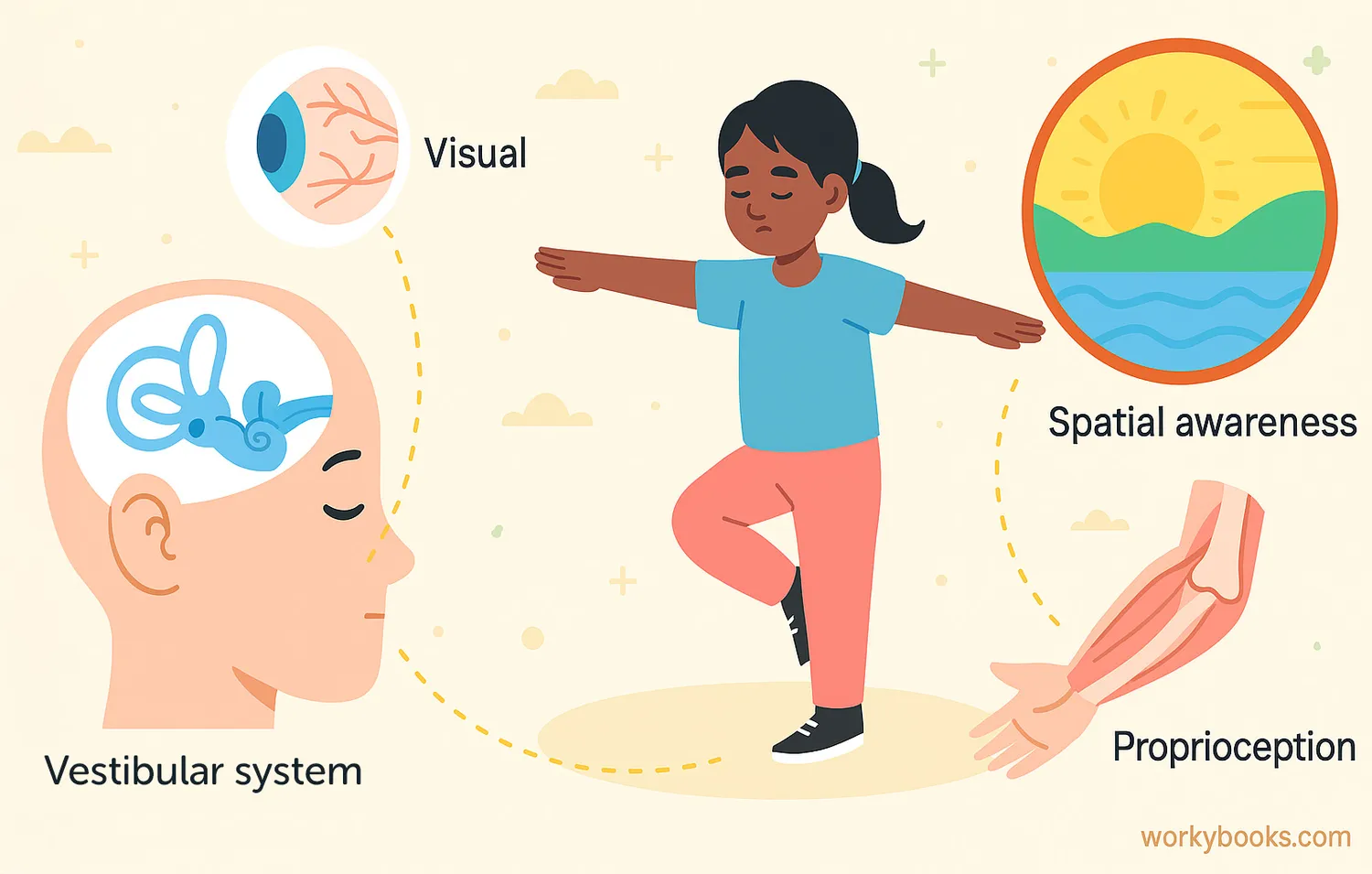
Imagine trying to stand on one foot with your eyes closed. It's tricky, right? That wobble you feel is your body's amazing system for balance hard at work. Our ability to stay upright, walk, run, and even just sit still without falling over is thanks to a complex network of sensory systems.
One of the most important parts of your balance system is hidden deep inside your inner ear. This area contains the vestibular system, a tiny but powerful set of fluid-filled canals and sacs. As your head moves, the fluid inside these canals shifts, bending tiny hair-like cells. These cells then send electrical signals to your brain, telling it exactly how your head is positioned and if it's moving, like when you nod or turn your head.
But balance isn't just about your ears! Your eyes also play a crucial role. When you look at the horizon, your brain uses that visual information to help orient your body. If you've ever felt dizzy after spinning around, it's partly because your eyes and inner ear are sending conflicting messages to your brain. This can lead to a temporary feeling of disorientation.
Beyond balance, there's another incredible sense called proprioception. This is your body's ability to know where its parts are in space without looking. For example, you know if your arm is raised or if your knees are bent, even with your eyes closed. This sense comes from special sensory receptors located in your muscles, joints, and tendons. These receptors constantly send information to your brain about the stretch of your muscles and the angle of your joints. This constant feedback loop allows you to make smooth, coordinated movements, whether you're catching a ball or tying your shoes.
The brain acts like a supercomputer, taking all this information – from your inner ear, your eyes, and your muscles and joints – and combining it to create a complete picture of your body's position and motion. This allows you to maintain spatial awareness and react quickly to changes in your environment, preventing falls and allowing you to perform everyday activities with ease. These amazing sensory systems are constantly working together, giving you the power to move and interact with the world around you.
Interesting Fact: People can improve their balance and proprioception through practice and exercises, which is why athletes often train with unstable surfaces or blindfolds.
Comprehension quiz (10 questions)
1. Which system is in the inner ear?
2. What sends signals about muscle stretch?
3. How does the brain know head position?
4. What is proprioception?
5. How do eyes assist balance?
6. Conflicting messages cause disorientation.
7. What is the brain's role?
8. Which helps in coordinated movements?
9. What happens if inner ear fluid shifts?
10. What term means 'knowing where body parts are without looking'?
Perfect for the way you teach
- Build comprehension skills
- Auto-graded quiz
- Differentiated reading
- Read together at home
- Improve fluency
- Quiet reading time
- Reading curriculum support
- Independent practice
- Track Lexile growth