Stamen Anatomy
Interactive passage with audio narration, comprehension questions, and printable PDF.
By completing this purchase you agree to our Terms of Use and Privacy Policy. Your subscription renews automatically until you cancel. You can cancel anytime from your account settings. All sales are final and non-refundable. Digital content is available for download in your account immediately upon purchase.
What's included
Stamen Anatomy preview and details
About this printable Stamen Anatomy science reading passage, NGSS-aligned (Grade 6)
Sample passage and quiz from Stamen Anatomy
Reading passage and comprehension quiz preview
Stamen Anatomy
Imagine a world without colorful flowers or the fruits we love to eat. How do these amazing plants come into existence? A big part of the answer lies within the hidden wonders of a flower's reproductive parts. Today, we'll focus on the stamen, which is the male reproductive organ of a flower.
The stamen might seem small, but it plays a crucial role in plant reproduction. Think of it as a tiny factory for making something essential: pollen. Pollen contains the male reproductive cells of the plant, much like seeds contain the beginnings of a new plant. Without pollen, many plants wouldn't be able to make seeds and reproduce.
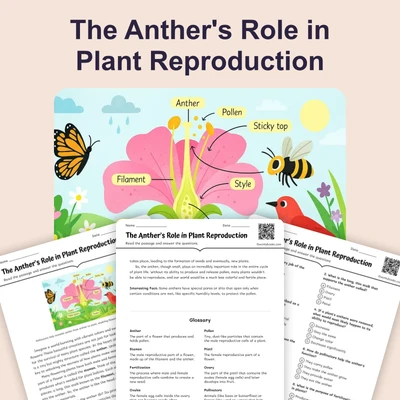
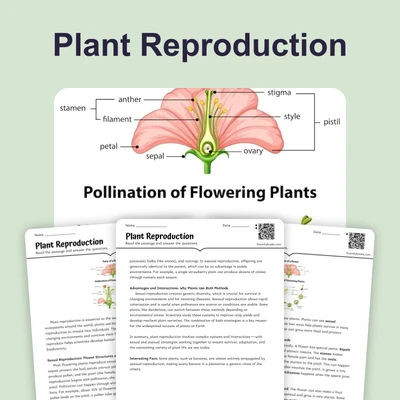
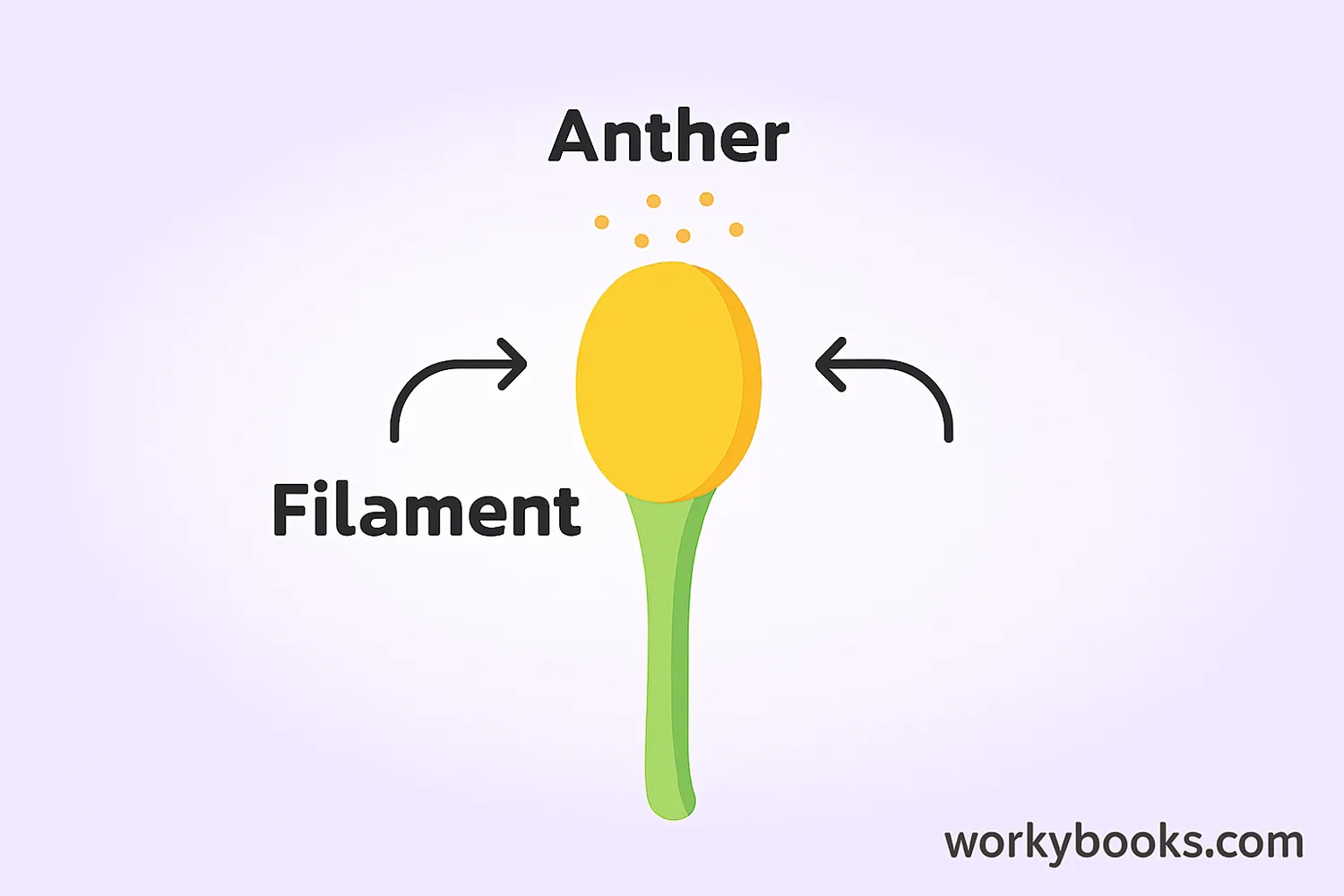
Each stamen is typically made up of two main parts: the anther and the filament. The anther is the part at the top of the stamen. It often looks like a small, usually yellowish or brownish sac. This is where the magic happens! Inside the anther, pollen grains are produced and stored until they are ready to be released. When you see a flower dusted with yellow powder, that's often pollen coming from the anthers.
Supporting the anther is the filament. The filament is a slender, stalk-like structure that holds the anther up. Its main job is to position the anther in the best possible place so that the pollen can be easily picked up by pollinators, like bees or butterflies, or carried away by the wind. Think of the filament as a strong stem holding up a valuable treasure.
Together, the anther and the filament work as a team. The filament provides support and position, while the anther produces and stores the vital pollen. This specialized structure and its specific functions are perfect examples of how different parts of an organism are designed to perform particular jobs, ensuring the plant's survival and the continuation of its species. Understanding the stamen helps us appreciate the intricate design of nature and the essential process of how plants reproduce and thrive in our world.
Interesting Fact: Some flowers have stamens that are so tiny you need a magnifying glass to see them, while others, like those of lilies, are quite large and easy to spot!
Comprehension quiz (10 questions)
1. What is the stamen?
2. Where is pollen produced?
3. The filament's main job is to:
4. Why is pollen important?
5. What would happen without stamens?
6. How do pollinators help the stamen?
7. A strong wind can help distribute pollen. True or False?
8. Which structure supports the anther?
9. If a plant's anthers were removed, what would be the most likely outcome?
10. The word 'stamen' refers to:
Perfect for the way you teach
- Build comprehension skills
- Auto-graded quiz
- Differentiated reading
- Read together at home
- Improve fluency
- Quiet reading time
- Reading curriculum support
- Independent practice
- Track Lexile growth