Teotihuacán and the Ancient Maya
Interactive passage with audio narration, comprehension questions, and printable PDF.
By completing this purchase you agree to our Terms of Use and Privacy Policy. Your subscription renews automatically until you cancel. You can cancel anytime from your account settings. All sales are final and non-refundable. Digital content is available for download in your account immediately upon purchase.
What's included
Teotihuacán and the Ancient Maya preview and details
About this printable Teotihuacán and the Ancient Maya reading passage (Grades 5-8)
Sample passage and quiz from Teotihuacán and the Ancient Maya
Reading passage and comprehension quiz preview
Teotihuacán and the Ancient Maya
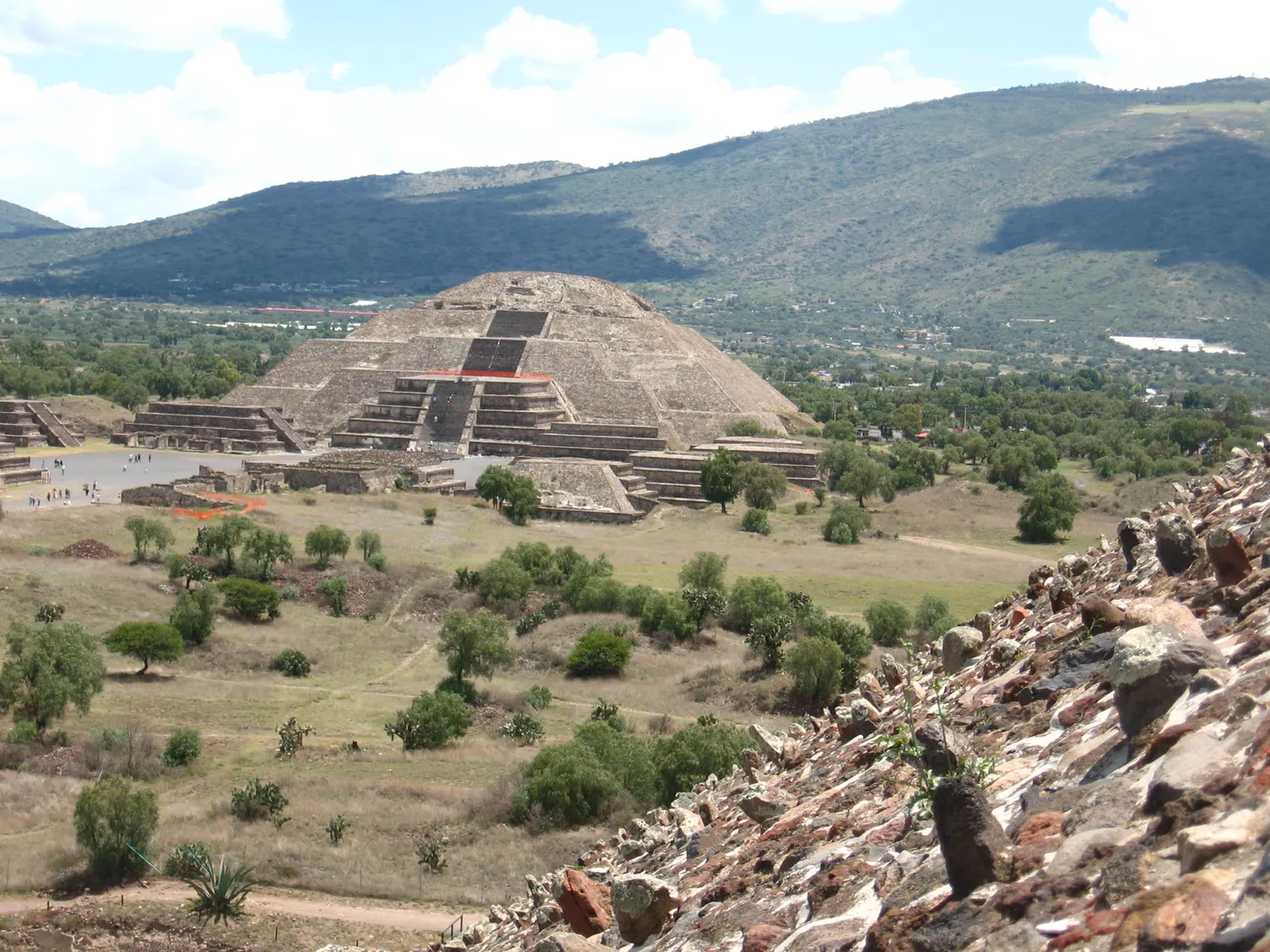
Teotihuacán, located northeast of modern-day Mexico City, was one of the largest cities in the world around 300 CE. Syced / Wikimedia Commons (CC0).
Two of the most important ancient civilizations in the Americas were Teotihuacán and the Maya. By 300 CE, both had developed advanced urban centers, complex societies, and unique cultural traditions. These civilizations shaped the history of Mesoamerica, the region that includes parts of present-day Mexico and Central America.
Teotihuacán, located northeast of modern-day Mexico City, was one of the largest cities in the world around 300 CE. Its population may have reached over 100,000 people. Archaeologists have discovered massive pyramids, broad avenues, and colorful murals in the city. The Pyramid of the Sun, built from stone and earth, still stands today as a sign of the city's power. Teotihuacán was a center for trade, connecting distant regions through a network of markets. Its residents lived in multi-family apartment compounds and followed a social hierarchy—from rulers and priests to merchants, artisans, and farmers. The city's religious life focused on several gods, including the Feathered Serpent. Evidence from murals and pottery shows that Teotihuacán influenced art and religion across Mesoamerica.
The Maya civilization thrived in the rainforests of present-day Guatemala, Belize, Honduras, and southern Mexico. Instead of one large city, the Maya built many independent city-states like Tikal, Palenque, and Copán. Each city-state had its own king and government. The Maya are famous for their writing system of glyphs, which recorded history, rituals, and the lives of rulers. Archaeologists have found carved stelae and books called codices, which provide evidence about Maya politics and daily life. The Maya developed an advanced calendar and made discoveries in astronomy and mathematics. Their society was organized by class, with kings and nobles at the top, followed by scribes, artisans, and farmers.
Both Teotihuacán and the Maya depended on their environment for resources. Teotihuacán used the nearby mountains and rivers for agriculture and trade, while the Maya adapted to rainforest conditions by building raised fields and reservoirs. Over time, both civilizations faced challenges. Teotihuacán declined after 550 CE, possibly due to internal conflict, drought, or invasion. Some Maya cities fell in the 800s and 900s, likely because of war, environmental stress, and changing trade routes, though other Maya communities survived for centuries more.
The accomplishments of Teotihuacán and the Maya had a lasting impact on later cultures in the Americas. Their art, architecture, writing, and religious beliefs influenced generations. Archaeological discoveries—like murals in Teotihuacán or glyphs in Maya cities—help historians understand how people lived, worked, and governed. Today, the ruins of these ancient cities remind us of the complexity and creativity of early American civilizations.
These civilizations demonstrate how geography, resources, and human choices shaped the rise and fall of societies. Studying Teotihuacán and the Maya helps us explore larger themes of change, continuity, and cultural achievement in world history.
Interesting Fact: The Maya invented the concept of zero in mathematics, hundreds of years before it appeared in Europe.
Comprehension quiz (8 questions)
1. Where was Teotihuacán located?
2. What did Maya city-states have?
3. What is the Pyramid of the Sun?
4. Why did Teotihuacán decline?
5. How did Maya adapt to their environment?
6. What did both civilizations have in common?
7. Teotihuacán's murals influenced other cultures. True or False?
8. What is a 'hierarchy'?
Perfect for the way you teach
- Build comprehension skills
- Auto-graded quiz
- Differentiated reading
- Read together at home
- Improve fluency
- Quiet reading time
- Reading curriculum support
- Independent practice
- Track Lexile growth