This learning resource is available in interactive and printable formats. The interactive worksheet can be played online and assigned to students. The Printable PDF version can be downloaded and printed for completion by hand.
This rigorous reading passage explores the Abbasid Golden Age, a remarkable period in world Middle Eastern history when Baghdad became a global center for science, mathematics, and culture. Students will learn about the contributions of scholars, the translation movement, and how geography and society shaped advancements in medicine, astronomy, and literature. The passage includes a glossary, timeline, graphic organizers, and activities aligned to CA HSS 7.2.5 and CCSS RH.6-8.2, CCSS RH.6-8.4, CCSS RH.6-8.7. The resource is designed for use in world and world history curricula and features a read aloud audio option and a complete Spanish translation to support diverse learners. This engaging content challenges students to analyze historical change, continuity, and cause-and-effect while building academic vocabulary and critical literacy.
CONTENT PREVIEW
Expand content preview
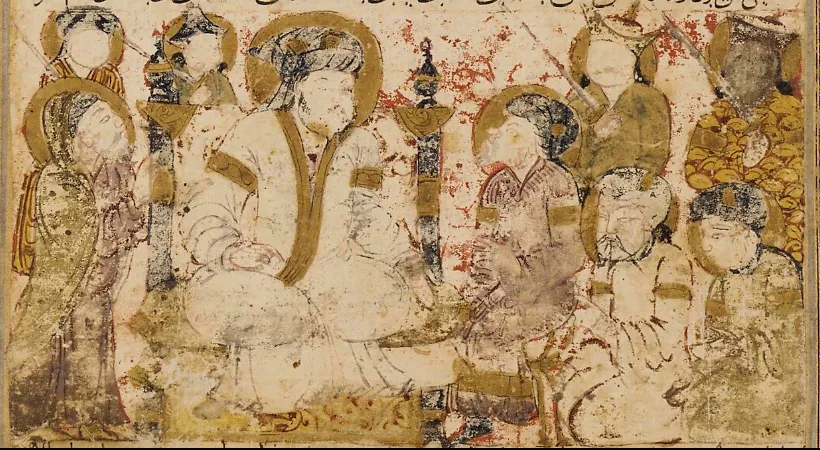
"Balami - Tarikhnama - Abu'l-'Abbas al-Saffah is proclaimed the first 'Abbasid Caliph by Abu Ali Bal'ami / Wikimedia Commons
The Abbasid Golden Age refers to a period from the mid-8th to the 13th century CE, when the Islamic world, especially the city of Baghdad, became a global center of knowledge, scientific discovery, and cultural exchange. The Abbasid Caliphate, which ruled much of Southwestern Asia and North Africa, encouraged learning and welcomed scholars from many lands. This era is known for significant advancements in science, mathematics, medicine, literature, and philosophy that deeply influenced later civilizations.
The Abbasid Caliphs built Baghdad along the Tigris River in 762 CE. Its location was chosen for its access to trade routes and fertile lands. The city quickly grew into a cosmopolitan center, attracting skilled artisans, writers, and scientists. The House of Wisdom, founded in the early 9th century, became famous for its collection of books and as a hub for translation and original research. Scholars translated important works from Greek, Persian, and Indian sources, making them available in Arabic. For example, the mathematician al-Khwarizmi, working in Baghdad around 820 CE, wrote influential texts on algebra and introduced the Hindu-Arabic numeral system to the Islamic world.
Advancements in science and medicine were supported by the Abbasid belief that gaining knowledge was an important religious and social duty. Physicians like al-Razi (Rhazes) and Ibn Sina (Avicenna) made breakthroughs in diagnosing and treating diseases, compiling medical encyclopedias that were used for centuries. Astronomers at observatories in Baghdad and Damascus mapped the stars, calculated the earth's circumference, and improved navigation techniques. Libraries were filled with manuscripts, and poets such as al-Mutanabbi contributed to a flourishing of Arabic literature.
Social life in the Abbasid Caliphate reflected the diversity of its empire. While caliphs and wealthy patrons supported scholars and artists, daily life for most people was shaped by trade, agriculture, and religious practice. The translation movement allowed knowledge from many cultures—Greek, Indian, Persian—to merge with Islamic ideas, creating a unique intellectual tradition. Over time, the empire faced political challenges, but many of its cultural and scientific achievements continued to influence Europe and Asia long after the Abbasid period ended.
The Abbasid Golden Age is significant because it preserved ancient knowledge, inspired new discoveries, and showed how the exchange of ideas across societies can lead to historic achievements. It highlights the connections between geography, social structure, and innovation in world history.
Interesting Fact: The word "algorithm" comes from the name of al-Khwarizmi, whose work in Baghdad shaped the future of mathematics and computer science.
When was Baghdad founded?
762 CE820 CE750 CE900 CE
Who wrote about algebra in Baghdad?
Ibn Sinaal-Khwarizmial-Razial-Mutanabbi
What was the House of Wisdom?
A palaceA library and research centerA mosqueA market
How did geography help Baghdad grow?
It was near trade routesIt was on a mountainIt had gold minesIt was close to the sea
Why did the Abbasids support knowledge?
For religious and social dutyTo conquer landsTo build palacesTo make weapons
What effect did translation have?
Spread knowledge from other culturesStarted warsDestroyed old booksStopped trade
The Abbasid Golden Age ended in the 13th century. True or false?
TrueFalse
What does 'cosmopolitan' mean?
From one cultureFrom many culturesA type of foodA style of art
Perfect For:
👩🏫 Teachers
• Reading comprehension practice
• Auto-graded assessments
• Literacy skill development
👨👩👧👦 Parents
• Reading practice at home
• Comprehension improvement
• Educational reading time
🏠 Homeschoolers
• Reading curriculum support
• Independent reading practice
• Progress monitoring
Reading Features:
📖
Reading Passage
Engaging fiction or nonfiction text
❓
Comprehension Quiz
Auto-graded questions
📊
Instant Feedback
Immediate results and scoring
📄
Printable Version
Download for offline reading
🔊
Read Aloud
Voice-over with word highlighting
Reviews & Ratings
No reviews yet. Be the first to share your experience!
Related Content
Ancient Civilizations and the Environment
This engaging history reading passage explores how ancient civilizations such as Mesopotamia, Egypt, and the Maya adapte...
Gender Roles in Ancient Civilizations
This engaging history reading passage explores the roles of men and women in various ancient civilizations, including Me...
Writing Prompts Ancient Civilizations
Step into the shoes of an archaeologist with this engaging worksheet focused on ancient civilizations. Students will be ...
W.5.2.A-2W.5.1.CW.5.1.D
Power and Authority in Ancient Civilizations
This passage explores the roles of men in positions of power within ancient civilizations, focusing on their authority i...
Ancient Monarchy
This reading passage explores the concept of monarchy in ancient civilizations, focusing on the origins, structure, and ...
Evidence in Ancient History
This engaging history reading passage investigates how archaeologists and historians discover clues about how ancient pe...
Ancient Theocracy
This engaging history reading passage explores the concept of theocracy in ancient civilizations, where priests and reli...
Ancient Mathematics
This passage explores the essential role of mathematics in ancient civilizations, including Mesopotamia, Egypt, Greece, ...
Ancient Canaan
This educational passage explores the land of Canaan, the historical homeland of the ancient Israelites. Students will l...
Ancient Money Barter
This passage explores the fascinating evolution from barter to the earliest coins in ancient civilizations, focusing on ...
Ancient Science and Medicine
This comprehensive reading passage explores the development of science and medicine in ancient civilizations, including ...
Ancient Literature
This passage explores the importance of ancient stories and poems from civilizations such as Greece, India, and Israel. ...
Ancient Agriculture Farming
This passage explores the transformative impact of farming on ancient societies, examining how the Neolithic Revolution ...
Ancient Writing Systems
This engaging history reading passage explores the origins and evolution of ancient writing systems, including cuneiform...
Geography of Ancient Israel
This passage explores the rich geography of Ancient Israel, focusing on how landforms, climate, and natural resources sh...
Slavery Across Civilizations
This detailed history reading passage explores the role and impact of slavery across several ancient civilizations, incl...
Social Classes in Ancient Societies
This passage explores the concept of social hierarchies in ancient civilizations, focusing on why societies such as Meso...
Social structures in Ancient World
This passage explores the organization and significance of family life in ancient societies, focusing on how extended fa...
Polytheism and Monotheism in Ancient Times
This passage explores the religious beliefs of ancient civilizations, focusing on the differences and similarities betwe...
Women in Ancient Societies
This reading passage explores the complex roles of women in the ancient world, focusing on civilizations such as Mesopot...