This learning resource is available in interactive and printable formats. The interactive worksheet can be played online and assigned to students. The Printable PDF version can be downloaded and printed for completion by hand.
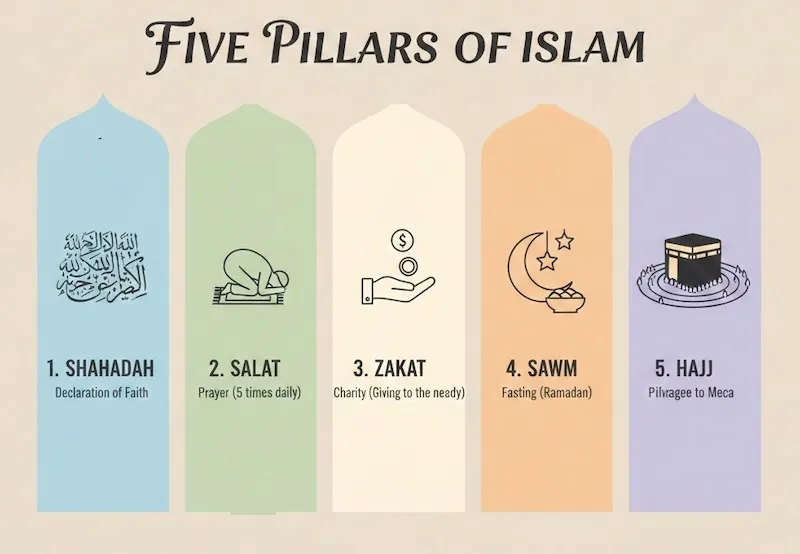
This passage explores the significance of the Five Pillars of Islam, a foundational set of practices in the religion that originated in the world Middle East. Students will gain an understanding of each pillar—Shahada, Salat, Zakat, Sawm, and Hajj—along with their historical and cultural context. The passage discusses the geographic roots of Islam in the Arabian Peninsula, its impact on daily life and social organization, and provides examples from primary sources such as early Islamic texts and archaeological findings. It is designed for use in classrooms and aligns with CA HSS 6.2 and 7.2, and CCSS RH.6-8.1 standards. Also included are activities, a glossary, quiz, graphic organizers, and a Spanish translation, making it accessible for diverse learners. A read aloud audio feature supports differentiated instruction and English Language Learners. This resource is ideal for students studying world civilizations, world religions, and the history of Southwestern Asia.
CONTENT PREVIEW
Expand content preview
The religion of Islam began in the Arabian Peninsula in the early 7th century CE. Its followers, called Muslims, believe that the Prophet Muhammad received messages from God, or Allah, in the city of Mecca. These messages, later collected in the Qur'an, form the foundation of Islamic belief. Central to this belief are the Five Pillars of Islam, a set of core duties that guide the lives of Muslims worldwide.
The Five Pillars of Islam are Shahada (declaration of faith), Salat (ritual prayer), Zakat (charity), Sawm (fasting during Ramadan), and Hajj (pilgrimage to Mecca). Each pillar represents a distinct form of worship and obligation. For example, the Shahada requires Muslims to publicly declare their faith in one God and Muhammad as his messenger. The Salat involves praying five times a day at specific times, often facing the Kaaba, a sacred structure located in Mecca. Archaeological evidence, such as early mosques discovered in Arabia, confirms that the direction of prayer was important from the earliest days of Islam.
The third pillar, Zakat, is the giving of a portion of one’s wealth to those in need. This practice helped create a sense of social responsibility and reduced economic inequality within early Muslim communities. One example from the 8th century shows how the Umayyad Caliphate established official tax collectors to ensure Zakat was distributed fairly. The fourth pillar, Sawm, calls for fasting during the month of Ramadan. During this time, Muslims refrain from eating and drinking from sunrise to sunset to develop self-control and empathy for the less fortunate. Historical texts and diaries from travelers like Ibn Battuta describe how Ramadan was observed across different regions, showing both continuity and adaptation over time.
The fifth pillar, Hajj, is the pilgrimage to Mecca that every Muslim is expected to make at least once if able. The Hajj occurs annually and draws millions of people from around the world. Archaeologists have uncovered ancient routes and rest stations that pilgrims used for centuries to reach Mecca. The rituals performed during Hajj, such as circling the Kaaba and standing on the Plain of Arafat, have remained largely unchanged since the time of Muhammad in the 600s CE.
The Five Pillars not only define individual religious duties but also shape the social and cultural fabric of Muslim societies. They promote unity, compassion, and a shared sense of purpose. Studying the Five Pillars helps historians understand how Islam spread rapidly across Southwestern Asia and beyond, influencing law, daily routines, and social hierarchy in ancient civilizations.
The Five Pillars of Islam connect to broader themes in ancient history, such as the role of religion in shaping societies and the impact of geography on cultural practices.
Interesting Fact: The Hajj pilgrimage gathers more than two million Muslims from over 180 countries each year, making it one of the largest annual gatherings in the world.
Where did Islam begin?
Arabian PeninsulaIndiaChinaEurope
What is the name of Islam's holy book?
Qur'anTorahBibleVedas
How many times do Muslims pray daily?
FiveThreeSevenOne
Why is Zakat important?
Promotes charity and fairnessIncreases wealthIs a type of prayerMarks the new year
What is the purpose of Sawm (fasting)?
Develops self-controlShows braveryCelebrates harvestMarks a birthday
How did geography impact the Hajj?
Pilgrims traveled ancient desert routesIt stopped the pilgrimageIt caused warsIt changed the Qur'an
The Five Pillars are only for leaders. True or false?
TrueFalse
What does 'hierarchy' mean?
A ranking systemA prayer ritualA sacred buildingA pilgrimage route
Perfect For:
👩🏫 Teachers
• Reading comprehension practice
• Auto-graded assessments
• Literacy skill development
👨👩👧👦 Parents
• Reading practice at home
• Comprehension improvement
• Educational reading time
🏠 Homeschoolers
• Reading curriculum support
• Independent reading practice
• Progress monitoring
Reading Features:
📖
Reading Passage
Engaging fiction or nonfiction text
❓
Comprehension Quiz
Auto-graded questions
📊
Instant Feedback
Immediate results and scoring
📄
Printable Version
Download for offline reading
🔊
Read Aloud
Voice-over with word highlighting
Reviews & Ratings
No reviews yet. Be the first to share your experience!
Related Content
Ancient Civilizations and the Environment
This engaging history reading passage explores how ancient civilizations such as Mesopotamia, Egypt, and the Maya adapte...
Gender Roles in Ancient Civilizations
This engaging history reading passage explores the roles of men and women in various ancient civilizations, including Me...
Writing Prompts Ancient Civilizations
Step into the shoes of an archaeologist with this engaging worksheet focused on ancient civilizations. Students will be ...
W.5.2.A-2W.5.1.CW.5.1.D
Power and Authority in Ancient Civilizations
This passage explores the roles of men in positions of power within ancient civilizations, focusing on their authority i...
Evidence in Ancient History
This engaging history reading passage investigates how archaeologists and historians discover clues about how ancient pe...
Ancient Monarchy
This reading passage explores the concept of monarchy in ancient civilizations, focusing on the origins, structure, and ...
Ancient Theocracy
This engaging history reading passage explores the concept of theocracy in ancient civilizations, where priests and reli...
Ancient Mathematics
This passage explores the essential role of mathematics in ancient civilizations, including Mesopotamia, Egypt, Greece, ...
Ancient Canaan
This educational passage explores the land of Canaan, the historical homeland of the ancient Israelites. Students will l...
Ancient Money Barter
This passage explores the fascinating evolution from barter to the earliest coins in ancient civilizations, focusing on ...
Ancient Science and Medicine
This comprehensive reading passage explores the development of science and medicine in ancient civilizations, including ...
Ancient Literature
This passage explores the importance of ancient stories and poems from civilizations such as Greece, India, and Israel. ...
Ancient Agriculture Farming
This passage explores the transformative impact of farming on ancient societies, examining how the Neolithic Revolution ...
Ancient Writing Systems
This engaging history reading passage explores the origins and evolution of ancient writing systems, including cuneiform...
Geography of Ancient Israel
This passage explores the rich geography of Ancient Israel, focusing on how landforms, climate, and natural resources sh...
Slavery Across Civilizations
This detailed history reading passage explores the role and impact of slavery across several ancient civilizations, incl...
Social Classes in Ancient Societies
This passage explores the concept of social hierarchies in ancient civilizations, focusing on why societies such as Meso...
Social structures in Ancient World
This passage explores the organization and significance of family life in ancient societies, focusing on how extended fa...
Polytheism and Monotheism in Ancient Times
This passage explores the religious beliefs of ancient civilizations, focusing on the differences and similarities betwe...
Women in Ancient Societies
This reading passage explores the complex roles of women in the ancient world, focusing on civilizations such as Mesopot...