The Kingdom Divides: Israel and Judah — Reading Comprehension
Rate this
Premium Resource
Present
Present in classroom. No work saved
Assign
Classroom with student accounts, Track progress
Quick Play
No student accounts, assign with a link
Grades
5
6
7
8
PRINT+DIGITAL RESOURCE
This learning resource is available in interactive and printable formats. The interactive worksheet can be played online and assigned to students. The Printable PDF version can be downloaded and printed for completion by hand.
This engaging passage, 'The Kingdom Divides: Israel and Judah,' guides students through the dramatic split of ancient Israel into two kingdoms after King Solomon’s reign. The text explores the causes, events, and impacts of this division, focusing on figures like Rehoboam and Jeroboam, and connecting the story to archaeological evidence. Students will analyze change over time, cause-and-effect relationships, and the significance of this period in the context of the ancient Near East. Academic vocabulary is highlighted and explained. The resource includes a glossary, timeline, multiple-choice quiz, writing prompts, two graphic organizers, and a Spanish translation, making it accessible and rigorous for diverse learners. This history reading passage aligns with CA HSS 6.3 and CCSS RH.6-8.1, and features audio read-aloud support for all learners.
CONTENT PREVIEW
Expand content preview
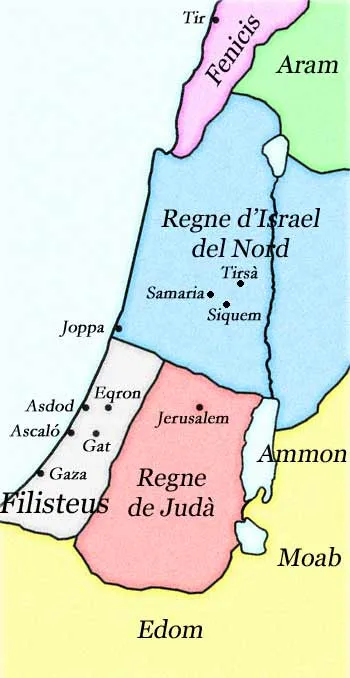
"Israel i Judà" by Selfmade / Wikimedia Commons
The ancient kingdom of Israel split into two separate kingdoms, Israel and Judah, around 930 BCE after the death of King Solomon. This division shaped the political and religious history of the region for centuries. The causes of this split reveal how leadership, geography, and social tensions can transform a nation.
King Solomon, known for his wisdom and grand building projects, ruled a united Israel with its capital in Jerusalem. However, his policies burdened the people with heavy taxes and forced labor. After Solomon died, his son Rehoboam became king. According to the Hebrew Bible, representatives from the northern tribes asked Rehoboam to lighten their labor and taxes. Rehoboam refused, insisting on even harsher treatment. This decision angered the northern tribes, leading to a major revolt.
Jeroboam, a former official under Solomon, became the leader of the northern tribes. The ten northern tribes broke away and formed a new kingdom called Israel, with its capital at Shechem and later Samaria. The southern tribes, mainly Judah and Benjamin, remained loyal to Rehoboam and kept Jerusalem as their capital. Archaeological evidence, such as ancient city walls in Samaria and Jerusalem, supports the existence of these two distinct kingdoms. The division also created religious tensions. Jeroboam established new centers of worship at Bethel and Dan to keep his people from traveling to Jerusalem, which led to controversies over religious practices.
The split between Israel and Judah had long-lasting consequences. Both kingdoms faced threats from powerful neighbors, such as Egypt and Assyria. The Kingdom of Israel fell to the Assyrians in 722 BCE, and many Israelites were exiled. Judah survived longer, but it was eventually conquered by the Babylonians in 586 BCE. Despite these challenges, both kingdoms maintained unique cultural and religious identities. Primary sources like the Hebrew Bible, Assyrian records, and archaeological discoveries help historians piece together this complex period.
The division of Israel and Judah demonstrates how internal conflict and external pressures can reshape history. It shows the importance of leadership choices, social unity, and geography in the fate of civilizations. This story connects to broader themes of ancient history, such as the rise and fall of kingdoms, the role of religion, and the struggles of ordinary people.
Interesting Fact: The term "Ten Lost Tribes" refers to the Israelites from the northern kingdom who disappeared from history after the Assyrian conquest.
Who was king after Solomon?
RehoboamJeroboamDavidNebuchadnezzar
What city was the capital of Judah?
JerusalemSamariaBethelShechem
Who conquered the kingdom of Israel?
The AssyriansThe BabyloniansThe EgyptiansThe Persians
Why did the northern tribes rebel?
High taxes and harsh laborReligious freedomForeign invasionLack of land
What was a result of the split?
Two kingdoms formedPeace with neighborsA new religionA united monarchy
What did Jeroboam do for worship?
Built new worship centersDestroyed templesMoved capital to JerusalemBanned religious practices
The split happened after Solomon's death. (True/False)
TrueFalse
What does 'exile' mean?
Forced removal from homelandTo celebrate a festivalTo build a cityTo farm the land
Perfect For:
👩🏫 Teachers
• Reading comprehension practice
• Auto-graded assessments
• Literacy skill development
👨👩👧👦 Parents
• Reading practice at home
• Comprehension improvement
• Educational reading time
🏠 Homeschoolers
• Reading curriculum support
• Independent reading practice
• Progress monitoring
Reading Features:
📖
Reading Passage
Engaging fiction or nonfiction text
❓
Comprehension Quiz
Auto-graded questions
📊
Instant Feedback
Immediate results and scoring
📄
Printable Version
Download for offline reading
🔊
Read Aloud
Voice-over with word highlighting
Reviews & Ratings
No reviews yet. Be the first to share your experience!
Related Content
Ancient Civilizations and the Environment
This engaging history reading passage explores how ancient civilizations such as Mesopotamia, Egypt, and the Maya adapte...
Gender Roles in Ancient Civilizations
This engaging history reading passage explores the roles of men and women in various ancient civilizations, including Me...
Writing Prompts Ancient Civilizations
Step into the shoes of an archaeologist with this engaging worksheet focused on ancient civilizations. Students will be ...
W.5.2.A-2W.5.1.CW.5.1.D
Power and Authority in Ancient Civilizations
This passage explores the roles of men in positions of power within ancient civilizations, focusing on their authority i...
Evidence in Ancient History
This engaging history reading passage investigates how archaeologists and historians discover clues about how ancient pe...
Ancient Monarchy
This reading passage explores the concept of monarchy in ancient civilizations, focusing on the origins, structure, and ...
Ancient Theocracy
This engaging history reading passage explores the concept of theocracy in ancient civilizations, where priests and reli...
Ancient Mathematics
This passage explores the essential role of mathematics in ancient civilizations, including Mesopotamia, Egypt, Greece, ...
Ancient Canaan
This educational passage explores the land of Canaan, the historical homeland of the ancient Israelites. Students will l...
Ancient Money Barter
This passage explores the fascinating evolution from barter to the earliest coins in ancient civilizations, focusing on ...
Ancient Science and Medicine
This comprehensive reading passage explores the development of science and medicine in ancient civilizations, including ...
Ancient Literature
This passage explores the importance of ancient stories and poems from civilizations such as Greece, India, and Israel. ...
Ancient Agriculture Farming
This passage explores the transformative impact of farming on ancient societies, examining how the Neolithic Revolution ...
Ancient Writing Systems
This engaging history reading passage explores the origins and evolution of ancient writing systems, including cuneiform...
Geography of Ancient Israel
This passage explores the rich geography of Ancient Israel, focusing on how landforms, climate, and natural resources sh...
Slavery Across Civilizations
This detailed history reading passage explores the role and impact of slavery across several ancient civilizations, incl...
Social Classes in Ancient Societies
This passage explores the concept of social hierarchies in ancient civilizations, focusing on why societies such as Meso...
Social structures in Ancient World
This passage explores the organization and significance of family life in ancient societies, focusing on how extended fa...
Polytheism and Monotheism in Ancient Times
This passage explores the religious beliefs of ancient civilizations, focusing on the differences and similarities betwe...
Women in Ancient Societies
This reading passage explores the complex roles of women in the ancient world, focusing on civilizations such as Mesopot...