The Mongol Empire Connects Asia β Reading Comprehension
Rate this
Premium Resource
Present
Present in classroom. No work saved
Assign
Classroom with student accounts, Track progress
Quick Play
No student accounts, assign with a link
Grades
5
6
7
8
PRINT+DIGITAL RESOURCE
This learning resource is available in interactive and printable formats. The interactive worksheet can be played online and assigned to students. The Printable PDF version can be downloaded and printed for completion by hand.
This passage explores the rise and impact of the Mongol Empire, one of the largest empires in world history. It examines how the Mongols, under leaders like Genghis Khan and Kublai Khan, connected distant regions of Asia through conquest and the creation of a vast trade network known as the Silk Road. Students will learn about primary sources, archaeological evidence, and the ways the empire shaped cultural exchange, economic growth, and daily life for millions. The content aligns with CA HSS 6.7 and Common Core standards RH.6-8.1, RH.6-8.2, and RH.6-8.4, supporting skills in historical analysis, reading comprehension, and critical thinking. Includes a read aloud audio option, Spanish translation, and engaging activities for deeper understanding.
CONTENT PREVIEW
Expand content preview
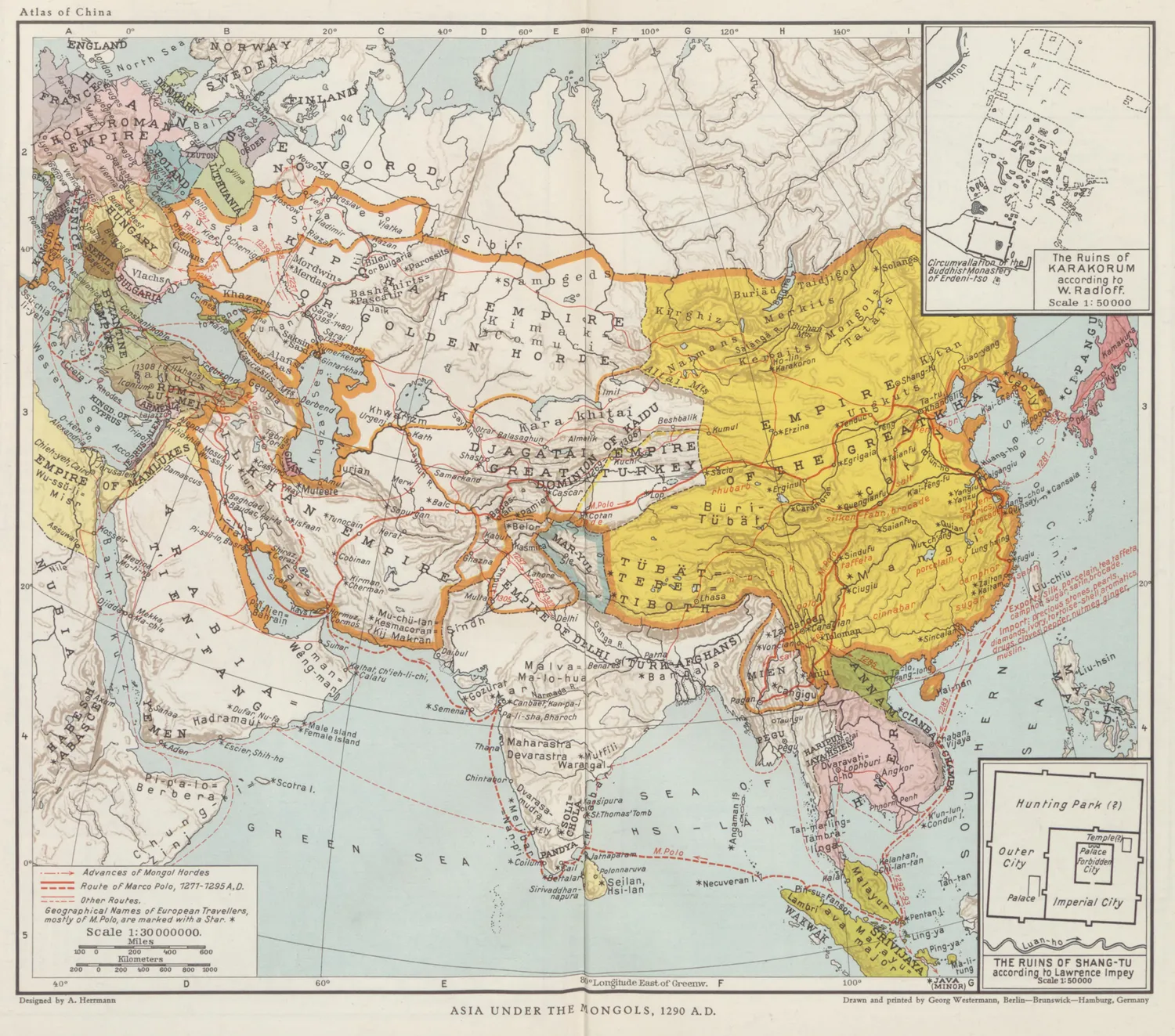
"Asia under the Mongols 1290 AD" by Albert Herrmann & Georg Westermann / Source: Wikimedia Commons (Public domain).
The Mongol Empire was the largest contiguous land empire in history, stretching from Eastern Europe across Asia between the 13th and 14th centuries. Founded by Genghis Khan in 1206, the Mongols united many nomadic tribes and rapidly conquered vast territories. Their empire included lands that today are China, Mongolia, Russia, Iran, and parts of Eastern Europe.
The Mongols changed history by creating a network of connections across continents. Under Genghis Khan and his descendants, they built a powerful military that used superior tactics such as swift cavalry attacks and psychological warfare. Their armies captured important cities, like Beijing (then called Khanbaliq) in 1215. Primary sources, such as the travel writings of Marco Polo, describe how the Mongols ruled with both strict laws and religious tolerance. Archaeological finds, including coins and pottery along the Silk Road, show the spread of goods and ideas during this period.
Trade and cultural exchange flourished under Mongol rule. The Pax Mongolica, or "Mongol Peace," made it safer for merchants, travelers, and diplomats to cross Asia. The empire improved roads, built relay stations, and protected caravans. Items like silk, spices, and paper moved from China to Europe, while knowledge about astronomy, medicine, and mathematics traveled in both directions. For example, the Persian historian Rashid al-Din wrote detailed accounts of Mongol society and their impact on global commerce. The Mongols also encouraged different peoples to communicate, creating a unique blend of cultures in major cities like Samarkand and Baghdad.
However, Mongol rule brought both positive and negative effects. While the empire led to economic growth and cultural exchange, it also caused destruction in cities that resisted, and many people were killed in battles. The Mongol social structure placed Mongols and their allies above conquered peoples, but there was still some room for talented individuals from many backgrounds to rise in society. Over time, the empire weakened and divided into separate khanates, each ruled by different descendants of Genghis Khan.
The Mongol Empire's legacy is still felt today. By connecting distant regions, they changed the course of world history and set the stage for even greater exchange between East and West in later centuries. Studying the Mongols helps us understand how geography, leadership, and technology shape the rise and fall of empires.
Interesting Fact: The Mongols used a sophisticated postal system called the Yam, which allowed messages to travel across thousands of miles in just a few days.