The Mughal Empire Rules India with Cannons
Interactive passage with audio narration, comprehension questions, and printable PDF.
By completing this purchase you agree to our Terms of Use and Privacy Policy. Your subscription renews automatically until you cancel. You can cancel anytime from your account settings. All sales are final and non-refundable. Digital content is available for download in your account immediately upon purchase.
What's included
The Mughal Empire Rules India with Cannons preview and details
About this printable The Mughal Empire Rules India with Cannons reading passage (Grades 5-8)
Sample passage and quiz from The Mughal Empire Rules India with Cannons
Reading passage and comprehension quiz preview
The Mughal Empire Rules India with Cannons
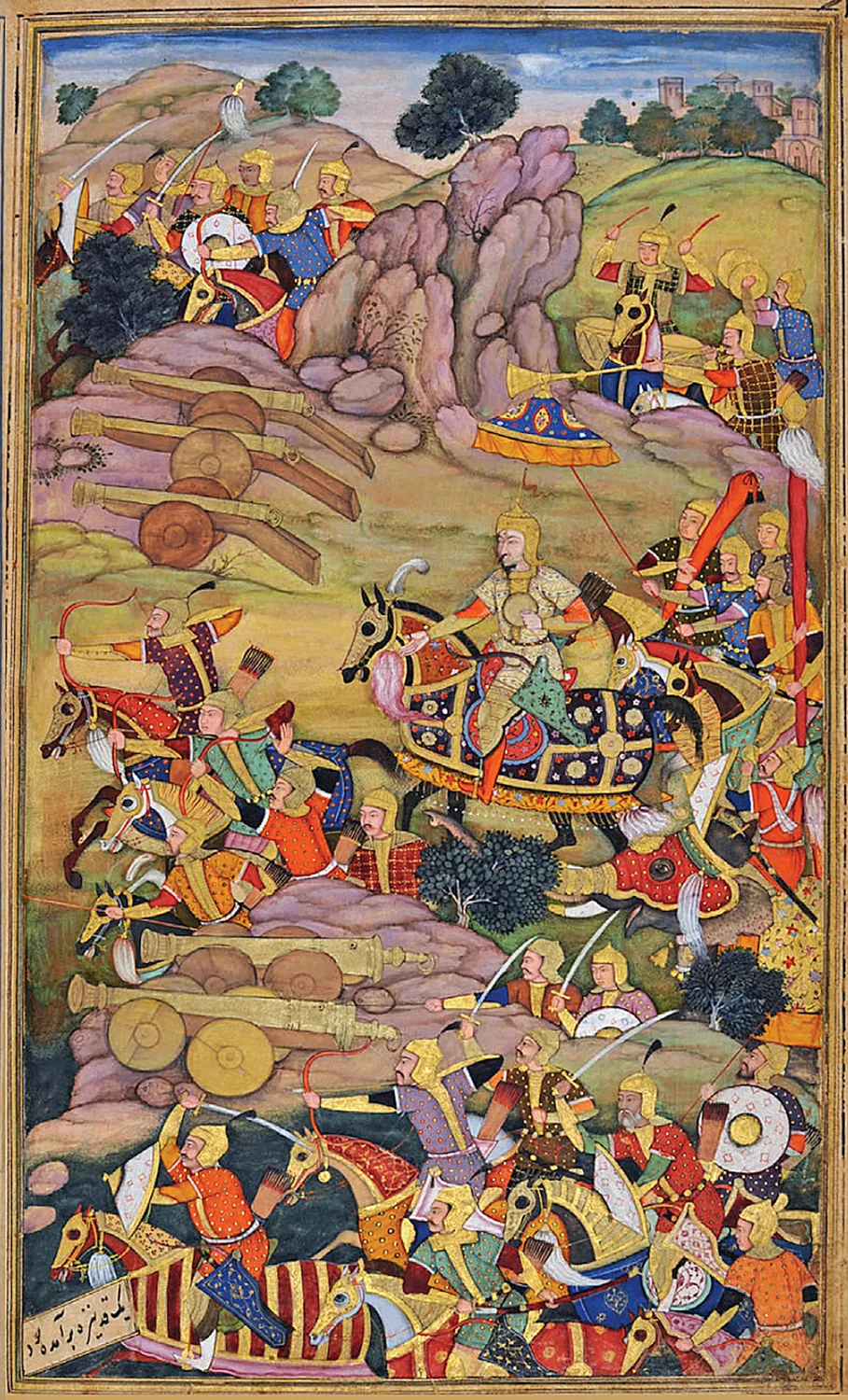
"1526-First Battle of Panipat-Ibrahim Lodhi and Babur" by Painters of Babur /
Source: Wikimedia Commons (Public domain).
The Mughal Empire changed the future of India by introducing new military technology and creating a powerful, multicultural state. In the early 1500s, Babur, a descendant of Timur and Genghis Khan, led his army from Central Asia into northern India. Babur’s forces used gunpowder weapons, especially cannons, for the first time in Indian warfare. This technological advantage helped Babur win the Battle of Panipat in 1526, defeating the much larger army of the Delhi Sultanate and establishing Mughal rule.
Babur’s victory at Panipat marked the beginning of a new era. The Mughal army’s use of firearms and cannons shocked Indian rulers, who still relied mainly on elephants and swords. Archaeological studies of Panipat’s battlefield have uncovered remains of cannonballs and fragments of early guns, confirming historical accounts. The Mughals adapted to India’s geography by building strong fortifications and organizing their armies for both open battles and sieges. Their military innovations allowed the empire to expand rapidly across the Indian subcontinent.
Under Babur’s grandson, Akbar the Great, the Mughal Empire reached its height. Akbar modernized the army by recruiting soldiers from many backgrounds and training them with the latest weapons. He encouraged the use of artillery and supported engineers who improved cannon design. The empire’s capital cities, like Agra and Fatehpur Sikri, became centers of trade, learning, and religious tolerance. Akbar’s court records describe massive cannons used to defend forts and intimidate enemies. However, Mughal success was not just about technology. Akbar’s policies of religious tolerance and fair taxation helped unite different people, making the empire strong.
The Mughal Empire’s advanced military and inclusive government brought stability to much of India for nearly 200 years. Mughal rule changed daily life for millions, from farmers to nobles. The empire’s wealth supported art, architecture, and science, leaving a legacy that can still be seen in landmarks like the Taj Mahal. However, over time, maintaining such a large empire proved difficult. New rivals, including European powers with their own gunpowder weapons, challenged Mughal control by the 1700s.
The story of the Mughal Empire shows how technology and leadership can shape history. It connects to broader themes of change, cultural blending, and the rise and fall of empires studied in world history.
Interesting Fact: The Mughal emperor Akbar’s largest cannon, called Fatehpur, was so massive that it took a team of elephants to move it.
Comprehension quiz (8 questions)
1. Who led the Mughal army into India?
2. Which battle started Mughal rule?
3. What technology did the Mughals use in war?
4. What did Akbar do to strengthen the empire?
5. Why were Mughal cannons important?
6. How did the empire’s size affect its future?
7. The Mughals used elephants instead of cannons.
8. What does 'fortifications' mean?
Perfect for the way you teach
- Build comprehension skills
- Auto-graded quiz
- Differentiated reading
- Read together at home
- Improve fluency
- Quiet reading time
- Reading curriculum support
- Independent practice
- Track Lexile growth