This learning resource is available in interactive and printable formats. The interactive worksheet can be played online and assigned to students. The Printable PDF version can be downloaded and printed for completion by hand.
This passage introduces students to the epic of the Ramayana and its role in teaching the concept of dharma within ancient Indian society. Students will learn about the story’s main characters, such as Rama, Sita, and Ravana, and analyze how the Ramayana influenced social norms, daily life, and moral behavior. The passage integrates archaeological and literary evidence to provide a deep understanding of the Ramayana’s historical context and cultural significance. Accompanied by a timeline, glossary, comprehension activities, graphic organizers, and a Spanish translation, this resource supports CA HSS 6.1 and CCSS RI.6-8. It also provides a read-aloud audio option for accessibility. This comprehensive lesson is ideal for exploring ancient civilizations and world religions, and for developing students’ skills in historical analysis, critical thinking, and academic vocabulary.
CONTENT PREVIEW
Expand content preview
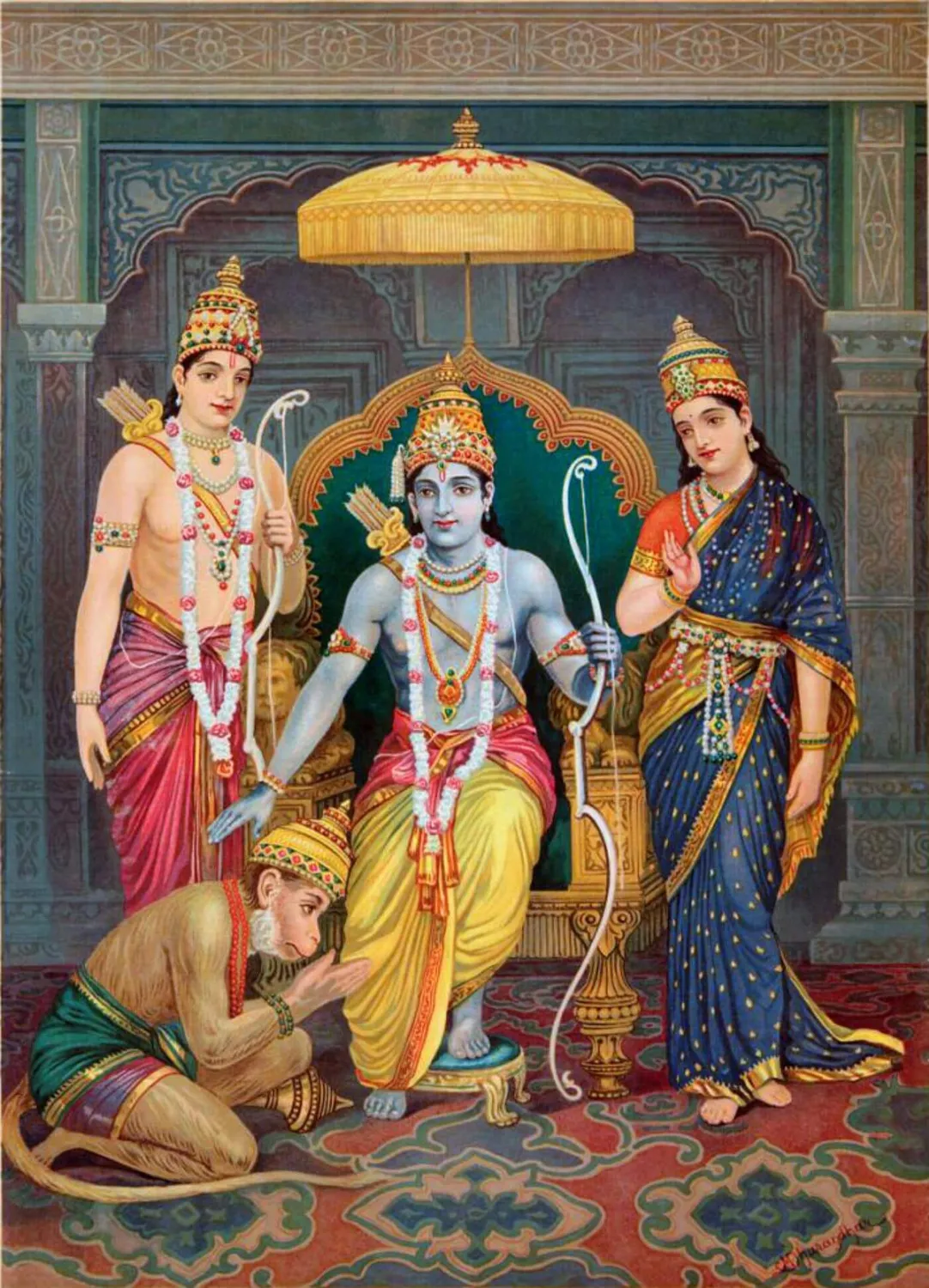
"Sree Raghunandan - Ram Laxman Sita and Hanuman, M. V. Dhurandhar (1867- 1944) / Source: Wikimedia Commons (Public domain).
The Ramayana is one of the oldest and most important epics of ancient India. Composed in Sanskrit by the poet Valmiki around the 5th to 4th century BCE, the Ramayana tells the story of Prince Rama, his wife Sita, and his brother Lakshmana. The epic's setting spans the ancient kingdoms of Ayodhya and Lanka, offering a window into the beliefs and daily life of Indian society over two thousand years ago.
At the heart of the Ramayana is the concept of dharma. In Hindu tradition, dharma refers to the moral and social duties that guide how people should act. Throughout the Ramayana, characters face difficult choices that test their commitment to dharma. For example, Rama obeys his father’s command to go into exile for fourteen years, even though it means giving up his right to the throne. Sita, his wife, chooses to follow Rama into the forest, displaying loyalty and devotion. These actions illustrate how personal sacrifice and duty are valued in ancient Indian culture.
The Ramayana is filled with dramatic events. The demon king Ravana kidnaps Sita and takes her to his kingdom of Lanka. With the help of his loyal brother Lakshmana and the monkey general Hanuman, Rama embarks on a quest to rescue Sita. The epic features vivid descriptions of battles, alliances, and journeys, including Hanuman leaping across the ocean to find Sita. Archaeological evidence, such as ancient temples and stone carvings in India and Southeast Asia, shows how the story of the Ramayana spread and shaped art and culture across the region. The Ramayana was not just a story, but a guide for rulers and families on how to live according to the values of their society.
For centuries, the Ramayana has played a key role in shaping social hierarchy and daily customs. Its characters became moral examples for kings, warriors, and ordinary people. In village dramas and temple carvings, scenes from the Ramayana taught lessons about justice, respect, and the importance of keeping promises. The epic’s popularity also encouraged the spread of Sanskrit language and Hindu beliefs throughout Asia, showing how literature can influence both religion and government.
In conclusion, the Ramayana is more than an ancient poem—it is a powerful work that helped define the values and identity of ancient India. Its lessons about dharma, sacrifice, and righteousness continue to influence millions of people today. The Ramayana reminds us that stories can teach important lessons about how to live in a community and uphold moral values.
This theme of moral guidance through literature connects the Ramayana to other world epics and religious texts, highlighting how ancient civilizations used stories to shape their cultures and societies.
Interesting Fact: The Ramayana has been performed in dance, drama, and song for over two thousand years, and versions of the story exist in many Asian countries, including Thailand and Indonesia.
Who wrote the Ramayana?
ValmikiHanumanRavanaSita
What is dharma?
A type of foodA moral dutyA cityA weapon
Where was Sita taken by Ravana?
AyodhyaLankaDelhiGanges
Why did Rama go into exile?
To find SitaBy his father's commandTo fight RavanaTo become king
How did the Ramayana spread across Asia?
Through tradeThrough art and literatureThrough warThrough farming
What is one main lesson from the Ramayana?
How to build housesThe value of dharmaHow to farmThe taste of spices
The Ramayana is more than a poem. (True/False)
TrueFalse
Which word means a long heroic poem?
hierarchyepicSanskritkingdom
Perfect For:
👩🏫 Teachers
• Reading comprehension practice
• Auto-graded assessments
• Literacy skill development
👨👩👧👦 Parents
• Reading practice at home
• Comprehension improvement
• Educational reading time
🏠 Homeschoolers
• Reading curriculum support
• Independent reading practice
• Progress monitoring
Reading Features:
📖
Reading Passage
Engaging fiction or nonfiction text
❓
Comprehension Quiz
Auto-graded questions
📊
Instant Feedback
Immediate results and scoring
📄
Printable Version
Download for offline reading
🔊
Read Aloud
Voice-over with word highlighting
Reviews & Ratings
No reviews yet. Be the first to share your experience!
Related Content
Geography of Ancient India
This passage explores the geography of Ancient India and its impact on the rise of civilization along the Indus River. L...
Trade Across Ancient India
This history reading passage explores Ancient India's trade networks and their impact on global connections. Students wi...
Cotton and Spices of Ancient India
This detailed passage explores the significance of cotton and spices as two of ancient India's most valuable resources. ...
The Caste System in Ancient India
This passage explores the origins, structure, and impact of the caste system in Ancient India, a hierarchical social ord...
The Vedas: Ancient Texts
This passage explores the Vedas, ancient texts from India that form the foundation of Hinduism. Students will learn abou...
Sanskrit and Indian Literature
This engaging passage explores Sanskrit, the classical language of ancient India, and its impact on culture, literature,...
Evidence in Ancient History
This engaging history reading passage investigates how archaeologists and historians discover clues about how ancient pe...
Ashoka the Great: India's Emperor
This passage explores the life and legacy of Ashoka the Great, emperor of the Mauryan Empire in ancient India. Discover ...
Indian Mathematician Invent Zero
This engaging history reading passage explores the invention of zero by ancient Indian mathematicians, focusing on the c...
Indian Science, Math, and Art
This engaging history reading passage explores the enduring achievements of Ancient India in science, mathematics, and a...
Ancient Literature
This passage explores the importance of ancient stories and poems from civilizations such as Greece, India, and Israel. ...
Ancient Philosophy
This reading passage takes students on a journey through the philosophical traditions of ancient Greece, India, and Chin...
The Delhi Sultanate and Islam in India
Explore the rise of the Delhi Sultanate and the arrival of Islam in India with this engaging history reading passage. St...
The Chola Empire Rules Southern India
This passage explores the achievements and legacy of the Chola Empire, which ruled Southern India from the 9th to 13th c...
Ancient Theocracy
This engaging history reading passage explores the concept of theocracy in ancient civilizations, where priests and reli...
Ancient Canaan
This educational passage explores the land of Canaan, the historical homeland of the ancient Israelites. Students will l...
Ancient Science and Medicine
This comprehensive reading passage explores the development of science and medicine in ancient civilizations, including ...
Geography of Ancient Israel
This passage explores the rich geography of Ancient Israel, focusing on how landforms, climate, and natural resources sh...
Ancient Writing Systems
This engaging history reading passage explores the origins and evolution of ancient writing systems, including cuneiform...
Ancient Agriculture Farming
This passage explores the transformative impact of farming on ancient societies, examining how the Neolithic Revolution ...