Reading PassagePremium

Tracing Food Energy Back to the Sun

Interactive passage with audio narration, comprehension questions, and printable PDF.

No ratings yet
Grades 4–6ScienceElaReadingEnglish · SpanishInteractive · Printable
Aligned to5-LS1-15-PS3-1
Just this resource
$1.50
One-time purchase
Best value
Unlock everything
$49.99$24.99/yr
50% off until Sept 15 — 10,000+ resources
Renews at $49.99/year.

By completing this purchase you agree to our Terms of Use and Privacy Policy. Your subscription renews automatically until you cancel. You can cancel anytime from your account settings. All sales are final and non-refundable. Digital content is available for download in your account immediately upon purchase.

Unlock above to use these actions

What's included

Reading passage
Audio narration
Comprehension quiz
Writing activity
Glossary & flashcards
Differentiated version
Spanish translation

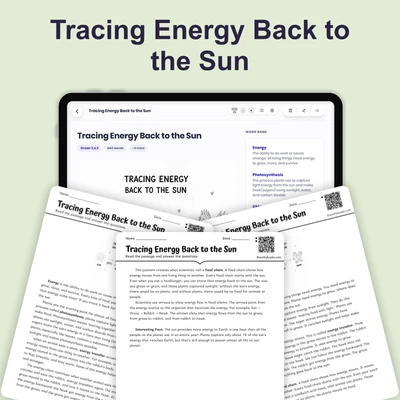
Tracing Food Energy Back to the Sun preview and details

About this printable Tracing Food Energy Back to the Sun science reading passage, NGSS-aligned (Grades 4-6)

This 400-word reading passage introduces fifth-grade students to the concept of energy transfer from the sun to animals through plants. Aligned with NGSS standards 5-LS1-1 and 5-PS3-1, the passage explains how plants capture sunlight energy through photosynthesis and convert it into food energy stored in sugars. Students learn how this energy moves through the food chain when animals eat plants or other animals. The passage guides students through creating their own energy flow models using diagrams, flowcharts, or drawings. Audio-integrated features support diverse learners. Activities include multiple-choice questions testing recall and comprehension, writing prompts requiring students to explain energy transfer concepts, and graphic organizers for mapping the sequence of energy flow. The passage uses age-appropriate language and relatable examples like breakfast cereal and playground energy to help fifth graders understand that all energy in their food originally came from the sun, building foundational knowledge for understanding ecosystems and energy conservation.
Written by Workybooks TeamPublished by Workybooks
Preview

Sample passage and quiz from Tracing Food Energy Back to the Sun

Reading passage and comprehension quiz preview

Modeling Energy from Sun to Animals
Gemini_Generated_Image_h3hjsgh3hjsgh3hj
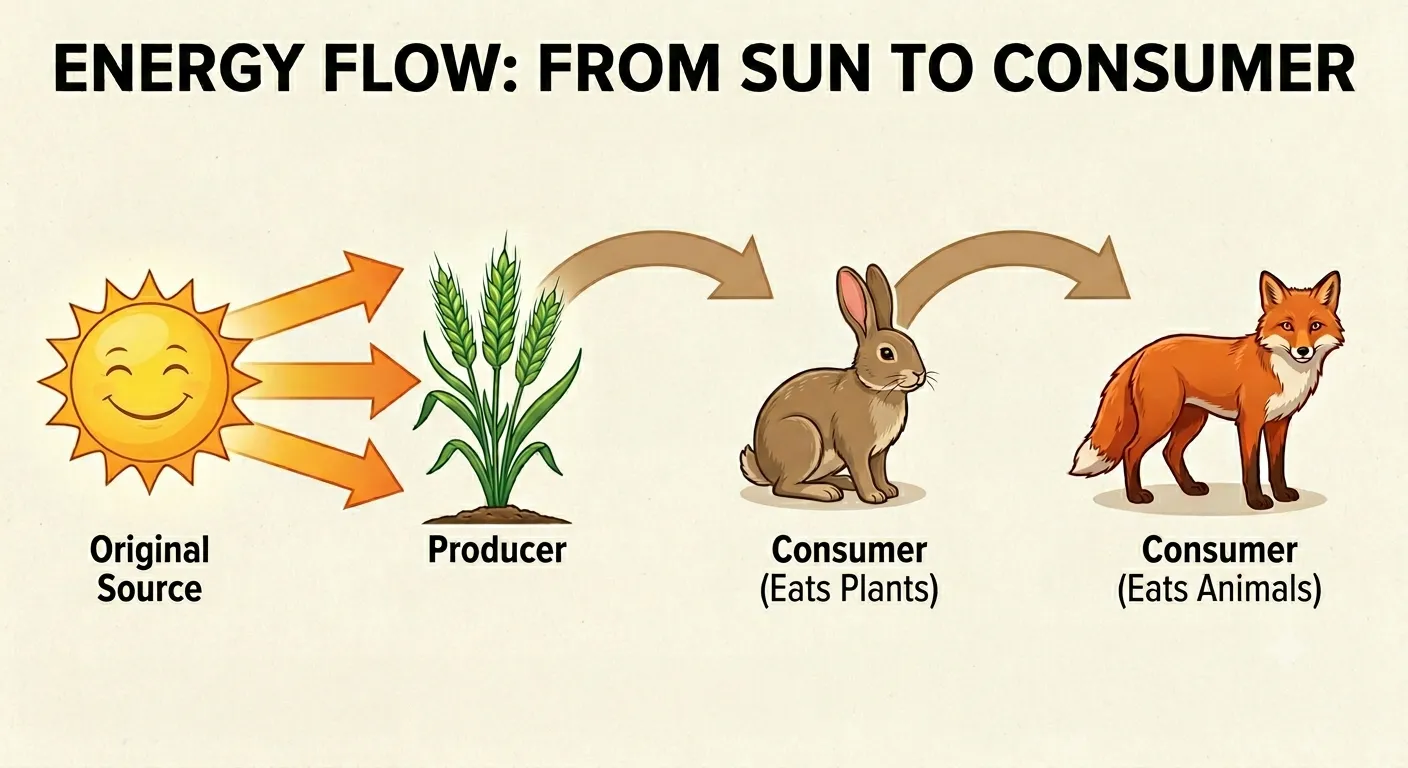
 You can create an energy flow model by drawing the sun, then an arrow pointing to a plant, then another arrow pointing to an animal that eats the plant, and finally an arrow pointing to an animal that eats other animals.

Energy is the ability to do work or cause change. All living things need energy to grow, move, and survive. Understanding where this energy comes from helps us see how all living things are connected.

Plants get their energy directly from the sun through a process called photosynthesis. During photosynthesis, plants use sunlight, water, and carbon dioxide from the air to make their own food in the form of sugars. These sugars store the sun's energy inside the plant. This is why plants are called producers—they produce their own food using energy from the sun.

Animals cannot make their own food like plants can. Instead, animals are consumers—they must eat other living things to get energy. When a rabbit eats grass, the energy stored in the grass moves into the rabbit's body. When a fox eats the rabbit, that same energy moves again into the fox. Even though the energy passes from one living thing to another, it all started as energy from the sun.

Scientists use models to show how energy moves from the sun to plants to animals. A model is a simple diagram or drawing that represents something more complex. You can create an energy flow model by drawing the sun, then an arrow pointing to a plant, then another arrow pointing to an animal that eats the plant, and finally an arrow pointing to an animal that eats other animals. The arrows show the direction that energy moves. Think of the arrows like a path that energy travels, similar to how water flows down a slide at a playground—it only goes one direction.

Creating your own energy flow model helps you see that the energy in a hamburger, a bowl of cereal, or an apple all came from the sun originally. The cereal came from wheat plants that captured sunlight. The hamburger came from a cow that ate grass or corn, which also captured sunlight. No matter what food you trace back, you will always end up at the sun as the original energy source.

Interesting Fact: A single leaf can capture enough sunlight energy in one day to power a small LED light bulb for several hours!

Comprehension quiz (8 questions)

1. Where do plants get their energy?

From the sun
From the soil
From water only
From animals

2. What is photosynthesis?

How animals eat food
How plants make food using sunlight
How water moves through soil
How energy disappears

3. Why are plants called producers?

They eat other living things
They need animals for energy
They make their own food
They only use water

4. What happens when a rabbit eats grass?

Energy moves from grass to rabbit
Energy disappears completely
Energy goes back to sun
Energy stays only in grass

5. What do arrows show in energy models?

The color of organisms
The size of animals
The direction energy moves
The temperature of sun

6. Where did energy in cereal originally start?

In the factory
In the sun
In the box
In the store

7. All food energy originally came from sun.

True
False

8. What is a consumer?

Organism that makes own food
Organism that eats other living things
Only plants in ecosystem
Energy from the sun
Who it's for

Perfect for the way you teach

Teachers
  • Build comprehension skills
  • Auto-graded quiz
  • Differentiated reading
Parents
  • Read together at home
  • Improve fluency
  • Quiet reading time
Homeschoolers
  • Reading curriculum support
  • Independent practice
  • Track Lexile growth
Topics

Reviews & Ratings

No reviews yet. Be the first to share your experience!

More reading you might love

13 more
Passage
Why Plants Need Water - reading educational content
Grades 4–6

Why Plants Need Water

life science · 5-LS1-1

$1.50
Passage
How Different Animals Get Energy from Food - reading educational content
Grades 4–6

How Different Animals Get Energy from Food

life science · 5-LS1-1+1

$1.50
Passage
Tracing Energy Back to the Sun - reading educational content
Grades 4–6

Tracing Energy Back to the Sun

life science · 5-LS1-1+1

$1.50
Passage
How Food Helps Animals Move - reading educational content
Grades 4–6

How Food Helps Animals Move

life science · 5-LS1-1+1

$1.50
Passage
How Food Helps Animals Heal - reading educational content
Grades 4–6

How Food Helps Animals Heal

life science · 5-LS1-1+1

$1.50
Passage
How Food Keeps Animals Warm - reading educational content
Grades 4–6

How Food Keeps Animals Warm

life science · 5-LS1-1+1

$1.50
Passage
Why Some Animals Need More Energy - reading educational content
Grades 4–6

Why Some Animals Need More Energy

life science · 5-LS1-1+1

$1.50
Passage
How Animals Get Energy from Food - reading educational content
Grades 4–6

How Animals Get Energy from Food

life science · 5-LS1-1+1

$1.50
Interactive
Photosynthesis Quiz for 4th Grade Science Students - game educational content
Grade 4

Photosynthesis Quiz for 4th Grade Science Students

photosynthesis · 4-LS1-1+1

Free
Passage
Energy for Living Things - reading educational content
Grades 4–6

Energy for Living Things

life science · 5-LS1-1+1

$1.50
Passage
What Kind of Energy Is Stored in Food - reading educational content
Grades 4–6

What Kind of Energy Is Stored in Food

life science · 5-LS1-1+1

$1.50
Passage
How Producers Make Food - reading educational content
Grades 4–6

How Producers Make Food

life science · 5-LS1-1+1

$1.50
Passage
How Consumers Get Food - reading educational content
Grades 4–6

How Consumers Get Food

life science · 5-LS1-1+1

$1.50
Copyright © 2026 Workybooks. Made with ♥ in California.