This engaging history reading passage explores the life and legacy of Vyasa, the legendary sage credited with preserving and organizing Hindu sacred texts in ancient India. Students will learn how Vyasa compiled the Vedas, composed the Mahabharata, and played a crucial role in transmitting religious knowledge through oral and written traditions. The passage highlights cause-and-effect relationships, change and continuity, and the human impact of Vyasa's work. Activities include a glossary, multiple choice quiz, writing prompts, graphic organizers, and a timeline. Spanish translation and read aloud audio are provided for accessibility. Aligned with CA HSS 6.1.2 and CCSS.RI.6.3, this resource helps students build historical thinking and ELA skills while connecting to broader themes in ancient history.
Written by Workybooks TeamPublished by Workybooks
Preview
Sample passage and quiz content
CONTENT PREVIEW
Expand content preview
"Saga Veda vyasa dictates Mahabharata" / Wikimedia Commons (Public domain).
Vyasa is recognized as one of the most important sages in ancient India, known for preserving and organizing Hindu sacred texts. According to tradition, Vyasa lived around 1500 BCE, although the exact date is debated by historians. He is often called "Veda Vyasa," which means the "divider of the Vedas," because he played a central role in compiling and arranging these foundational religious texts for future generations.
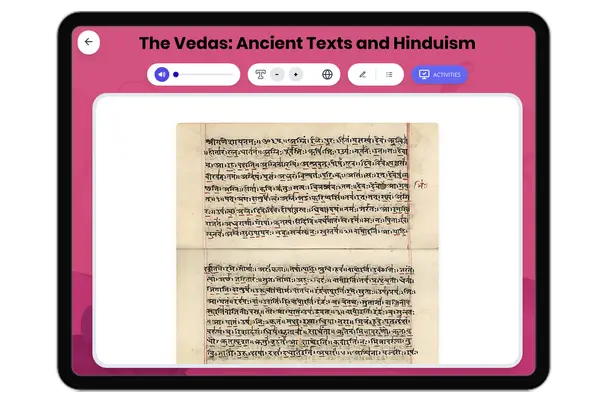
The Vedas are a collection of ancient hymns and rituals that form the core of Hinduism. For centuries, these texts were passed down orally, memorized by Brahmin priests. As Indian society grew and became more complex, there was a risk that parts of the Vedas might be forgotten or changed. Vyasa responded to this challenge by dividing the Vedas into four parts—the Rigveda, Yajurveda, Samaveda, and Atharvaveda—and assigning each section to a group of priests for careful preservation. This systematic organization ensured that the Vedas could be accurately remembered and shared across generations. Archaeological evidence, such as ancient manuscripts found in sites like Takshashila, supports the long tradition of Vedic learning in India.
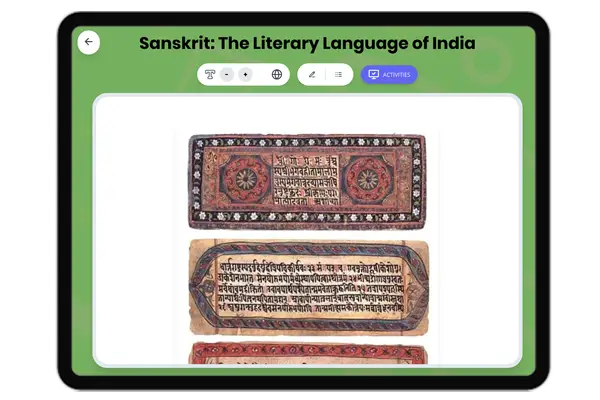
Vyasa is also famous for composing the Mahabharata, one of the world's longest epic poems. The Mahabharata contains stories, teachings, and the famous Bhagavad Gita. It reflects the values and beliefs of Indian society at the time, including ideas about duty, justice, and social roles. According to many legends, Vyasa dictated the Mahabharata to the god Ganesha, who wrote it down. While there are debates among scholars about whether Vyasa was a single person or a title used by several sages, his influence on Indian literature and religion is clear. For example, ancient inscriptions and Sanskrit manuscripts mention Vyasa as a key figure in transmitting knowledge.
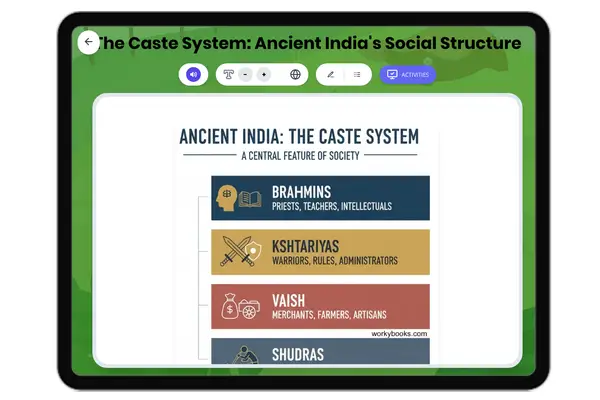
The work of Vyasa connects to the broader development of ancient Indian civilization. By preserving the Vedas and composing the Mahabharata, Vyasa helped shape religious practices, social hierarchy, and daily life. The caste system, rituals, and ideas about moral behavior described in these texts became central to Indian culture. The oral tradition remained strong, but Vyasa's efforts also encouraged the use of writing, marking a transition in how knowledge was kept and shared. His legacy continues today, as millions study and recite the Vedas and Mahabharata worldwide.
Vyasa's contributions show the power of individuals to preserve cultural heritage and influence society. His work reminds us of the importance of both oral and written traditions in history. The preservation of sacred texts in ancient India reflects broader themes of innovation, continuity, and change over time.
Interesting Fact: Vyasa is also recognized as one of the seven immortals, or "Chiranjivi," in Hindu tradition, believed to still be alive in the world today.
Who is Vyasa?
A sage who preserved Hindu textsA Greek philosopherA Chinese emperorAn Egyptian pharaoh
What did Vyasa organize?
The VedasThe PyramidsRoman lawsGreek tragedies
Which epic did Vyasa compose?
MahabharataIliadEpic of GilgameshAeneid
Why did Vyasa divide the Vedas?
To help priests remember themTo destroy themTo sell themTo hide them
How did Vyasa help preserve knowledge?
Organized texts and used oral traditionBuilt monumentsConquered landsInvented the wheel
What role did Ganesha play?
Wrote down the MahabharataFought in a warBuilt templesDiscovered America