What Are The 5 Effects Of Air Pollution? — Reading Comprehension
Rate this|
1
Premium Resource
Present
Present in classroom. No work saved
Assign
Classroom with student accounts, Track progress
Quick Play
No student accounts, assign with a link
Grades
6
PRINT+DIGITAL RESOURCE
This learning resource is available in interactive and printable formats. The interactive worksheet can be played online and assigned to students. The Printable PDF version can be downloaded and printed for completion by hand.
This engaging, audio-integrated reading passage, "What Are The 5 Effects Of Air Pollution?", is designed for 6th-grade students. It clearly explains the five major impacts of air pollution on human health and the environment, including respiratory problems, climate change, acid rain, smog, and harm to wildlife. Key terms are defined to support comprehension, and the content aligns with NGSS MS-ESS3-3, focusing on human impacts on the environment. Through accessible language and relevant examples, students will learn about this critical environmental issue and its far-reaching consequences. This passage is a valuable resource for teaching environmental science.
CONTENT PREVIEW
Expand content preview
Air pollution harms people, nature, and climate through smog, acid rain, and global warming.
Air pollution is a big problem that affects everyone on Earth. It happens when harmful substances, like chemicals and tiny particles, get into the air. These substances come from many places, such as cars, factories, and even burning wood. Understanding the effects of air pollution is important for keeping ourselves and our planet healthy.
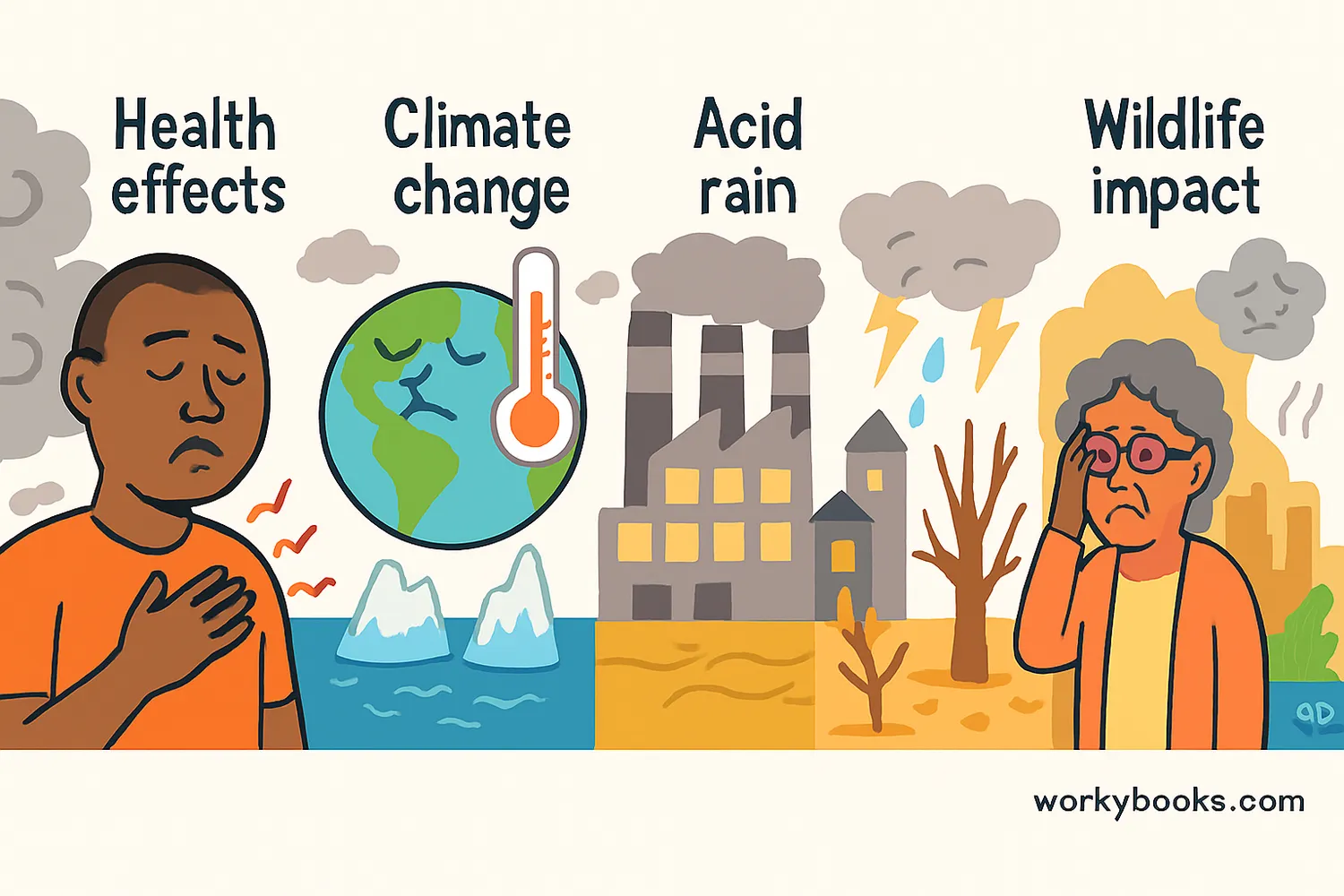
Here are five major ways air pollution impacts us:
One of the most immediate effects is on our health. Breathing in polluted air can lead to serious respiratory problems. This means issues with our lungs and breathing. People might get asthma, bronchitis, or other lung diseases. Children and older adults are often more vulnerable. The tiny particles in polluted air can even get into our bloodstream, affecting other parts of our body, including the heart.
Another significant effect is climate change. This is a long-term shift in global weather patterns. When certain gases, like carbon dioxide, are released into the atmosphere, they trap heat. This is known as the greenhouse effect. While some greenhouse effect is natural and good, too much leads to the Earth getting warmer. This global warming can cause glaciers to melt, sea levels to rise, and extreme weather events.
Air pollution also causes acid rain. This isn't just regular rain; it's rain that contains harmful acids from pollutants in the air. When factories release sulfur dioxide and nitrogen oxides, these gases mix with water in the clouds. When this acidic rain falls, it can damage trees, harm fish in lakes, and even wear away buildings and statues. It changes the chemistry of the soil and water, making it difficult for plants and animals to survive.
You might have also heard of smog. This is a type of air pollution that looks like a hazy, yellowish-brown cloud, often seen over cities. Smog is a mix of smoke and fog, created when sunlight reacts with pollutants from cars and industries. It reduces visibility and makes the air difficult to breathe. Smog can irritate eyes and throats and worsen respiratory problems.
Finally, air pollution has a big impact on wildlife and ecosystems. Animals breathe the same polluted air we do, which can make them sick. Pollutants can also get into their food and water sources. Acid rain can destroy forests and harm aquatic life. Climate change can alter habitats, forcing animals to move or putting them at risk of extinction. Protecting air quality is crucial for the survival of countless species.
Interesting Fact: Even indoor air can be more polluted than outdoor air, due to things like cleaning products, dust, and smoke from cooking or fireplaces.
Which of the following is NOT listed as a source of air pollution?
CarsFactoriesBurning woodClean water
What is one effect of air pollution on buildings and statues?
Makes them strongerWears them awayMakes them shinyPaints them green
True or False: Smog is a mix of smoke and fog.
TrueFalse
What does 'respiratory problems' primarily refer to?
Heart issuesDigestion issuesBreathing and lung issuesSkin problems
How does the greenhouse effect contribute to climate change?
Traps heat in atmosphereCreates more rainReflects sunlight awayCools the Earth
Which group of people is often more vulnerable to health effects from air pollution?
If a city has poor air quality alerts, what visible sign might residents notice?
Clear blue skyBright sunshineHazy, yellowish-brown cloudHeavy snow
What is a 'pollutant' in the context of air pollution?
Clean airHarmful substanceNatural gasWater vapor
Perfect For:
👩🏫 Teachers
• Reading comprehension practice
• Auto-graded assessments
• Literacy skill development
👨👩👧👦 Parents
• Reading practice at home
• Comprehension improvement
• Educational reading time
🏠 Homeschoolers
• Reading curriculum support
• Independent reading practice
• Progress monitoring
Reading Features:
📖
Reading Passage
Engaging fiction or nonfiction text
❓
Comprehension Quiz
Auto-graded questions
📊
Instant Feedback
Immediate results and scoring
📄
Printable Version
Download for offline reading
🔊
Read Aloud
Voice-over with word highlighting
Reviews & Ratings
No reviews yet. Be the first to share your experience!
Related Content
Tools and Technology in Earth Science
This middle school science reading passage explores the wide range of tools and technologies used in Earth science, from...
MS-ESS2-2MS-ESS3-2MS-ETS1-1MS-PS4-3
What Is Earth Science?
This engaging middle school science passage introduces students to the field of Earth science, aligning with NGSS standa...
MS-ESS1MS-ESS2MS-ESS3SEP
Scientific Inquiry in Earth Science
This passage explores scientific inquiry in Earth science for grades 6-8, aligned with NGSS standards MS-ESS1-4, MS-ESS2...
MS-ESS1-4MS-ESS2-1MS-ESS3-5SEP
What Is Space Weather and How Does It Affect the Earth?
This NGSS-aligned science passage for middle school explains what space weather is and how it affects Earth. Students le...
MS-ESS2-2
Earth: Our Home in Space
This engaging Grade 4-5 science passage, aligned to NGSS, introduces students to Earth's special place in the solar syst...
My Planet Earth
In this passage, students explore Earth as their home planet. They learn that Earth is made of land, water, and air, and...
FL.SS.2.G.1.1SS.2.G.1.3
Meteorite Impacts on Earth
This engaging science reading passage for Grades 4-5 explores meteorite impacts on Earth, aligning with NGSS standards. ...
Facts About Earth
This engaging science reading passage introduces Grade 4 and 5 students to Earth, our home planet. Aligned with NGSS sta...
Earth's Quick and Slow Changes
In 'Earth's Quick and Slow Changes,' students categorize 12 Earth events by their speed of occurrence, enhancing underst...
Earth Day and Types of Pollution
Earth Day is coming! Get ready to learn about pollution and test your knowledge. Click for a free reading passage and qu...
RI.4.1RI.4.2ESS3.CESS3.A
Earth Changes Over Millions of Years
This engaging, audio-integrated science passage for Grade 4-5 students explores how Earth has changed over millions of y...
Rare Earth Minerals in Smartphones and Computers
Rare earth minerals are critical for smartphones, computers, and renewable energy. Mining them has environmental impacts...
RI.5.3RI.6.3RI.7.3
What Makes Earth Perfect for Life?
This Grade 4-5 science passage, aligned with NGSS standards, explores the essential features that make Earth the perfect...
Earth Changes Word Sort
This word sort activity helps students understand different rates of change in Earth's systems. Students classify 12 geo...
Escape Velocity and Space Travel
This middle school science passage introduces students to the concept of escape velocity—the minimum speed required to b...
MS-ESS1-2MS-PS2-4
Earth's Spheres
This middle school science passage introduces students to Earth's four major spheres: the geosphere, hydrosphere, atmosp...
MS-ESS2-4MS-ESS2-6
The Diameter of Earth
This science reading passage explains the diameter of Earth, describing it as about 12,742 kilometers or 7,918 miles acr...
5-PS2-1
Earth: Our Home Planet
This comprehensive science passage for grades 6-8 explores Earth’s unique characteristics and the interconnected systems...
MS-ESS1-2
Aphelion and Perihelion
This engaging reading passage, 'Aphelion and Perihelion,' delves into the fascinating aspects of Earth's elliptical orbi...
MS-ESS1-1: DEVELOP AND USE A MODEL OF THE EARTH-SUN-MOON SYSTEM TO DESCRIBE THE CYCLIC PATTERNS OF LUNAR PHASESECLIPSES OF THE SUN AND MOONAND SEASONS.
Earth's Rotation
This middle school science passage, aligned with NGSS standard MS-ESS1-1, focuses on Earth's rotation—how Earth spins on...