What are the reactants of Photosynthesis — Reading Comprehension
Rate this
Premium Resource
Present
Present in classroom. No work saved
Assign
Classroom with student accounts, Track progress
Quick Play
No student accounts, assign with a link
Grades
3
4
5
6
7
8
PRINT+DIGITAL RESOURCE
This learning resource is available in interactive and printable formats. The interactive worksheet can be played online and assigned to students. The Printable PDF version can be downloaded and printed for completion by hand.
This comprehensive science passage, aligned with NGSS standards for middle school, provides a detailed yet accessible explanation of photosynthesis. It focuses on the key reactants—carbon dioxide, water, and light energy—and their roles in the process. The passage explains how these inputs are transformed into the products, glucose and oxygen, within a plant's chloroplasts. It also highlights the critical role of chlorophyll and connects the process to the broader cycle of energy and gas exchange on Earth. The content is structured to be used for self-study, with clear, factual language and a logical flow from the basic definition to real-world connections. The text is designed to help students understand the fundamental concepts of how plants create their own food and sustain ecosystems.
CONTENT PREVIEW
Expand content preview
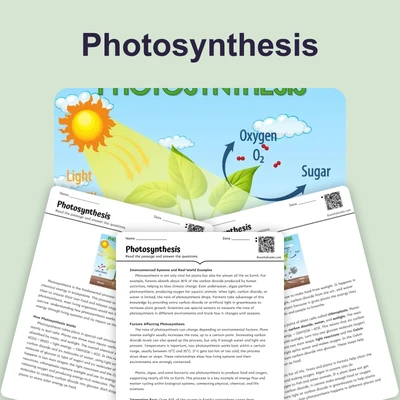
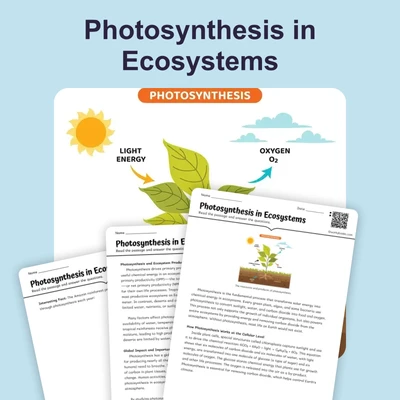
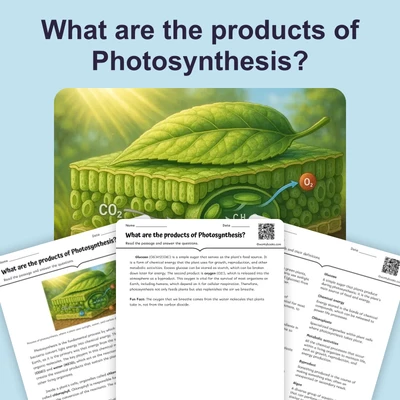
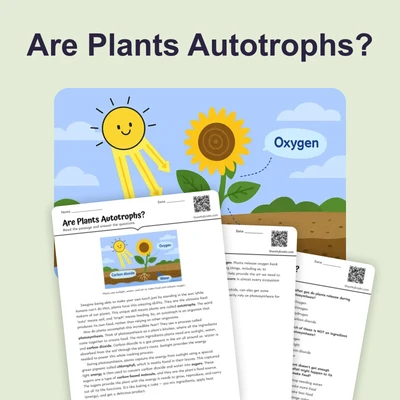
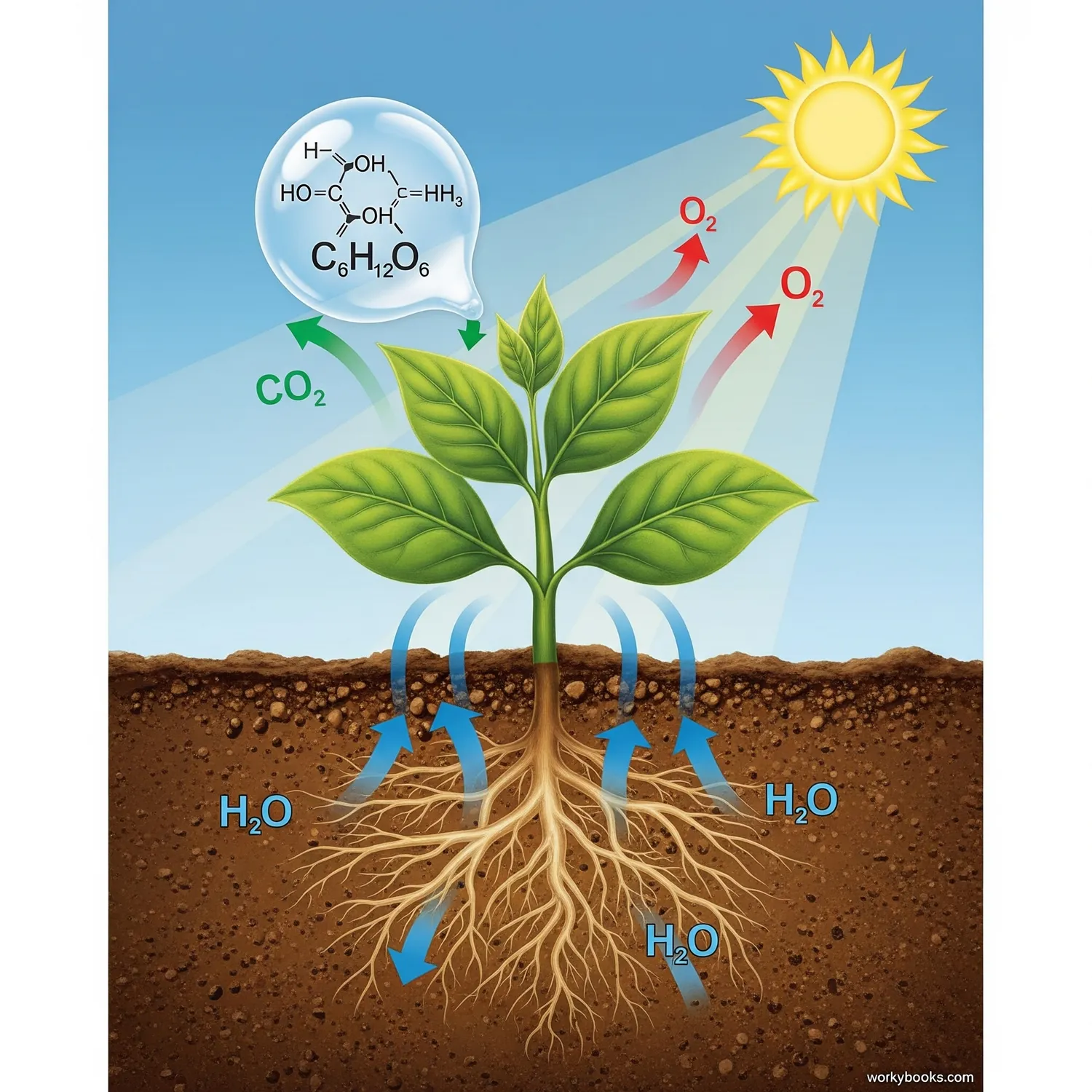
Photosynthesis, showing the reactants (carbon dioxide, water, and light) and the products (glucose and oxygen).
Photosynthesis is the remarkable process used by plants, algae, and some bacteria to convert light energy into chemical energy. This chemical energy is stored in the form of glucose, a type of sugar. Photosynthesis is the foundation of most food webs on Earth, as it produces the food and oxygen that sustain nearly all life. Without this process, the flow of energy from the sun would not be captured and converted into a usable form for living organisms.
To create glucose, photosynthetic organisms need three primary ingredients: sunlight, carbon dioxide, and water. These "ingredients" are known as reactants. Plants absorb water (H2O) from the soil through their roots and take in carbon dioxide (CO2) from the atmosphere through tiny pores on their leaves called stomata. Sunlight provides the energy needed to power the chemical reaction. Inside the plant's cells, organelles called chloroplasts contain a green pigment called chlorophyll, which is specialized for capturing light energy.
The process of photosynthesis can be summarized by a simple chemical equation: 6CO2+6H2O+Light Energy→C6H12O6+6O2. The reactants, carbon dioxide and water, are transformed with the help of light energy into the products: glucose (C6H12O6) and oxygen (O2). Glucose provides the plant with the energy it needs to grow, while the oxygen is released as a byproduct into the atmosphere. This oxygen is vital for the respiration of animals and humans.
The interdependence between photosynthesis and cellular respiration is a critical concept in biology. Photosynthesis uses the carbon dioxide produced by animals and humans and releases the oxygen we need to breathe. In turn, plants use the glucose created during photosynthesis to fuel their own cellular respiration, just as animals do. This creates a balanced cycle of gas exchange that maintains life on our planet.
Fun Fact: Photosynthesis is responsible for creating most of the oxygen we breathe, but about half of the oxygen on Earth is produced by marine organisms like phytoplankton, which are microscopic, plant-like organisms in the ocean.
What are the three primary ingredients, or reactants, needed for photosynthesis?
Oxygen, glucose, and waterCarbon dioxide, water, and sunlightGlucose, sunlight, and oxygenWater, oxygen, and carbon dioxide
Where do plants absorb carbon dioxide for photosynthesis?
Through their rootsFrom the soilThrough stomata on their leavesDirectly from sunlight
What is the main purpose of chlorophyll in a plant cell?
To produce oxygenTo capture light energyTo absorb waterTo store glucose
The chemical equation for photosynthesis shows that carbon dioxide and water are converted into what two products?
Oxygen and chlorophyllWater and glucoseGlucose and oxygenCarbon dioxide and water
Which of the following is a byproduct of photosynthesis?
GlucoseWaterCarbon dioxideOxygen
Based on the passage, what is the relationship between photosynthesis and cellular respiration?
They are completely separate processes.They are two different names for the same process.The products of one process are the reactants of the other.Both processes produce glucose and oxygen.
If a plant is placed in a sealed jar with no access to light, what would be the most likely result for the plant?
It would produce a large amount of glucose.It would release oxygen but not produce glucose.It would be unable to perform photosynthesis.It would absorb more carbon dioxide.
Which of the following best describes the main idea of the reading passage?
The importance of stomata in gas exchange.A detailed explanation of the products of photosynthesis.A summary of the reactants and process of photosynthesis.The role of chlorophyll in creating plant color.
Perfect For:
👩🏫 Teachers
• Reading comprehension practice
• Auto-graded assessments
• Literacy skill development
👨👩👧👦 Parents
• Reading practice at home
• Comprehension improvement
• Educational reading time
🏠 Homeschoolers
• Reading curriculum support
• Independent reading practice
• Progress monitoring
Reading Features:
📖
Reading Passage
Engaging fiction or nonfiction text
❓
Comprehension Quiz
Auto-graded questions
📊
Instant Feedback
Immediate results and scoring
📄
Printable Version
Download for offline reading
🔊
Read Aloud
Voice-over with word highlighting
Reviews & Ratings
No reviews yet. Be the first to share your experience!
Related Content
Cell Structure and Function
This middle school science passage introduces the fundamental concept that cells are the basic unit of life, aligned wit...
MS-LS1-1MS-LS1-2
Claws vs. Nails: Structure and Function
This engaging, audio-integrated reading passage, "Claws vs. Nails: Structure and Function," introduces sixth-grade stude...
Plant Parts Function Sort
This classification activity helps students understand how different plant structures contribute to survival. Students c...
4-LS1-1
Animal Structures Word Sort
This engaging classification activity helps students understand the different structures that make up animal bodies. Stu...
4-LS1-1
The Nature of Life Science
This passage, aligned with NGSS MS-LS1-1, introduces students in grades 6-8 to the foundational concepts of life science...
MS-LS1-1
Science Vocabulary
This worksheet on domain-specific words will help students learn some science vocabulary. Students will be asked to matc...
L.3.6L.3.4.A
Animal Body Parts and Their Functions
In this 'Animal Body Parts and Their Functions' word sort activity aligned with LS1.A, students learn about how differen...
Simple Machines Science Report
This science writing task requires students to clearly explain how three simple machines work using precise domain-speci...
W.5.4
Golgi Apparatus and Its Function
This NGSS-aligned reading passage introduces middle school students to the structure and function of the Golgi apparatus...
MS-LS1-1
What Are Plant Structures
This engaging 250-word reading passage introduces fourth-grade students to the fundamental concept of plant structures a...
NGSS 4-LS1-1
Whale Blubber: Function and Adaptation
This engaging, audio-integrated reading passage, 'Whale Blubber Function and Adaptation,' introduces young learners to t...
Bacteria: Prokaryotic Cell Structure
This engaging and audio-integrated reading passage, 'Bacteria: Prokaryotic Cell Structure,' introduces 6th-grade student...
Citizen Science and Ecological Monitoring
This engaging passage for grades 6-8 introduces the concept of citizen science and its critical role in ecological monit...
MS-LS2-1
Tools and Technology in Earth Science
This middle school science reading passage explores the wide range of tools and technologies used in Earth science, from...
MS-ESS2-2MS-ESS3-2MS-ETS1-1MS-PS4-3
The Nucleolus and Its Function
This NGSS-aligned reading passage focuses on the nucleolus, a key structure inside the cell’s nucleus responsible for ma...
MS-LS1-1MS-LS1-2
Animal External Structures
This engaging 250-word reading passage introduces fourth-grade students to the concept of animal external structures ali...
NGSS 4-LS1-1LS1.A
Blobfish Adaptations to Extreme Pressure
This engaging passage explores the fascinating world of the blobfish and its unique adaptations to the extreme pressure ...
What Is Earth Science?
This engaging middle school science passage introduces students to the field of Earth science, aligning with NGSS standa...
MS-ESS1MS-ESS2MS-ESS3SEP
The Pumpkin Life Cycle
This informational worksheet explores the pumpkin lifecycle, guiding students through procedural steps in a scientific t...
RI.2.3RI.2.10
The Aorta: Molecules to Organisms of the Body's Largest Artery
This educational content features a fascinating reading passage, audio integrated for an enhanced learning experience, a...