Claws vs. Nails: Structure and Function
Interactive passage with audio narration, comprehension questions, and printable PDF.
By completing this purchase you agree to our Terms of Use and Privacy Policy. Your subscription renews automatically until you cancel. You can cancel anytime from your account settings. All sales are final and non-refundable. Digital content is available for download in your account immediately upon purchase.
What's included
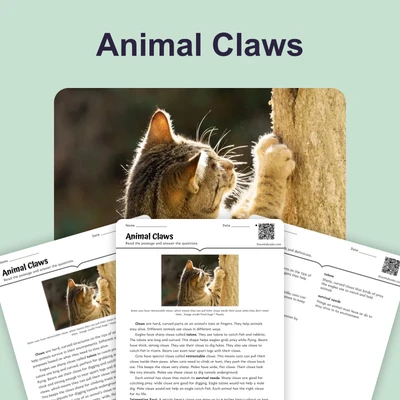
Claws vs. Nails: Structure and Function preview and details
About this printable Claws vs. Nails: Structure and Function science reading passage, NGSS-aligned (Grade 6)
Sample passage and quiz from Claws vs. Nails: Structure and Function
Reading passage and comprehension quiz preview
Claws vs. Nails: Structure and Function
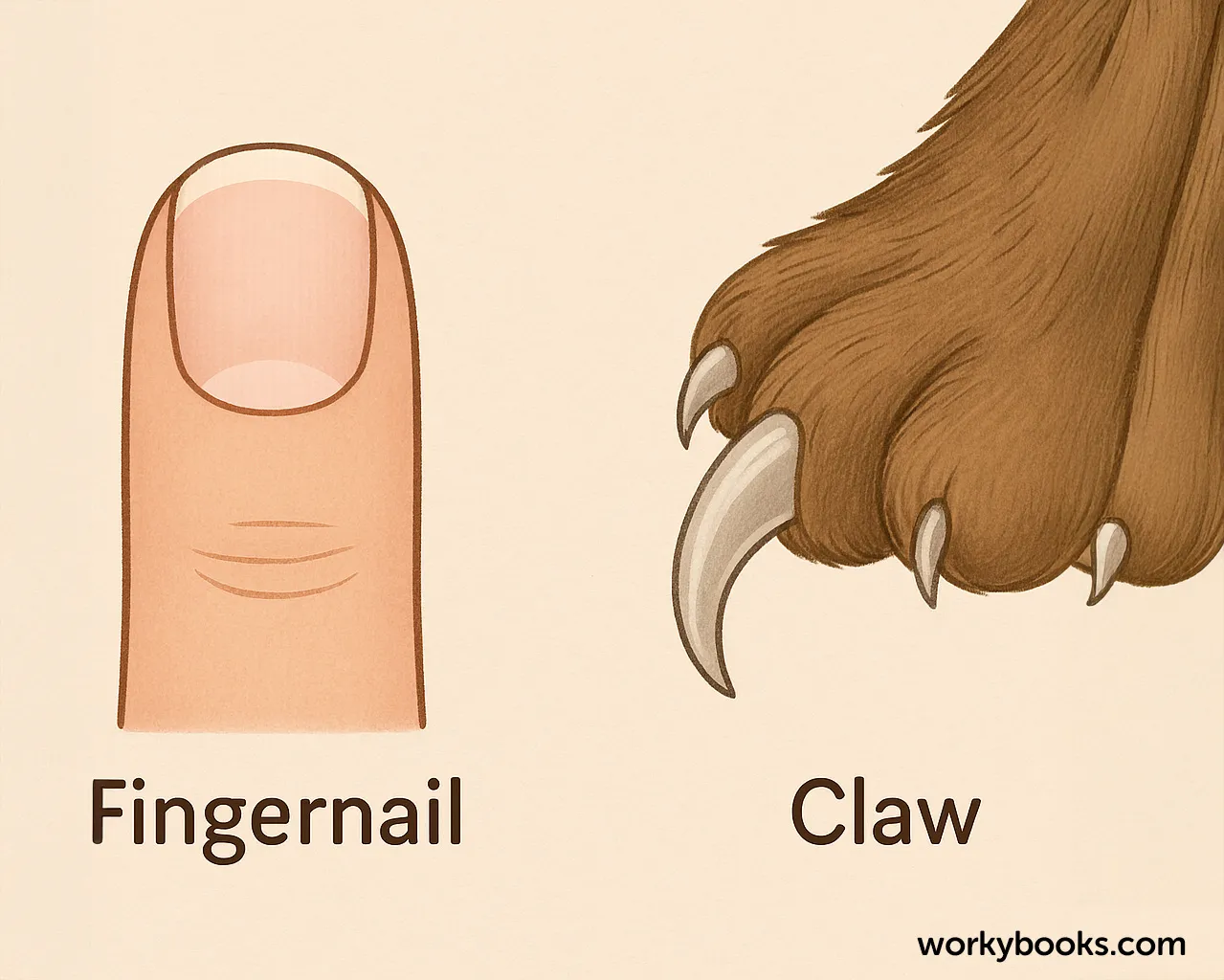
Imagine looking at your fingernails. Now, picture the sharp, curved tips on a cat's paw. While both are made of a tough material, their shapes and uses are surprisingly different! This difference is all about structure and function – how something is built and what it does.
Your fingernails are flat plates made of a protein called keratin. They protect your fingertips and help you pick up small objects or scratch an itch. Humans, along with other primates like monkeys, have nails. These nails allow for a greater sense of touch at the fingertips and help with gripping things that are thin or smooth. Think about how you use your nails to open a soda can or separate two pieces of paper. These are tasks that require fine motor skills, which our nails help with.
Claws, on the other hand, are much more than just flat plates. They are sharp, curved structures found on many animals, including cats, dogs, birds, and reptiles. Like nails, claws are also made of keratin, but they are shaped for very specific purposes. For a predator like a cat, claws are essential tools for hunting. They help to grasp and hold onto prey. Claws can also be used for climbing trees, digging burrows for shelter, or even for defense against other animals.
Think about a hawk. Its powerful talons (a type of claw found on birds of prey) are perfectly designed to catch and carry fish or small mammals. A badger uses its strong claws to dig extensive tunnel systems. Even a small squirrel uses its sharp claws to grip tree bark as it scurries up a trunk. The evolutionary development of claws or nails in different species is a perfect example of adaptation – how organisms develop features that help them survive in their environment.
So, while both nails and claws are made of the same basic material, their distinct structures allow them to perform very different functions, showcasing the incredible diversity and efficiency of natural design in the animal kingdom.
Interesting Fact: The largest known claws belonged to a dinosaur called Therizinosaurus, with individual claws reaching up to 3 feet in length!
Comprehension quiz (10 questions)
1. What material are both fingernails and claws made of?
2. What is the primary function of human fingernails?
3. Which animals are mentioned as having claws?
4. How do claws help a predator like a cat?
5. What is 'adaptation' in an organism?
6. How are talons different from typical claws?
7. A badger uses its claws mainly for what?
8. The shape of nails allows for better fine motor skills.
9. What does the word 'function' mean in science?
10. What might happen if a predator like a hawk had flat nails instead of talons?
Perfect for the way you teach
- Build comprehension skills
- Auto-graded quiz
- Differentiated reading
- Read together at home
- Improve fluency
- Quiet reading time
- Reading curriculum support
- Independent practice
- Track Lexile growth