Cell Structure and Function — Reading Comprehension
Rate this
Premium Resource
Present
Present in classroom. No work saved
Assign
Classroom with student accounts, Track progress
Quick Play
No student accounts, assign with a link
Grades
5
6
7
8
Standards
MS-LS1-1
MS-LS1-2
PRINT+DIGITAL RESOURCE
This learning resource is available in interactive and printable formats. The interactive worksheet can be played online and assigned to students. The Printable PDF version can be downloaded and printed for completion by hand.
This middle school science passage introduces the fundamental concept that cells are the basic unit of life, aligned with NGSS standards MS-LS1-1 and MS-LS1-2. The reading covers the essential structures all cells share, including the cell membrane, cytoplasm, DNA, and ribosomes, and explains how each structure's function supports the life of the cell. Students will learn how the cell operates like a factory or city, with each part having a specific job. The passage also compares simple (prokaryotic) and complex (eukaryotic) cells, building understanding through relatable analogies and real-world applications. The resource includes a glossary, Spanish translation, simplified reading version, a multiple-choice quiz, writing prompts, and graphic organizers, supporting diverse learners and reinforcing key concepts. Audio integration is included to enhance accessibility.
CONTENT PREVIEW
Expand content preview
Cells are the foundation of all living things, from the smallest bacteria to the tallest trees and the largest animals. Every living thing is made of one or more cells, and these cells carry out the basic processes that keep life going. Biologists use microscopes to observe cells and have discovered that, despite their small size, cells contain specialized parts that work together as a system. Understanding cell structure and function helps us answer questions about growth, disease, and even how medicines work.
Cell Structures: Working Together Like a Factory
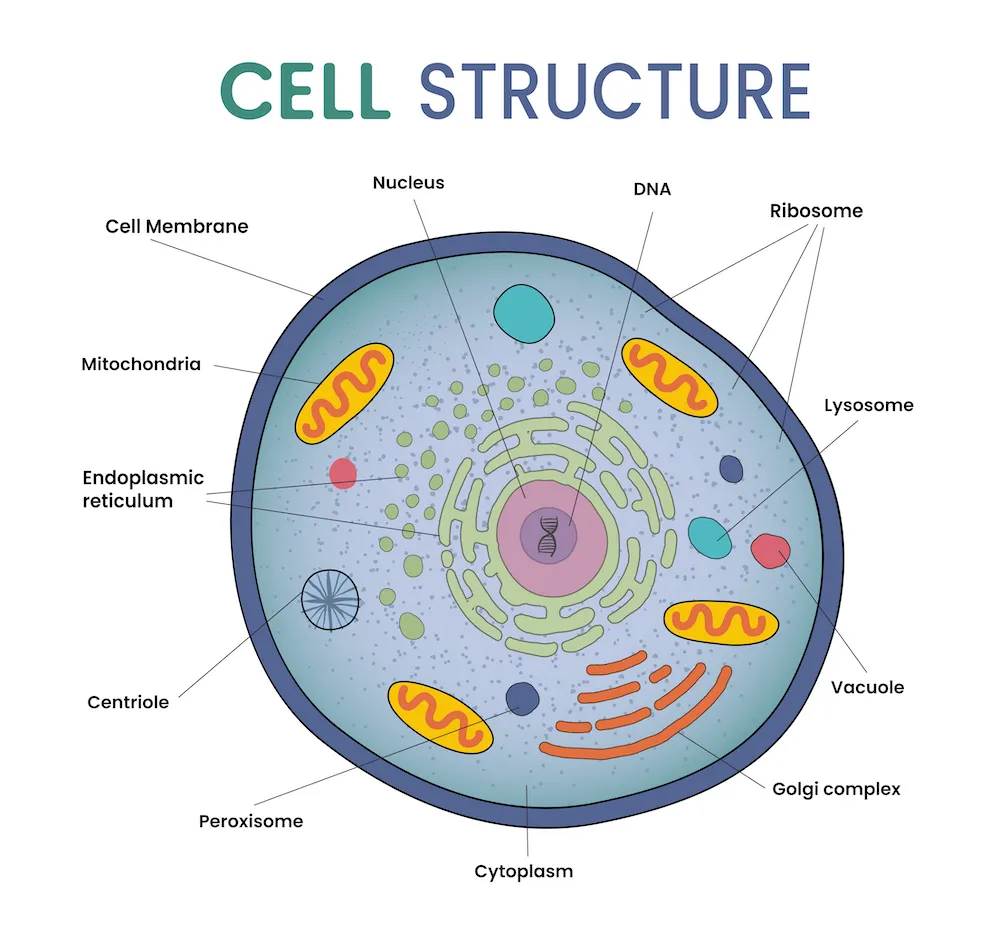
All cells, no matter where they are found, share key components. The cell membrane acts as a protective barrier, controlling what enters and leaves the cell; it is like the security gate of a factory, letting in supplies and sending out waste. Inside, the cytoplasm is a jelly-like fluid where cell activities happen, similar to the workspace where workers move and machines operate. Every cell has genetic material, usually in the form of DNA, which carries instructions for making proteins and controlling the cell’s activities. Ribosomes act as the cell’s protein factories, reading the genetic code and building the proteins needed for structure and function. Each part of the cell is adapted to its job, and if one part fails, the whole system can be affected.
Types of Cells: Simple and Complex Systems
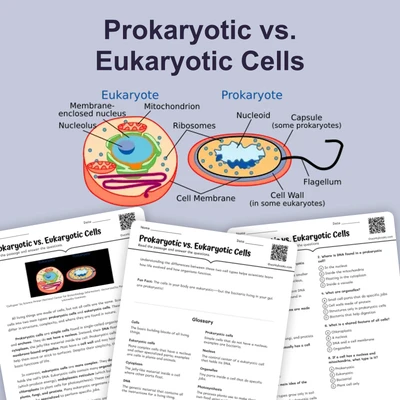
Scientists divide cells into two main categories: prokaryotic and eukaryotic. Prokaryotic cells, such as bacteria, are simple and lack internal compartments. Their DNA floats freely in the cytoplasm. Eukaryotic cells, found in plants, animals, fungi, and protists, are more complex. They have a nucleus that contains the DNA and other specialized structures called organelles. For example, the mitochondria in eukaryotic cells generate energy, while chloroplasts in plant cells capture sunlight for photosynthesis. The differences in cell structures allow organisms to perform more complex tasks and adapt to diverse environments.
Structure and Function: Why the Design Matters
The design of each cell part reflects its function. The thin, flexible cell membrane allows for selective transport of materials, which is essential for maintaining balance inside the cell. Ribosomes must be able to move freely in the cytoplasm or attach to certain membranes to efficiently build proteins. The presence or absence of organelles changes what a cell can do. For example, only plant cells have chloroplasts for photosynthesis, while animal cells rely on mitochondria for energy. These differences are the result of evolution and natural selection, which shape cell structures to meet specific needs over generations.
Cells are not just passive building blocks—they are dynamic systems that sense and respond to their surroundings. Research into cell biology has led to advances in medicine, agriculture, and environmental science, showing how the study of cells connects to broader scientific principles and benefits society.
Interesting Fact: The human body contains about 37 trillion cells, and each second, millions of new cells are made to replace old or damaged ones!
What is the main function of the cell membrane?
To control what enters and leaves the cellTo make proteinsTo store genetic materialTo produce energy from sunlight
Which cell part is responsible for making proteins?
RibosomeCell membraneCytoplasmNucleus
Which statement best explains how cell structure relates to function?
Each part of a cell has a unique job that helps the cell survive.All cells have the same shape and do the same thing.Cells only need DNA to function.Cell structure does not affect its function.
What is one difference between prokaryotic and eukaryotic cells?
Eukaryotic cells have a nucleus; prokaryotic cells do not.Prokaryotic cells have more organelles than eukaryotic cells.Only prokaryotic cells make proteins.Eukaryotic cells lack a cell membrane.
What does the cytoplasm do in a cell?
It is where cell activities happen.It controls what enters the cell.It stores DNA.It makes energy from sunlight.
What does the word 'organelle' mean as used in the passage?
A specialized part of a cell with a specific jobA type of cellA kind of proteinA barrier around the cell
In the passage, what is the cell compared to?
A factory or cityA bookA vehicleA computer
Why are ribosomes important to the cell?
They build proteins that help the cell function.They act as the cell’s protective barrier.They store energy for the cell.They let materials in and out.
Cells are not just passive building blocks. True or False?
TrueFalse
All cells have a cell membrane, cytoplasm, DNA, and ribosomes. True or False?
TrueFalse
Perfect For:
👩🏫 Teachers
• Reading comprehension practice
• Auto-graded assessments
• Literacy skill development
👨👩👧👦 Parents
• Reading practice at home
• Comprehension improvement
• Educational reading time
🏠 Homeschoolers
• Reading curriculum support
• Independent reading practice
• Progress monitoring
Reading Features:
📖
Reading Passage
Engaging fiction or nonfiction text
❓
Comprehension Quiz
Auto-graded questions
📊
Instant Feedback
Immediate results and scoring
📄
Printable Version
Download for offline reading
🔊
Read Aloud
Voice-over with word highlighting
Reviews & Ratings
No reviews yet. Be the first to share your experience!
Related Content
Antonie van Leeuwenhoek and the Discovery of Animalcules
This NGSS-aligned science passage explores the groundbreaking work of Antonie van Leeuwenhoek, a pioneer in microscopic ...
MS-LS1-1MS-LS1-2
Robert Hooke and the Naming of 'Cells'
This NGSS-aligned reading passage introduces middle school students to Robert Hooke's discovery and naming of 'cells' in...
MS-LS1-1MS-LS1-2
Rudolf Virchow and His Contribution to Cell Theory
This NGSS-aligned science reading passage introduces students to Rudolf Virchow, a key historical figure in cell biology...
MS-LS1-1MS-LS1-2
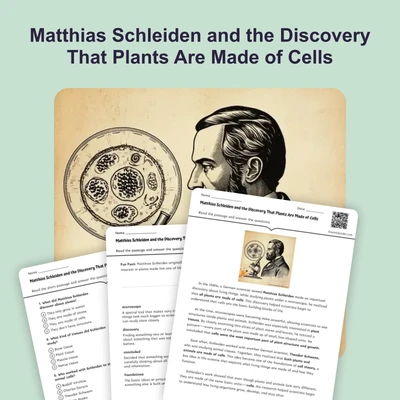
Matthias Schleiden and the Discovery That Plants Are Made of Cells
This NGSS-aligned science passage explains how Matthias Schleiden, a German scientist in the 1830s, discovered that all ...
MS-LS1-1MS-LS1-2
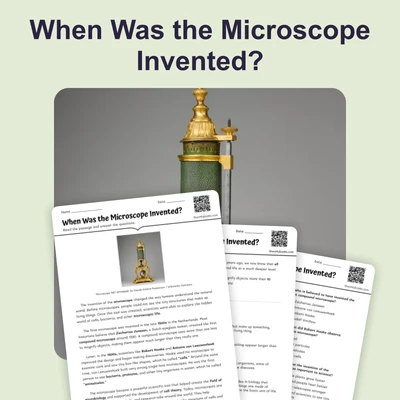
When Was the Microscope Invented?
This NGSS-aligned reading passage introduces students to the invention of the microscope, an essential scientific tool. ...
MS-LS1-1MS-LS1-2
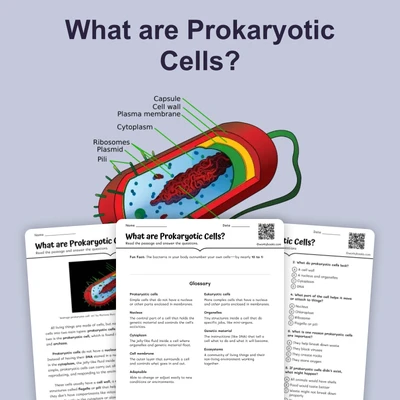
What are Prokaryotic Cells?
This NGSS-aligned science reading passage explains prokaryotic cells, the simplest type of cells found in single-celled ...
MS-LS1-1MS-LS1-2
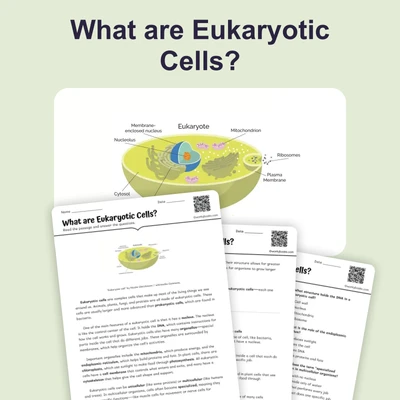
What are Eukaryotic Cells?
This NGSS-aligned reading passage introduces middle school students to eukaryotic cells, which are complex cells found i...
MS-LS1-1MS-LS1-2
Prokaryotic vs. Eukaryotic Cells
This NGSS-aligned reading passage helps middle school students compare prokaryotic and eukaryotic cells. Supporting stan...
MS-LS1-1MS-LS1-2
What is an Organelle?
This NGSS-aligned reading passage introduces middle school students to the concept of organelles. Supporting MS-LS1-
MS-LS1-1MS-LS1-2
Chromoplast: Nature's Color Palette
This passage details chromoplast functions in pigment production, ecological signaling, and nutrition. Aligned with NGSS...
MS-LS1-1MS-LS1-2MS-LS1-6LS1.C
Parts of the Cell
This informational science passage, aligned with NGSS standard MS-LS1-1, introduces students to the parts of the cell an...
MS-LS1-1MS-LS1-2
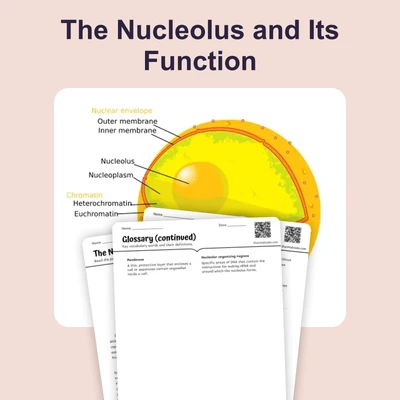
The Nucleolus and Its Function
This NGSS-aligned reading passage focuses on the nucleolus, a key structure inside the cell’s nucleus responsible for ma...
MS-LS1-1MS-LS1-2
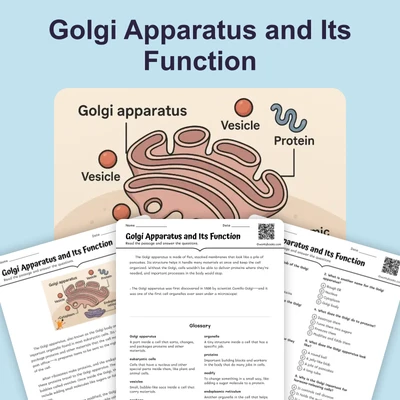
Golgi Apparatus and Its Function
This NGSS-aligned reading passage introduces middle school students to the structure and function of the Golgi apparatus...
MS-LS1-1
Is a Platypus a Mammal?
This interactive science reading passage, titled "Is a Platypus a Mammal? The Monotreme Mystery!", delves into the uniqu...
MS-LS1-1
Where Do Platypus Live?
This engaging science reading passage, titled "Where Do Platypus Live? Finding Australia's Elusive Swimmer," explores th...
MS-LS1-1
The Amazing Red Panda
This engaging science reading passage, titled "The Amazing Red Panda: A Fluffy Tree Dweller," introduces students to one...
MS-LS1-1MS-LS4-D
Where Do Red Pandas Live?
This science reading passage, titled "Where Do Red Pandas Live? In the Mountain Forests," explores the specific habitat ...
MS-LS1-1
Przewalski's Horse
This engaging science reading passage, titled "Przewalski's Horse: A Wild Comeback Story," introduces students to the tr...
MS-LS4-DMS-LS1-1
The Quokka
This engaging science reading passage, titled "The Quokka: The Happiest Animal on Earth?", introduces students to one of...
MS-LS4-DMS-LS1-1
The Proboscis Monkey
This interactive science reading passage, titled "The Proboscis Monkey: A Monkey with a Mighty Nose!", introduces studen...