This learning resource is available in interactive and printable formats. The interactive worksheet can be played online and assigned to students. The Printable PDF version can be downloaded and printed for completion by hand.
This engaging passage, ideal for Grade 5 learners and audio integrated, delves into the fascinating world of the giant isopod and its vital role as a scavenger in the deep ocean food web. Students will learn about its unique life cycle, habitat, and how it contributes to the ecosystem. Aligned with NGSS Standard LS1.B: Growth and Development of Organisms, this resource introduces key scientific vocabulary and concepts, making complex marine biology accessible. It highlights adaptations for survival in extreme environments and emphasizes the interconnectedness of life in the deep sea. Discover the hidden life of these mysterious deep-sea creatures.
CONTENT PREVIEW
Expand content preview
Giant isopods clean the ocean floor and grow through molting in extreme deep-sea conditions.
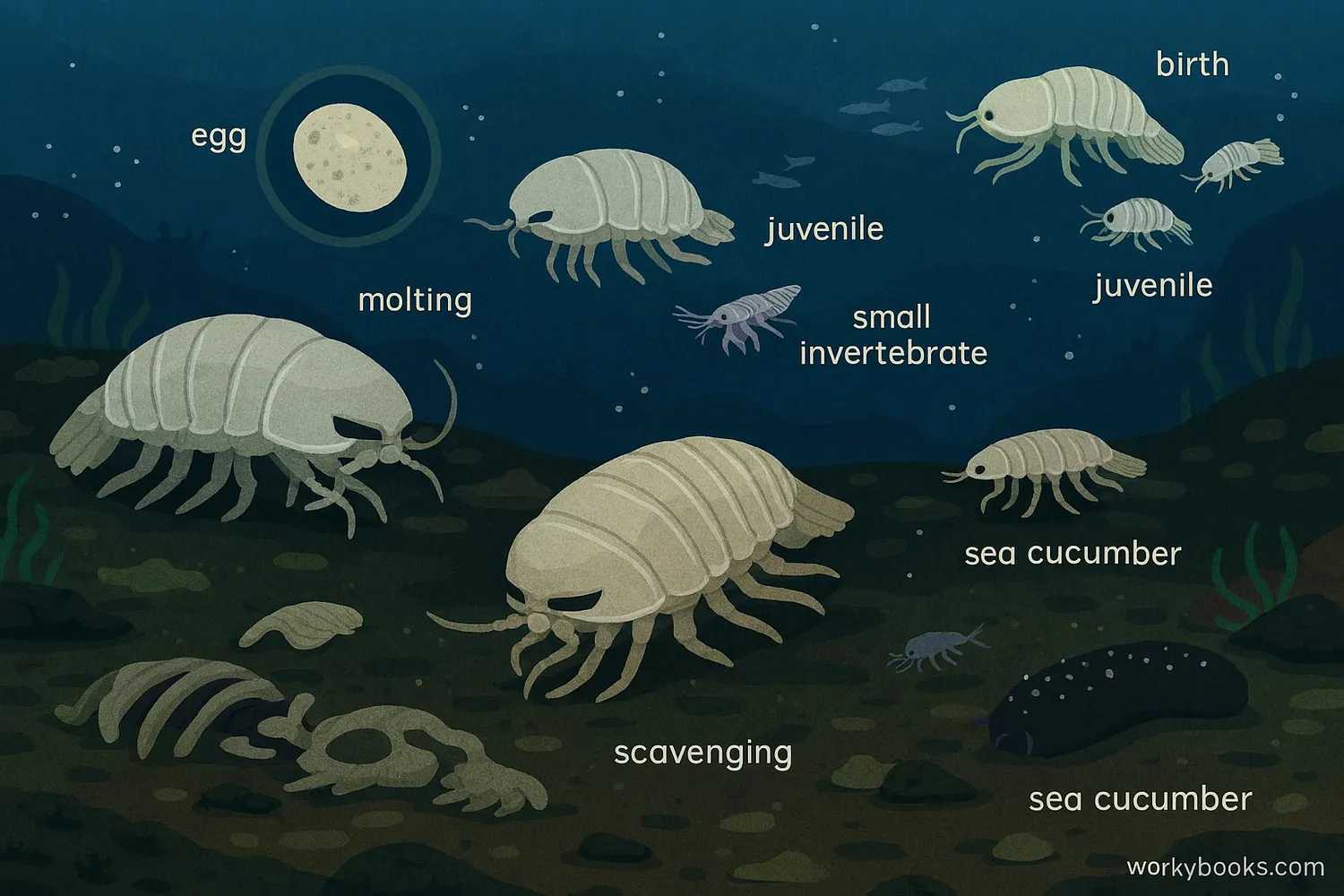
Meet the Giant Isopod Giant isopods are amazing ocean animals that look like enormous pill bugs, or roly-polies. These creatures live deep in the ocean, far below where sunlight can reach. Some giant isopods can grow up to 16 inches long, which is bigger than a football!
Where They Live Giant isopods live on the ocean floor at depths between 550 and 7,000 feet. Down there, it is very cold and completely dark. Food is hard to find, so animals must be clever to survive.
What They Eat Giant isopods are scavengers. This means they eat dead plants and animals. One of their favorite meals is a whale fall—when a dead whale sinks to the bottom of the ocean, isopods can feast on it for years! They also eat dead fish, squid, and other slow-moving animals like sea cucumbers and sponges. Sometimes, they catch weak or slow prey. Giant isopods are like the ocean floor’s cleanup crew. They help keep the sea clean by eating dead things.
How They Eat Giant isopods use their strong jaws to tear food into pieces. Their mouths have four sets of jaws that work together to break down tough food. Because food is so rare in the deep sea, they can go up to 5 years without eating! When food does arrive, they eat as much as they can all at once. This is called a feast-or-famine lifestyle.
Special Adaptations These animals have amazing adaptations. They have a hard exoskeleton to protect their bodies, and very large compound eyes to help them see in the dark. If they feel threatened, they can curl up into a ball, just like their pill bug cousins.
Why Are They Important? Giant isopods are decomposers. By eating dead plants and animals, they recycle nutrients back into the ocean. This helps other animals survive and keeps the ocean healthy.
Interesting Fact: Giant isopods are related to shrimp and crabs—and in some countries, people even eat them as food!
How big can giant isopods grow?
Up to 16 inchesUp to 3 inchesUp to 2 feetUp to 6 inches
Where do giant isopods live?
Ocean floorRainforestMountainsRivers
What is a whale fall?
Dead whale on ocean floorWhale jumping out of waterWhale swimming fastBaby whale born
Why can isopods go 5 years without food?
Food is rare in deep seaThey hibernateThey are smallThey eat plants
What do isopods use to eat tough food?
Strong jawsSharp teethLong tonguesClaws
How do isopods help the ocean?
Recycle nutrientsMake wavesGrow plantsHunt big fish
Is a giant isopod a scavenger? (True/False)
TrueFalse
What does 'exoskeleton' mean?
Hard outer shellSoft bodyBig eyeStrong tail
Perfect For:
👩🏫 Teachers
• Reading comprehension practice
• Auto-graded assessments
• Literacy skill development
👨👩👧👦 Parents
• Reading practice at home
• Comprehension improvement
• Educational reading time
🏠 Homeschoolers
• Reading curriculum support
• Independent reading practice
• Progress monitoring
Reading Features:
📖
Reading Passage
Engaging fiction or nonfiction text
❓
Comprehension Quiz
Auto-graded questions
📊
Instant Feedback
Immediate results and scoring
📄
Printable Version
Download for offline reading
🔊
Read Aloud
Voice-over with word highlighting
Reviews & Ratings
No reviews yet. Be the first to share your experience!
Related Content
The Nature of Life Science
This passage, aligned with NGSS MS-LS1-1, introduces students in grades 6-8 to the foundational concepts of life science...
MS-LS1-1
Aerobic Organisms
This engaging, audio-integrated reading passage, titled 'Aerobic Organisms: The Breath of Life,' introduces students to ...
From Cells to Organisms
This educational passage, "From Cells to Organisms," explores the fundamental concept of how living things are built, st...
Using Dichotomous Keys to Identify Organisms
This audio-integrated passage, 'Using Dichotomous Keys to Identify Organisms,' introduces 6th-grade students to a fundam...
Science Vocabulary
This worksheet on domain-specific words will help students learn some science vocabulary. Students will be asked to matc...
L.3.6L.3.4.A
The Aorta: Molecules to Organisms of the Body's Largest Artery
This educational content features a fascinating reading passage, audio integrated for an enhanced learning experience, a...
Tools and Technology for Life Scientists
This informational passage for grades 6-8 explores the essential tools and technology used by life scientists, aligned t...
MS-LS1-1MS-LS1.A
Simple Machines Science Report
This science writing task requires students to clearly explain how three simple machines work using precise domain-speci...
W.5.4
Cryptobiosis: Pausing Life to Survive
This engaging, audio-integrated reading passage explores the amazing biological process of cryptobiosis, where organisms...
From Senses to Actions
This Grade 4-5 science passage, 'From Senses to Actions,' explores how our senses work together with the brain and body ...
The Science of Hibernation
This educational module, featuring an audio-integrated reading passage titled 'The Science of Hibernation,' is designed ...
The Life Cycle of a Giant Panda
This engaging, audio-integrated reading passage, titled "The Life Cycle of a Giant Panda," explores the fascinating stag...
How Bats Use Sound to See
This Grade 4-5 science passage, 'How Bats Use Sound to See,' explores the fascinating process of echolocation in bats. S...
Citizen Science and Ecological Monitoring
This engaging passage for grades 6-8 introduces the concept of citizen science and its critical role in ecological monit...
MS-LS2-1
The Pumpkin Life Cycle
This informational worksheet explores the pumpkin lifecycle, guiding students through procedural steps in a scientific t...
RI.2.3RI.2.10
Life Cycle Stages
This comprehensive word sort activity helps Grade 3 students understand the universal stages of life cycles as outlined ...
Growth and Development of Organisms
This middle school science passage, aligned with NGSS standards MS-LS1-4 and MS-LS1-5, provides an in-depth look at the ...
MS-LS1-4MS-LS1-5
Life Makers
This engaging word sort activity helps elementary students understand the diverse methods of reproduction in living orga...
What Is Earth Science?
This engaging middle school science passage introduces students to the field of Earth science, aligning with NGSS standa...
MS-ESS1MS-ESS2MS-ESS3SEP
Barnacles and Biofouling
This engaging, audio-integrated reading passage, 'Barnacles and Biofouling,' delves into the fascinating world of how ti...