What does the Sympathetic Nervous System do — Reading Comprehension
Rate this
Premium Resource
Present
Present in classroom. No work saved
Assign
Classroom with student accounts, Track progress
Quick Play
No student accounts, assign with a link
Grades
3
4
5
6
7
8
PRINT+DIGITAL RESOURCE
This learning resource is available in interactive and printable formats. The interactive worksheet can be played online and assigned to students. The Printable PDF version can be downloaded and printed for completion by hand.
"This science passage provides a clear, comprehensive overview of the sympathetic nervous system and its role in the 'fight or flight' response, tailored for a middle school audience (grades 6-8). The content aligns with life science standards (e.g., NGSS MS-LS1-8) by explaining how the body's systems work together to respond to stimuli and maintain homeostasis. Students will learn about key concepts such as involuntary bodily functions, the role of neurotransmitters like epinephrine, and the physiological changes that occur during a stress response, including increased heart rate, redirected blood flow, and glucose release. The passage connects these biological processes to relatable real-world examples, helping students understand the science behind their body's automatic reactions. This learning module is designed for self-study and includes multiple-choice questions to assess both factual recall and deeper conceptual understanding."
CONTENT PREVIEW
Expand content preview
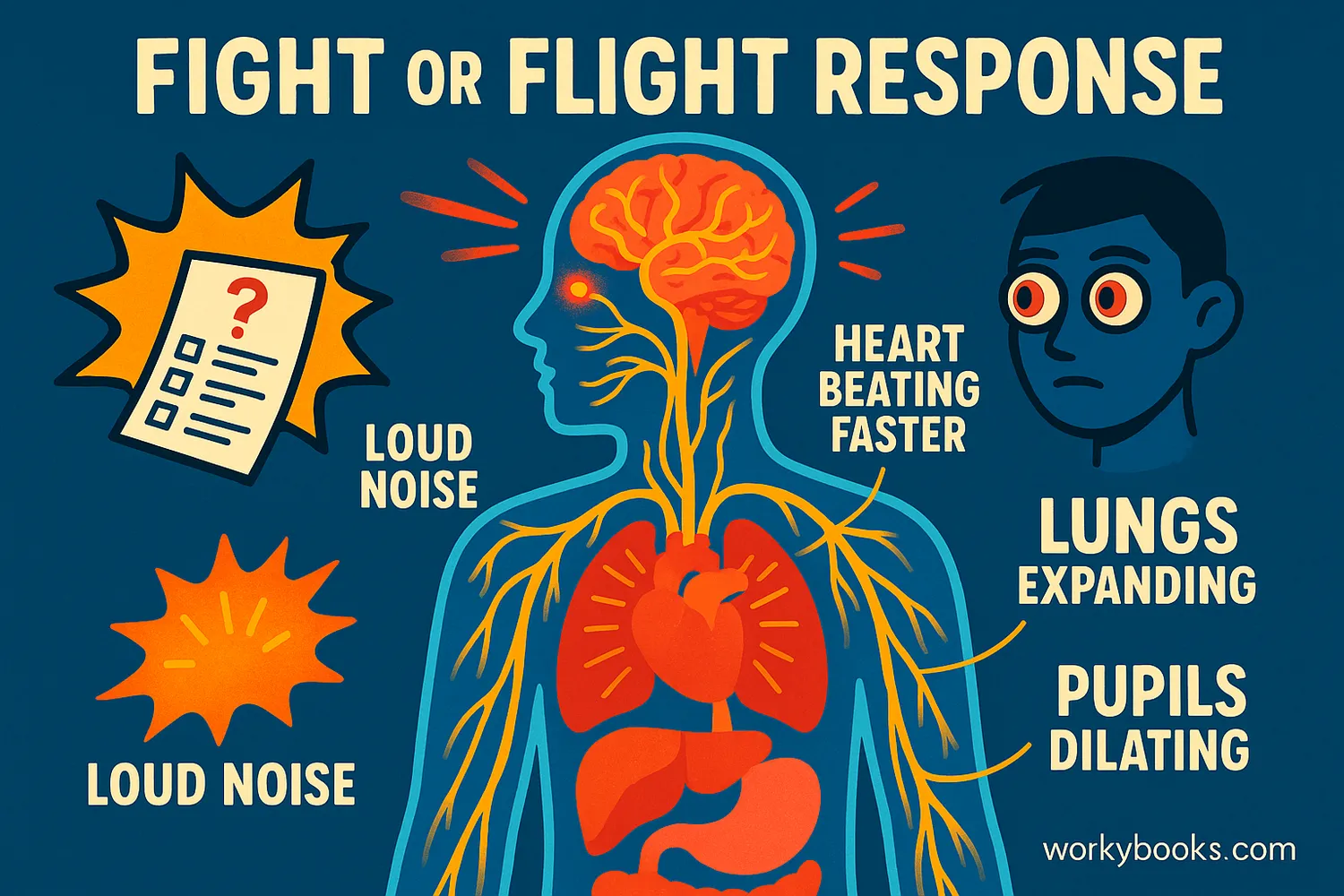
The body's "fight or flight" response, activated by the sympathetic nervous system to prepare the body for a stressful or challenging situation.
The sympathetic nervous system is a crucial part of your body's autonomic nervous system, which controls involuntary functions like heart rate, breathing, and digestion. Its primary role is to prepare your body for sudden, demanding situations—what scientists call the "fight or flight" response. This system is activated when your brain perceives a threat, a stressful situation, or even intense physical activity. It quickly mobilizes the body's resources to help you respond to a challenge, whether that means running away from danger or performing at your best in a sports competition.
When the sympathetic nervous system is triggered, it sends signals throughout the body, causing a cascade of physiological changes. Your heart rate and breathing rate increase to pump more oxygen-rich blood to your muscles. Your blood vessels constrict in non-essential areas like the digestive system but dilate in your muscles and brain. This redirection of blood flow ensures that your muscles have the energy they need for a quick reaction, and your brain is alert and focused. Simultaneously, your pupils dilate to improve your vision, and your liver releases stored glucose into your bloodstream for an instant energy boost.
A key part of this response involves chemical messengers called neurotransmitters, such as epinephrine and norepinephrine. These chemicals are released by nerves and glands, including the adrenal glands, to amplify the "fight or flight" signals and sustain the body's heightened state. For example, the adrenal glands release a rush of epinephrine (also known as adrenaline) that can make you feel a sudden surge of energy and power. Once the threat or stress is over, the parasympathetic nervous system takes over, working to calm the body down and return it to a state of rest and balance.
Fun Fact: The "goosebumps" you get when you're cold or scared are a leftover function of the sympathetic nervous system. In our ancestors, this response would have made their hair stand on end, making them look bigger and more intimidating to predators.
What is the primary function of the sympathetic nervous system?
To calm the body downTo control voluntary muscle movementTo prepare the body for "fight or flight"To help with long-term digestion
What is an example of an involuntary function controlled by the autonomic nervous system?
Kicking a ballReading a bookBreathingWriting your name
How does the sympathetic nervous system affect heart rate and breathing?
It slows them downIt speeds them upIt has no effect on themIt makes them irregular
Which of the following is NOT a change that occurs when the sympathetic nervous system is activated?
Pupils dilateDigestion speeds upBlood flow is redirectedGlucose is released from the liver
What is the role of neurotransmitters like epinephrine in the "fight or flight" response?
To slow down muscle reactionsTo help the body restTo amplify and sustain the body's responseTo redirect blood flow to the stomach
Based on the passage, what can you infer about the parasympathetic nervous system?
It is always active at the same time as the sympathetic system.It has a calming effect on the body.It is responsible for releasing adrenaline.It only works during sleep.
What is the main idea of the reading passage?
The nervous system is made up of many different parts.The sympathetic nervous system helps the body perform everyday tasks.The "fight or flight" response is a dangerous and outdated body function.The sympathetic nervous system prepares the body for stressful situations.
A student is about to give a presentation and feels their heart racing and hands sweating. This is an example of:
The parasympathetic nervous system calming them.The sympathetic nervous system preparing them to "fight."The body conserving energy for later use.A conscious, voluntary response to stress.
Perfect For:
👩🏫 Teachers
• Reading comprehension practice
• Auto-graded assessments
• Literacy skill development
👨👩👧👦 Parents
• Reading practice at home
• Comprehension improvement
• Educational reading time
🏠 Homeschoolers
• Reading curriculum support
• Independent reading practice
• Progress monitoring
Reading Features:
📖
Reading Passage
Engaging fiction or nonfiction text
❓
Comprehension Quiz
Auto-graded questions
📊
Instant Feedback
Immediate results and scoring
📄
Printable Version
Download for offline reading
🔊
Read Aloud
Voice-over with word highlighting
Reviews & Ratings
No reviews yet. Be the first to share your experience!
Related Content
The Nature of Life Science
This passage, aligned with NGSS MS-LS1-1, introduces students in grades 6-8 to the foundational concepts of life science...
MS-LS1-1
Aerobic Organisms
This engaging, audio-integrated reading passage, titled 'Aerobic Organisms: The Breath of Life,' introduces students to ...
From Cells to Organisms
This educational passage, "From Cells to Organisms," explores the fundamental concept of how living things are built, st...
Using Dichotomous Keys to Identify Organisms
This audio-integrated passage, 'Using Dichotomous Keys to Identify Organisms,' introduces 6th-grade students to a fundam...
Science Vocabulary
This worksheet on domain-specific words will help students learn some science vocabulary. Students will be asked to matc...
L.3.6L.3.4.A
The Aorta: Molecules to Organisms of the Body's Largest Artery
This educational content features a fascinating reading passage, audio integrated for an enhanced learning experience, a...
Simple Machines Science Report
This science writing task requires students to clearly explain how three simple machines work using precise domain-speci...
W.5.4
Tools and Technology for Life Scientists
This informational passage for grades 6-8 explores the essential tools and technology used by life scientists, aligned t...
MS-LS1-1MS-LS1.A
Cryptobiosis: Pausing Life to Survive
This engaging, audio-integrated reading passage explores the amazing biological process of cryptobiosis, where organisms...
From Senses to Actions
This Grade 4-5 science passage, 'From Senses to Actions,' explores how our senses work together with the brain and body ...
The Science of Hibernation
This educational module, featuring an audio-integrated reading passage titled 'The Science of Hibernation,' is designed ...
The Life Cycle of a Giant Panda
This engaging, audio-integrated reading passage, titled "The Life Cycle of a Giant Panda," explores the fascinating stag...
How Bats Use Sound to See
This Grade 4-5 science passage, 'How Bats Use Sound to See,' explores the fascinating process of echolocation in bats. S...
Citizen Science and Ecological Monitoring
This engaging passage for grades 6-8 introduces the concept of citizen science and its critical role in ecological monit...
MS-LS2-1
The Pumpkin Life Cycle
This informational worksheet explores the pumpkin lifecycle, guiding students through procedural steps in a scientific t...
RI.2.3RI.2.10
Life Cycle Stages
This comprehensive word sort activity helps Grade 3 students understand the universal stages of life cycles as outlined ...
What Is Earth Science?
This engaging middle school science passage introduces students to the field of Earth science, aligning with NGSS standa...
MS-ESS1MS-ESS2MS-ESS3SEP
Growth and Development of Organisms
This middle school science passage, aligned with NGSS standards MS-LS1-4 and MS-LS1-5, provides an in-depth look at the ...
MS-LS1-4MS-LS1-5
Life Makers
This engaging word sort activity helps elementary students understand the diverse methods of reproduction in living orga...
Barnacles and Biofouling
This engaging, audio-integrated reading passage, 'Barnacles and Biofouling,' delves into the fascinating world of how ti...