What Effect Does Human Activity Have On Many Ecosystems? — Reading Comprehension
Rate this
Premium Resource
Present
Present in classroom. No work saved
Assign
Classroom with student accounts, Track progress
Quick Play
No student accounts, assign with a link
Grades
6
PRINT+DIGITAL RESOURCE
This learning resource is available in interactive and printable formats. The interactive worksheet can be played online and assigned to students. The Printable PDF version can be downloaded and printed for completion by hand.
This educational content explores the significant effects of human activities on various ecosystems. Designed for a Grade 6 reading level, it aligns with NGSS Standard MS-ESS3-3 by encouraging students to understand how human actions, such as pollution, deforestation, and urbanization, lead to environmental changes like habitat loss and climate change. The passage defines key terms and provides real-world examples, helping students grasp the concepts of environmental degradation and the importance of conservation. It includes audio-integrated reading passages, multiple-choice questions, a glossary, and short-answer prompts to enhance comprehension and critical thinking about monitoring and minimizing human impacts on the environment.
CONTENT PREVIEW
Expand content preview
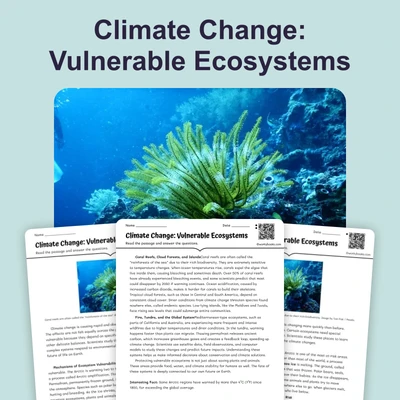
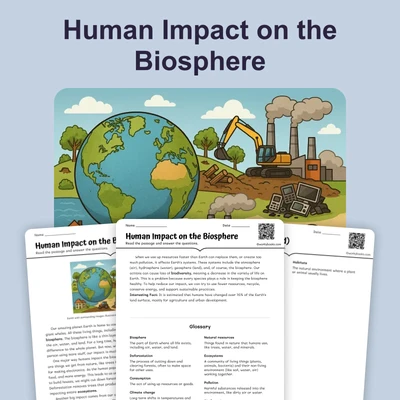
Human impact on ecosystems: pollution, deforestation, climate change, and solutions for a healthier planet.
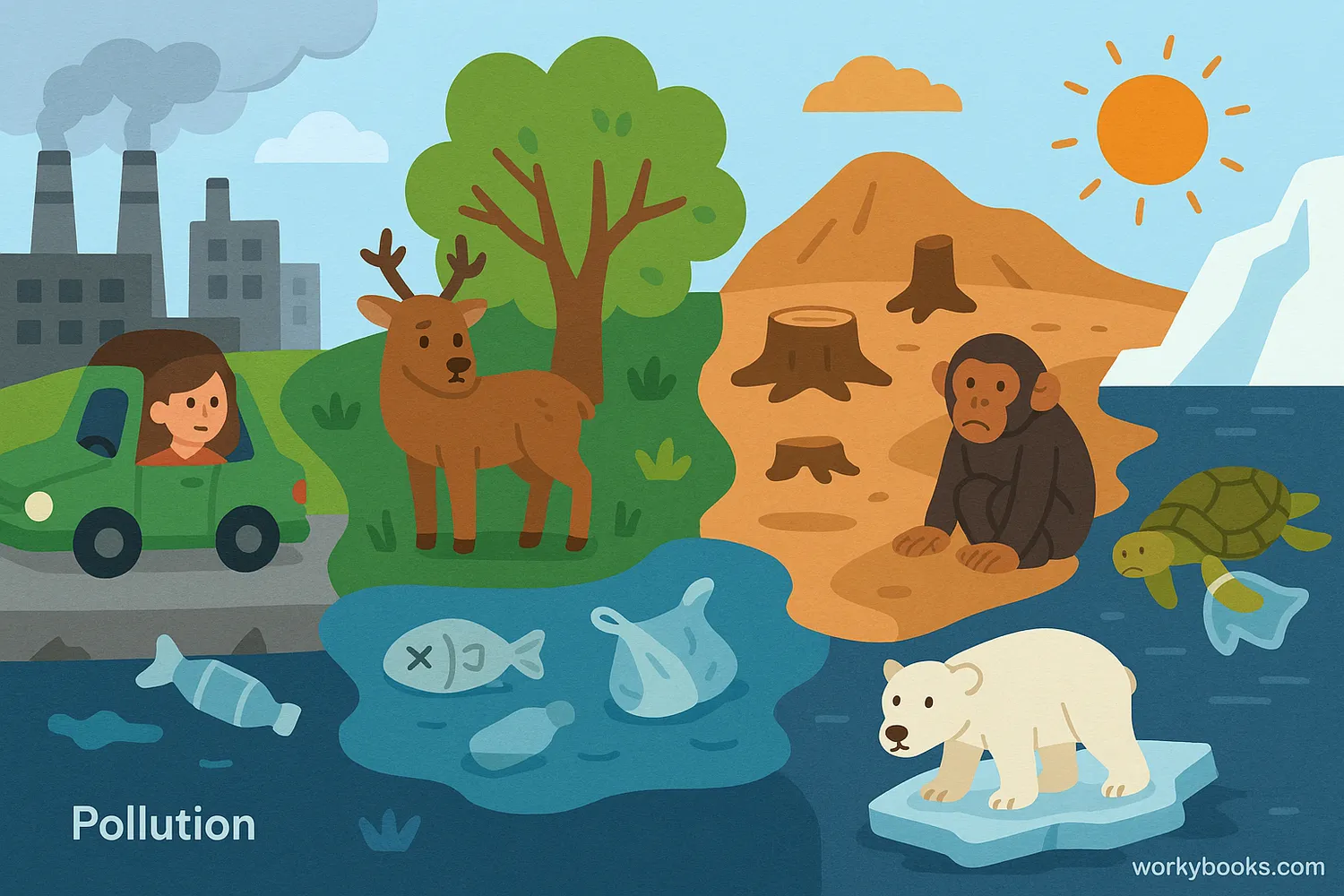
Our planet is full of amazing ecosystems, which are communities of living things (like plants and animals) and their non-living environment (like water, soil, and air). But what happens when humans interact with these delicate systems? Our actions, both big and small, can have a huge impact.
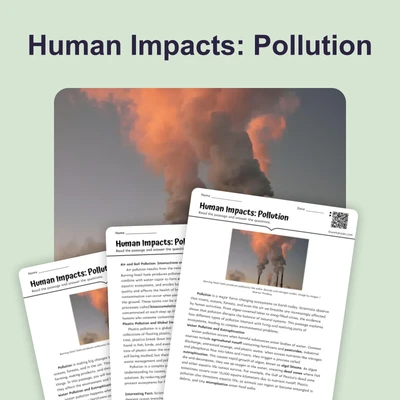
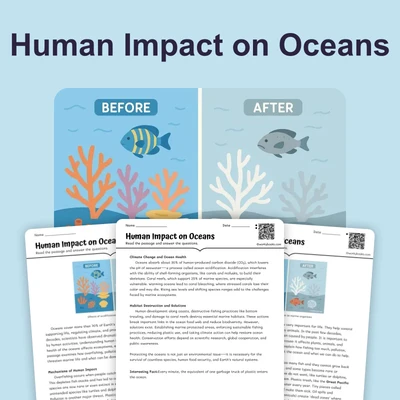
One major impact is pollution. When we drive cars, factories release smoke, or even when we throw away trash incorrectly, harmful substances can enter the air, water, and soil. Air pollution can make it hard for animals to breathe and damage plants. Water pollution, often from chemicals or plastic waste, harms fish and other aquatic life. For example, plastic bags in the ocean can be mistaken for food by sea turtles, causing them to get sick.
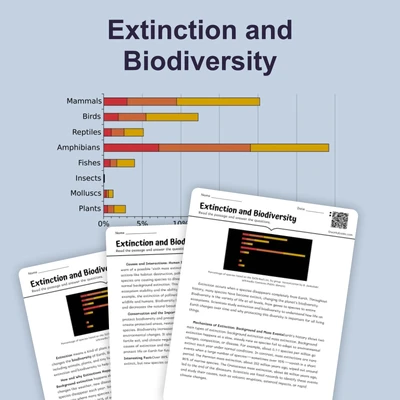
Another significant human activity is deforestation, which is the clearing of forests. We cut down trees for timber, to make space for farms, or to build cities. Forests are vital ecosystems; they provide homes for countless species, produce oxygen, and absorb carbon dioxide from the atmosphere. When forests are cut down, animals lose their habitat, which is their natural home. This can lead to a decrease in the number of different types of plants and animals, also known as a loss of biodiversity.
Human activities also contribute to climate change. When we burn fossil fuels for energy (like coal, oil, and natural gas), we release gases into the atmosphere that trap heat. This makes the Earth's temperature rise, leading to changes in weather patterns, melting glaciers, and rising sea levels. These changes can severely disrupt ecosystems, forcing animals to move or even threatening their survival.
So, what can we do? We can make choices that minimize our impact. This includes reducing waste, recycling, using less energy, and supporting efforts to protect natural areas. Understanding how our actions affect the environment is the first step towards creating a healthier planet for everyone.
Interesting Fact: A single plastic bottle can take up to 450 years to decompose, meaning plastic from hundreds of years ago is still in our environment today!
What are ecosystems made of?
Living and non-living thingsOnly plants and animalsJust water and soilOnly human activities
What is deforestation?
Clearing of forestsPlanting new treesStudying tree typesBuilding treehouses
How does water pollution harm sea turtles?
Mistake plastic for foodMakes water too coldIncreases oxygen levelsChanges their swim path
What is a habitat?
An animal's natural homeA type of pollutionA cut-down forestA human activity
Why are forests important for the atmosphere?
Produce oxygen, absorb CO2Create more fossil fuelsTrap heat for the EarthRelease harmful chemicals
Which activity contributes to climate change?
Burning fossil fuelsRecycling plastic bottlesPlanting new treesCleaning up rivers
What happens when animals lose their habitat?
Can decrease biodiversityIncreases human populationMakes air cleanerStrengthens ecosystems
What is the best way to reduce waste?
Recycling and reusingBurning more trashUsing more plasticCutting down forests
Supporting protection of natural areas helps minimize human impact.
TrueFalse
Which word means to make something smaller?
MinimizeMaximizeImpactBiodiversity
Perfect For:
👩🏫 Teachers
• Reading comprehension practice
• Auto-graded assessments
• Literacy skill development
👨👩👧👦 Parents
• Reading practice at home
• Comprehension improvement
• Educational reading time
🏠 Homeschoolers
• Reading curriculum support
• Independent reading practice
• Progress monitoring
Reading Features:
📖
Reading Passage
Engaging fiction or nonfiction text
❓
Comprehension Quiz
Auto-graded questions
📊
Instant Feedback
Immediate results and scoring
📄
Printable Version
Download for offline reading
🔊
Read Aloud
Voice-over with word highlighting
Reviews & Ratings
No reviews yet. Be the first to share your experience!
Related Content
Tools and Technology in Earth Science
This middle school science reading passage explores the wide range of tools and technologies used in Earth science, from...
MS-ESS2-2MS-ESS3-2MS-ETS1-1MS-PS4-3
What Is Earth Science?
This engaging middle school science passage introduces students to the field of Earth science, aligning with NGSS standa...
MS-ESS1MS-ESS2MS-ESS3SEP
Scientific Inquiry in Earth Science
This passage explores scientific inquiry in Earth science for grades 6-8, aligned with NGSS standards MS-ESS1-4, MS-ESS2...
MS-ESS1-4MS-ESS2-1MS-ESS3-5SEP
What Is Space Weather and How Does It Affect the Earth?
This NGSS-aligned science passage for middle school explains what space weather is and how it affects Earth. Students le...
MS-ESS2-2
Earth: Our Home in Space
This engaging Grade 4-5 science passage, aligned to NGSS, introduces students to Earth's special place in the solar syst...
My Planet Earth
In this passage, students explore Earth as their home planet. They learn that Earth is made of land, water, and air, and...
FL.SS.2.G.1.1SS.2.G.1.3
Meteorite Impacts on Earth
This engaging science reading passage for Grades 4-5 explores meteorite impacts on Earth, aligning with NGSS standards. ...
Facts About Earth
This engaging science reading passage introduces Grade 4 and 5 students to Earth, our home planet. Aligned with NGSS sta...
Earth's Quick and Slow Changes
In 'Earth's Quick and Slow Changes,' students categorize 12 Earth events by their speed of occurrence, enhancing underst...
Earth Day and Types of Pollution
Earth Day is coming! Get ready to learn about pollution and test your knowledge. Click for a free reading passage and qu...
RI.4.1RI.4.2ESS3.CESS3.A
Earth Changes Over Millions of Years
This engaging, audio-integrated science passage for Grade 4-5 students explores how Earth has changed over millions of y...
Rare Earth Minerals in Smartphones and Computers
Rare earth minerals are critical for smartphones, computers, and renewable energy. Mining them has environmental impacts...
RI.5.3RI.6.3RI.7.3
What Makes Earth Perfect for Life?
This Grade 4-5 science passage, aligned with NGSS standards, explores the essential features that make Earth the perfect...
Earth Changes Word Sort
This word sort activity helps students understand different rates of change in Earth's systems. Students classify 12 geo...
Escape Velocity and Space Travel
This middle school science passage introduces students to the concept of escape velocity—the minimum speed required to b...
MS-ESS1-2MS-PS2-4
Earth's Spheres
This middle school science passage introduces students to Earth's four major spheres: the geosphere, hydrosphere, atmosp...
MS-ESS2-4MS-ESS2-6
The Diameter of Earth
This science reading passage explains the diameter of Earth, describing it as about 12,742 kilometers or 7,918 miles acr...
5-PS2-1
Aphelion and Perihelion
This engaging reading passage, 'Aphelion and Perihelion,' delves into the fascinating aspects of Earth's elliptical orbi...
MS-ESS1-1: DEVELOP AND USE A MODEL OF THE EARTH-SUN-MOON SYSTEM TO DESCRIBE THE CYCLIC PATTERNS OF LUNAR PHASESECLIPSES OF THE SUN AND MOONAND SEASONS.
History of Life on Earth
This comprehensive middle school science reading passage provides an engaging overview of the history of life on Earth, ...
MS-ESS1-4MS-LS4-1
Earth: Our Home Planet
This comprehensive science passage for grades 6-8 explores Earth’s unique characteristics and the interconnected systems...