This learning resource is available in interactive and printable formats. The interactive worksheet can be played online and assigned to students. The Printable PDF version can be downloaded and printed for completion by hand.
Dive into the fascinating world of autotrophs with this engaging, audio-integrated reading passage designed for Grade 6 students. This educational content aligns with NGSS Disciplinary Core Idea LS1.C: Organization for Matter and Energy Flow, explaining how autotrophs are organisms that capture energy and matter from the physical environment to produce their own food. Students will learn about the process of photosynthesis, the role of sunlight, water, and carbon dioxide, and the importance of autotrophs as producers in ecosystems. Key terms like chloroplasts and chlorophyll are defined to enhance understanding. The passage is followed by comprehension questions, a glossary, and short answer questions to reinforce learning about these vital energy producers.
CONTENT PREVIEW
Expand content preview
Autotrophs are incredibly important for all life.
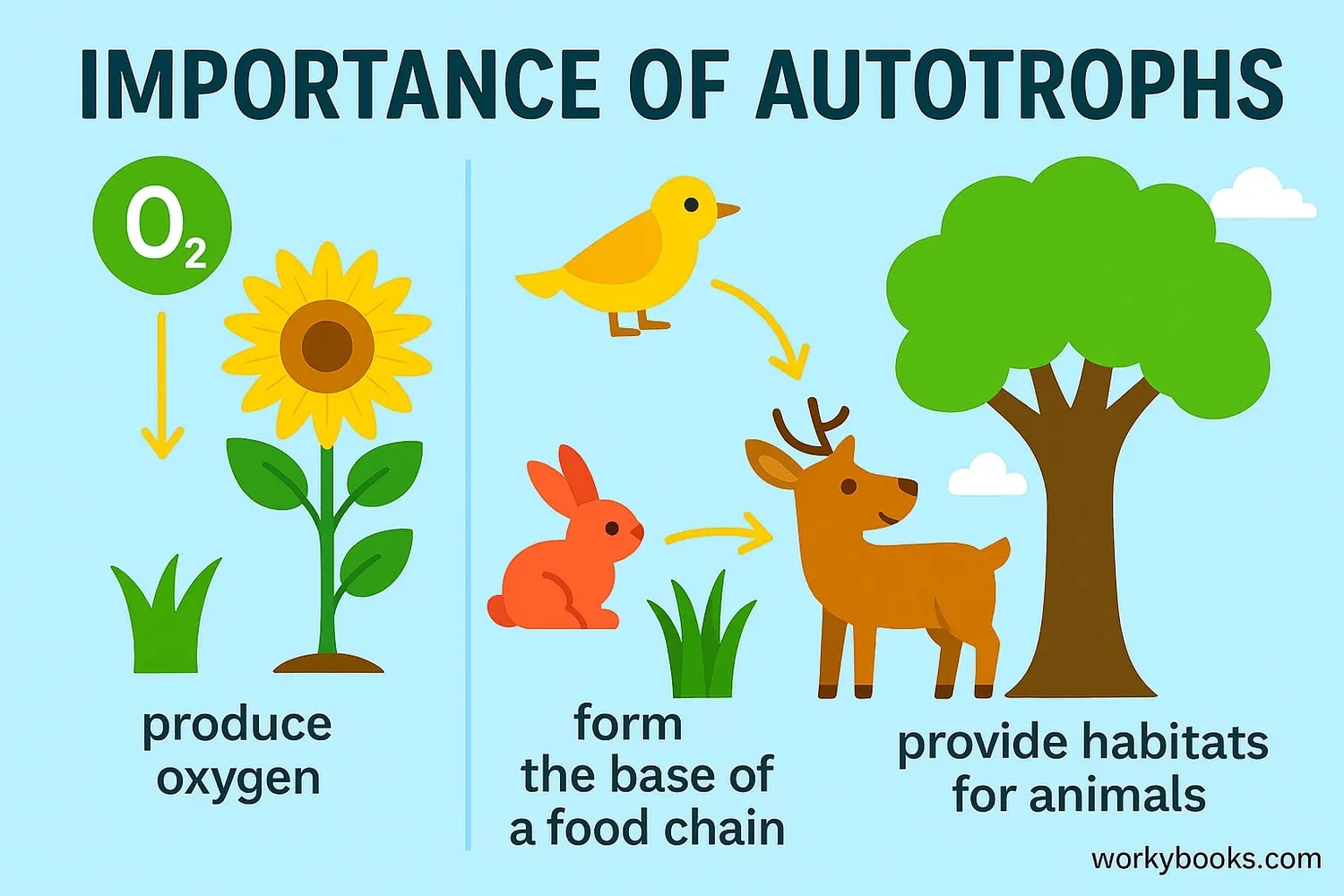
Autotrophs are organisms with the remarkable ability to produce their own food, often by using sunlight as an energy source. The term comes from the Greek words auto (“self”) and troph (“nourishing”), reflecting their capacity for self-sustenance. Unlike humans and other animals that must consume food, autotrophs create it—most commonly through photosynthesis, where light energy is converted into chemical energy.
Most autotrophs you encounter are plants. Think about a towering oak tree, a tiny blade of grass, or even the colorful flowers in a garden. All these plants are autotrophs. But it's not just plants; some types of bacteria and algae are also autotrophs. These organisms are often called producers because they produce their own food, forming the very base of almost every food chain on our planet.
How do they do it? The secret lies in a process called photosynthesis. During photosynthesis, autotrophs use energy from sunlight, water from the soil, and carbon dioxide from the air to create their own food in the form of sugars (like glucose). As a bonus, they also release oxygen, which is essential for many other living things, including us, to breathe! This process mainly happens in special parts of plant cells called chloroplasts, which contain a green pigment called chlorophyll that captures sunlight.
Autotrophs are incredibly important for all life. Without them, there would be no food for herbivores (animals that eat plants), and without herbivores, there would be no food for carnivores (animals that eat other animals). They are the original source of energy that flows through nearly every ecosystem. So, the next time you see a green leaf, remember the amazing work it's doing, not just for itself, but for the entire planet!
Interesting Fact: Some autotrophs, called chemoautotrophs, don't use sunlight for energy; instead, they use chemical reactions, often found in deep-sea vents where sunlight can't reach.
What is the primary way most autotrophs make food?
Eating other animalsUsing sunlight energyConsuming fungiBreaking down rocks
What gas do autotrophs release during photosynthesis?
Carbon dioxideNitrogenOxygenMethane
Which of these is NOT an example of an autotroph?
Oak treeAlgaeRabbitBacteria
Why are autotrophs called "producers"?
They make sheltersThey create foodThey build nestsThey produce heat
What captures sunlight in chloroplasts?
StemsRootsChlorophyllWater
Which Greek word means "self"?
TrophPhotoAutoSynth
Autotrophs are important for Earth's oxygen.
TrueFalse
Which defines 'food chain' best?
Linked feeding relationshipsAnimal hunting patternsPlant growing cyclesWater movement cycle
If all autotrophs disappeared, what would happen to herbivores?
They would grow biggerThey would have no foodThey would eat carnivoresThey would make their own food
How would the air change without photosynthesis?
More oxygenLess carbon dioxideLess oxygenNo change
Perfect For:
👩🏫 Teachers
• Reading comprehension practice
• Auto-graded assessments
• Literacy skill development
👨👩👧👦 Parents
• Reading practice at home
• Comprehension improvement
• Educational reading time
🏠 Homeschoolers
• Reading curriculum support
• Independent reading practice
• Progress monitoring
Reading Features:
📖
Reading Passage
Engaging fiction or nonfiction text
❓
Comprehension Quiz
Auto-graded questions
📊
Instant Feedback
Immediate results and scoring
📄
Printable Version
Download for offline reading
🔊
Read Aloud
Voice-over with word highlighting
Reviews & Ratings
No reviews yet. Be the first to share your experience!
Related Content
The Nature of Life Science
This passage, aligned with NGSS MS-LS1-1, introduces students in grades 6-8 to the foundational concepts of life science...
MS-LS1-1
Aerobic Organisms
This engaging, audio-integrated reading passage, titled 'Aerobic Organisms: The Breath of Life,' introduces students to ...
From Cells to Organisms
This educational passage, "From Cells to Organisms," explores the fundamental concept of how living things are built, st...
Using Dichotomous Keys to Identify Organisms
This audio-integrated passage, 'Using Dichotomous Keys to Identify Organisms,' introduces 6th-grade students to a fundam...
Science Vocabulary
This worksheet on domain-specific words will help students learn some science vocabulary. Students will be asked to matc...
L.3.6L.3.4.A
The Aorta: Molecules to Organisms of the Body's Largest Artery
This educational content features a fascinating reading passage, audio integrated for an enhanced learning experience, a...
Simple Machines Science Report
This science writing task requires students to clearly explain how three simple machines work using precise domain-speci...
W.5.4
Tools and Technology for Life Scientists
This informational passage for grades 6-8 explores the essential tools and technology used by life scientists, aligned t...
MS-LS1-1MS-LS1.A
Cryptobiosis: Pausing Life to Survive
This engaging, audio-integrated reading passage explores the amazing biological process of cryptobiosis, where organisms...
From Senses to Actions
This Grade 4-5 science passage, 'From Senses to Actions,' explores how our senses work together with the brain and body ...
The Science of Hibernation
This educational module, featuring an audio-integrated reading passage titled 'The Science of Hibernation,' is designed ...
The Life Cycle of a Giant Panda
This engaging, audio-integrated reading passage, titled "The Life Cycle of a Giant Panda," explores the fascinating stag...
How Bats Use Sound to See
This Grade 4-5 science passage, 'How Bats Use Sound to See,' explores the fascinating process of echolocation in bats. S...
Citizen Science and Ecological Monitoring
This engaging passage for grades 6-8 introduces the concept of citizen science and its critical role in ecological monit...
MS-LS2-1
The Pumpkin Life Cycle
This informational worksheet explores the pumpkin lifecycle, guiding students through procedural steps in a scientific t...
RI.2.3RI.2.10
Life Cycle Stages
This comprehensive word sort activity helps Grade 3 students understand the universal stages of life cycles as outlined ...
What Is Earth Science?
This engaging middle school science passage introduces students to the field of Earth science, aligning with NGSS standa...
MS-ESS1MS-ESS2MS-ESS3SEP
Growth and Development of Organisms
This middle school science passage, aligned with NGSS standards MS-LS1-4 and MS-LS1-5, provides an in-depth look at the ...
MS-LS1-4MS-LS1-5
Life Makers
This engaging word sort activity helps elementary students understand the diverse methods of reproduction in living orga...
Barnacles and Biofouling
This engaging, audio-integrated reading passage, 'Barnacles and Biofouling,' delves into the fascinating world of how ti...