This learning resource is available in interactive and printable formats. The interactive worksheet can be played online and assigned to students. The Printable PDF version can be downloaded and printed for completion by hand.
This engaging 4th-grade science reading passage, with audio integration, introduces students to the important ecological concept of bioaccumulation. The passage explains, in simple terms, how harmful substances like chemicals and heavy metals can accumulate in living organisms. It defines key terms such as bioaccumulation and biomagnification, using easy-to-understand analogies like a sponge soaking up water. The content aligns with the NGSS standard LS2.A: Interdependent Relationships in Ecosystems, helping students understand how organisms interact with their environment and how these interactions can be affected by pollution. The passage also includes a fun fact to capture students' interest and is followed by eight multiple-choice questions to assess their comprehension at different DOK levels. The questions test everything from literal recall to the application of learned concepts to new scenarios. With its audio-integrated format, this resource is perfect for diverse learning needs, providing a comprehensive and accessible way to explore how pollutants move through ecosystems.
CONTENT PREVIEW
Expand content preview
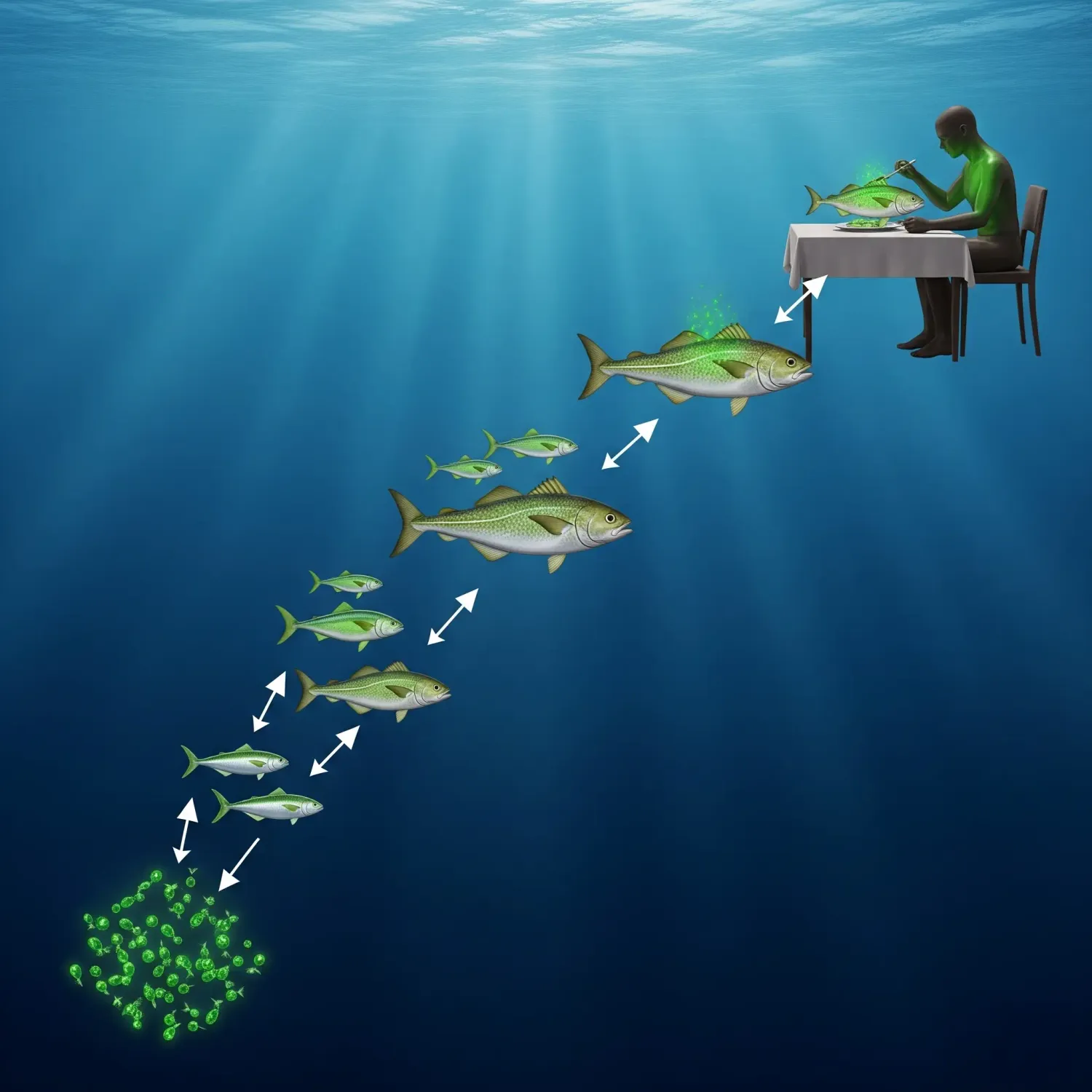
This diagram shows how toxins can build up in a food chain, a process called biomagnification.
Bioaccumulation is a process where harmful chemicals called toxins build up inside the bodies of living things over time. These toxins often come from pollution in our environment, such as chemicals in water or soil that animals can't get rid of easily.
One way bioaccumulation works is through the food chain. Here’s how it happens step by step:
Step 1: Tiny plants and algae in water absorb a little bit of pollution.
Step 2: Small fish eat many of these plants, so they collect more toxins in their bodies.
Step 3: Bigger fish eat lots of small fish, and the toxins add up even more in their bodies.
Step 4: Animals at the top of the food chain, like eagles, eat many big fish. These top predators end up with the most toxins of all.
This build-up can be dangerous. Too many toxins can make animals sick or even stop them from having healthy babies. For example, a pesticide called DDT got into lakes and rivers. Fish collected DDT in their bodies, and eagles that ate the fish got so much DDT that their eggshells became too thin. Many eagle eggs broke before hatching, and the eagle population almost disappeared!
Bioaccumulation is like collecting a penny from everyone in your school. One penny isn’t much, but if you collect from hundreds of students, you end up with a lot! In the same way, each step up the food chain adds more toxins.
That’s why protecting our environment from pollution is so important. We need to reduce pollution in water and be careful about what fish we eat, so that animals and people stay healthy. Stopping pollution at the source helps everyone in the food chain.
Interesting Fact: The bald eagle, America’s national bird, made a comeback after DDT was banned and now lives in all 50 states.
What is bioaccumulation?
Build up of toxins in animalsAnimals growing biggerPlants making foodFish swimming in rivers
Which animal gets the most toxins?
Tiny plantsSmall fishBig fishEagle
What happened to eagle eggshells from DDT?
Eggshells became thickEggshells became thinEggs got largerEggs changed color
Why is pollution in water a problem?
It helps plants growIt adds toxins to animalsIt makes water blueIt keeps fish warm
What is a food chain?
Order of eating and being eatenA tool for catching fishA place where birds liveA kind of pollution
How can we help stop bioaccumulation?
By polluting moreBy eating more fishBy stopping pollutionBy using more chemicals
Bioaccumulation is dangerous for animals. True or false?
TrueFalse
What does 'accumulate' mean?
To collect more and moreTo disappear quicklyTo swim fastTo change color
Perfect For:
👩🏫 Teachers
• Reading comprehension practice
• Auto-graded assessments
• Literacy skill development
👨👩👧👦 Parents
• Reading practice at home
• Comprehension improvement
• Educational reading time
🏠 Homeschoolers
• Reading curriculum support
• Independent reading practice
• Progress monitoring
Reading Features:
📖
Reading Passage
Engaging fiction or nonfiction text
❓
Comprehension Quiz
Auto-graded questions
📊
Instant Feedback
Immediate results and scoring
📄
Printable Version
Download for offline reading
🔊
Read Aloud
Voice-over with word highlighting
Reviews & Ratings
No reviews yet. Be the first to share your experience!
Related Content
The Nature of Life Science
This passage, aligned with NGSS MS-LS1-1, introduces students in grades 6-8 to the foundational concepts of life science...
MS-LS1-1
Aerobic Organisms
This engaging, audio-integrated reading passage, titled 'Aerobic Organisms: The Breath of Life,' introduces students to ...
From Cells to Organisms
This educational passage, "From Cells to Organisms," explores the fundamental concept of how living things are built, st...
Using Dichotomous Keys to Identify Organisms
This audio-integrated passage, 'Using Dichotomous Keys to Identify Organisms,' introduces 6th-grade students to a fundam...
Science Vocabulary
This worksheet on domain-specific words will help students learn some science vocabulary. Students will be asked to matc...
L.3.6L.3.4.A
The Aorta: Molecules to Organisms of the Body's Largest Artery
This educational content features a fascinating reading passage, audio integrated for an enhanced learning experience, a...
Simple Machines Science Report
This science writing task requires students to clearly explain how three simple machines work using precise domain-speci...
W.5.4
Tools and Technology for Life Scientists
This informational passage for grades 6-8 explores the essential tools and technology used by life scientists, aligned t...
MS-LS1-1MS-LS1.A
Cryptobiosis: Pausing Life to Survive
This engaging, audio-integrated reading passage explores the amazing biological process of cryptobiosis, where organisms...
From Senses to Actions
This Grade 4-5 science passage, 'From Senses to Actions,' explores how our senses work together with the brain and body ...
The Science of Hibernation
This educational module, featuring an audio-integrated reading passage titled 'The Science of Hibernation,' is designed ...
The Life Cycle of a Giant Panda
This engaging, audio-integrated reading passage, titled "The Life Cycle of a Giant Panda," explores the fascinating stag...
How Bats Use Sound to See
This Grade 4-5 science passage, 'How Bats Use Sound to See,' explores the fascinating process of echolocation in bats. S...
Citizen Science and Ecological Monitoring
This engaging passage for grades 6-8 introduces the concept of citizen science and its critical role in ecological monit...
MS-LS2-1
The Pumpkin Life Cycle
This informational worksheet explores the pumpkin lifecycle, guiding students through procedural steps in a scientific t...
RI.2.3RI.2.10
Life Cycle Stages
This comprehensive word sort activity helps Grade 3 students understand the universal stages of life cycles as outlined ...
What Is Earth Science?
This engaging middle school science passage introduces students to the field of Earth science, aligning with NGSS standa...
MS-ESS1MS-ESS2MS-ESS3SEP
Growth and Development of Organisms
This middle school science passage, aligned with NGSS standards MS-LS1-4 and MS-LS1-5, provides an in-depth look at the ...
MS-LS1-4MS-LS1-5
Life Makers
This engaging word sort activity helps elementary students understand the diverse methods of reproduction in living orga...
Barnacles and Biofouling
This engaging, audio-integrated reading passage, 'Barnacles and Biofouling,' delves into the fascinating world of how ti...