What Is Bioluminescence?
Interactive passage with audio narration, comprehension questions, and printable PDF.
By completing this purchase you agree to our Terms of Use and Privacy Policy. Your subscription renews automatically until you cancel. You can cancel anytime from your account settings. All sales are final and non-refundable. Digital content is available for download in your account immediately upon purchase.
What's included
What Is Bioluminescence? preview and details
About this printable What Is Bioluminescence? science reading passage, NGSS-aligned (Grade 6)
Sample passage and quiz from What Is Bioluminescence?
Reading passage and comprehension quiz preview
What Is Bioluminescence?
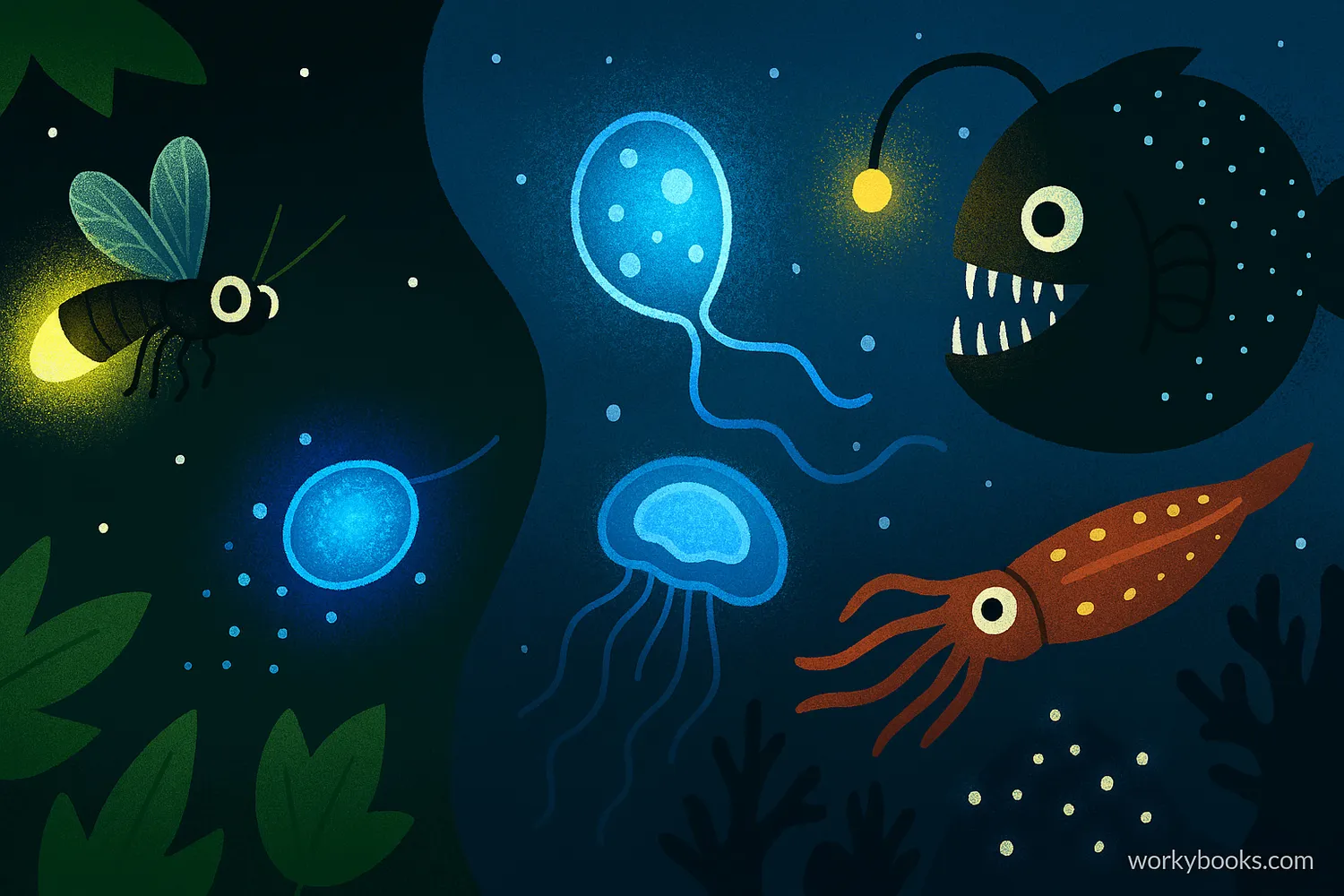
Imagine a world where living things glow, not from electricity, but from within themselves. This isn't a fantasy movie; it's the real phenomenon of bioluminescence! It's the incredible ability of certain organisms to produce their own light. This natural light show is a result of a fascinating chemical reaction happening inside their bodies. It's how fireflies light up summer nights and how many deep-sea creatures illuminate the darkest parts of the ocean.
So, how does this light magic work? At its heart, bioluminescence is an efficient chemical reaction that releases energy as light, with very little heat. This is different from a light bulb, which gets very hot. The main ingredients for this reaction are two special chemicals: a light-producing molecule called luciferin and an enzyme called luciferase. An enzyme is a protein that speeds up chemical reactions. When luciferin reacts with oxygen, and luciferase is present, along with other cofactors (helper molecules), light is created.
Many different types of organisms show off bioluminescence. Perhaps the most famous are fireflies, which use their flashing lights to attract mates. In the ocean, the diversity is even greater. Tiny dinoflagellates, a type of plankton, can cause waves to sparkle blue when disturbed. Anglerfish, living in the deep sea, have a special lure that glows, attracting prey in the pitch-black environment. Some jellyfish and squid also use bioluminescence for various reasons.
Why do these creatures glow? Bioluminescence serves many purposes. For some, like the anglerfish, it's about attracting prey. For others, like certain squid, it's a way to camouflage themselves by matching the faint light filtering down from the surface. Many organisms use it to deter predators, either by startling them or by creating a bright flash that draws the attention of an even larger predator. And, of course, for creatures like fireflies, it's crucial for communication and finding a partner to reproduce. This natural light is truly a marvel of the biological world!
Interesting Fact: Over 80% of deep-sea animals are thought to be bioluminescent, making the dark ocean depths surprisingly bright with living light.
Comprehension quiz (10 questions)
1. What is the name of the light-producing molecule?
2. What is the function of luciferase?
3. Bioluminescence is a type of chemical reaction.
4. Which best defines 'enzyme'?
5. How is bioluminescence different from a light bulb?
6. What causes waves to sparkle blue?
7. Which is NOT a purpose of bioluminescence?
8. An anglerfish uses its light for what?
9. If a new glowing sea creature is found, it most likely uses light for:
10. A plant glowing would represent:
Perfect for the way you teach
- Build comprehension skills
- Auto-graded quiz
- Differentiated reading
- Read together at home
- Improve fluency
- Quiet reading time
- Reading curriculum support
- Independent practice
- Track Lexile growth