Stone Age Reading Passages for 6th Grade
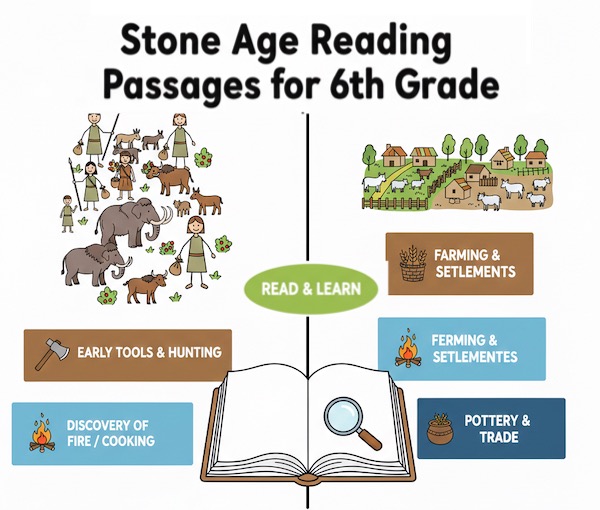
Everything teachers need to cover early humans, the Paleolithic Age, the Neolithic Revolution, and the rise of civilizations — aligned to 6th grade world history standards.Here is a Complete Curriculum Guide with Stone Age Reading Passages and Activities
The Stone Age is one of the most fascinating units in 6th grade history. It’s where students first encounter the big questions: How did early humans survive? Why did hunter-gatherers stop roaming and start farming? How did the Neolithic Revolution lead to the first civilizations? These are the stories that set the foundation for everything students will learn about ancient Mesopotamia, Egypt, and beyond. But teaching the Stone Age well — from human origins through the rise of early civilizations — requires well-structured Stone Age reading
But teaching the Stone Age well — requires a thoughtful sequence of reading passages, activities, and discussions that build on each other. That’s exactly what we’ve built at Workybooks.com
Workybooks.
Our digital library includes a complete set of Stone Age reading passages with comprehension activities covering every major topic in the curriculum — from the first humans and Paleolithic hunter-gatherers to the Neolithic Revolution and the rise of civilizations. Below, you’ll find a unit-by-unit breakdown of what’s covered, how the topics connect, and how you can use these resources in your classroom.
Unit 1: Human Origins and Species: Stone Age Reading Passages on Early Humans
Before students can understand the Stone Age timeline, they need to understand who the early humans were. This unit introduces students to the species that came before modern humans, how they evolved, and what made Homo sapiens unique.
Understanding human origins helps students grasp a critical concept: the story of the Stone Age isn’t just about tools and farming — it’s about how the human brain evolved to solve problems, communicate, and build societies.
Reading Comprehension Passages & Activities:
- First Humans — Who were the earliest human ancestors, and what set them apart from other species?
- Homo Erectus — How did Homo erectus spread across continents and adapt to new environments?
- Neanderthals — What was daily life like for Neanderthals, and why did they eventually disappear?
- Neanderthals and Homo Sapiens — How did these two species coexist, interact, and differ?
- Neanderthals and Denisovans — What do we know about Denisovans and their relationship with other early humans?
- Origins of Human Language — How did early human communication develop, and why did language matter for survival?
- Cognitive Revolution — What changed in the human brain that allowed Homo sapiens to create art, develop culture, and outlast other species?
Each passage includes vocabulary building, comprehension questions, and critical thinking prompts that connect back to the central question: what makes humans human?
🍎 Teachers: Use Workybooks’ digital reading passages to introduce each topic with guided reading, then follow up with discussion questions that encourage students to compare early human species. These passages are perfect for independent reading stations or whole-class instruction.
Unit 2: Human Migration — How Early Humans Spread Across the Globe
Once students understand who early humans were, the next question is: how did they get everywhere? This unit covers the incredible journey of early human migration — from Africa to every continent on Earth. Students explore how early humans traveled by land and sea, adapted to different climates, and eventually reached places as far as Australia and the Americas.
This unit connects directly to geography skills and helps students understand how climate, geography, and survival instincts shaped where humans settled.
Reading Comprehension Passages & Activities:
- Early Human Migration — Why did early humans leave Africa, and what routes did they follow?
- Paleolithic Migration by Land and Sea — How did prehistoric humans cross oceans and land bridges?
- Early Humans Reach Australia — What evidence do we have of the first humans in Australia, and how did they get there?
- Early Humans in Europe and Asia — How did migration patterns differ across continents, and what challenges did humans face?
- First Americans — How and when did humans first arrive in North and South America?
These passages help students visualize the scale of early human migration and understand how geography shaped human history long before the first civilizations emerged.
🍎 Teachers: Pair these reading passages with map activities where students trace migration routes. Workybooks passages include built-in comprehension checks and vocabulary exercises that reinforce both content knowledge and reading skills — ideal for 6th grade social studies and ELA integration.
Unit 3: The Paleolithic Age — Life as Hunter-Gatherers
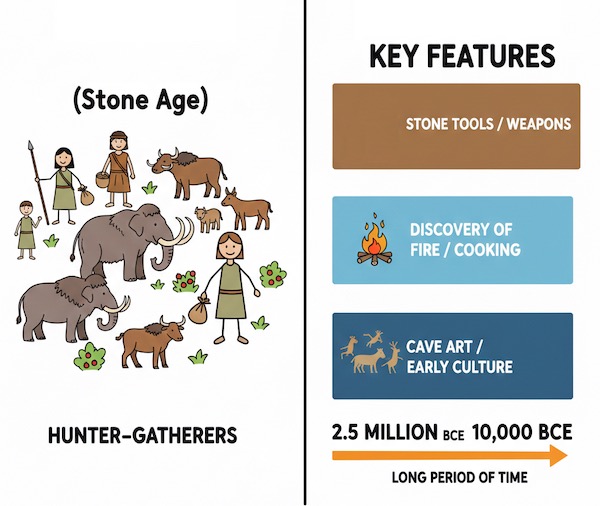
The Paleolithic Age — the Old Stone Age — is the longest period in human history, spanning roughly 3.3 million years. This unit helps students understand what daily life was like for early humans. Students learn about how they made tools, discovered fire, found shelter, created clothing, and expressed themselves through prehistoric cave art.
Students often ask: what did hunter-gatherers eat? How did early humans survive without farming or permanent homes? This unit answers those questions and paints a vivid picture of Paleolithic life.
Reading Comprehension Passages & Activities:
- Introduction to the Paleolithic Age — What defines the Paleolithic period, and how long did it last?
- Oldowan Tools — What were the earliest stone tools, and how were they made?
- Paleolithic Hand Axe — Why was the hand axe one of the most important tools in human history?
- Paleolithic Hunting Tools — What weapons and strategies did early humans use to hunt?
- Discovery of Fire — How did early humans make fire, and how did it transform their lives?
- Hunter-Gatherers — What was the hunter-gatherer lifestyle really like?
- Paleolithic Shelters — Where did early humans live, and how did they build shelters?
- Paleolithic Clothing — What did early humans wear, and how did clothing help them survive?
- Prehistoric Cave Art — What do cave paintings like those at Lascaux tell us about Paleolithic humans?
This is one of the most resource-rich units in the Stone Age curriculum, and each passage builds on the last. Students move from understanding basic survival to appreciating the creativity and ingenuity of early humans.
🍎 Teachers: This unit works beautifully as a two-week deep dive. Use Workybooks’ reading passages for daily guided reading, then have students complete a “Day in the Life of a Hunter-Gatherer” creative writing activity as a culminating project. Each passage comes with ready-to-use comprehension activities — no extra prep needed.
Unit 5: The Neolithic Revolution — How Farming Changed Everything
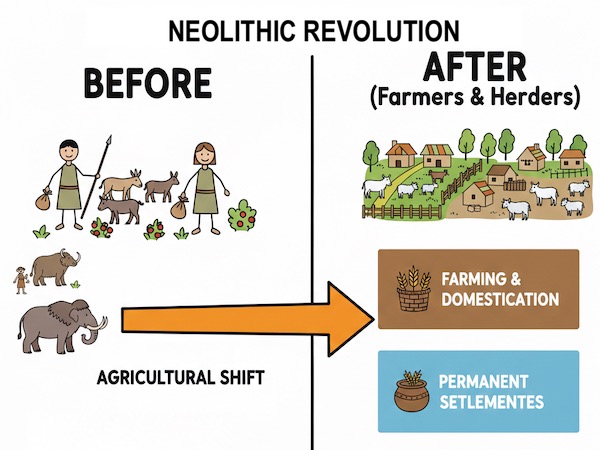
The Neolithic Revolution is the most important turning point students will study in this entire unit. It’s the moment when humans shifted from nomadic hunter-gatherer societies to settled farming communities. It changed everything. Agriculture led to food surplus, which led to division of labor, which led to social classes, trade, and eventually the first civilizations.
This is where students begin to see the direct connection between the Stone Age and the ancient civilizations they’ll study next: Mesopotamia, Egypt, the Indus Valley, and China.
Stone Age Reading Passages & Activities:
- Neolithic Revolution — What was the Neolithic Revolution, and why is it considered one of the most important events in human history?
- Neolithic Tools — How did tools change from the Paleolithic to the Neolithic Age, and what does that tell us about human progress?
- Domestication of Animals — Which animals were first domesticated, and how did domestication change human society?
- Neolithic Villages — What were the first permanent settlements like, and how were they organized?
- Neolithic Pottery — Why was the invention of pottery significant for food storage and trade?
- Nomads to Farmers — How did the relationship between settled farmers and nomadic groups shape early human societies?
- Life in the Neolithic Age — What was daily life like in a Neolithic village compared to the Paleolithic era?
This unit naturally sets up a Paleolithic vs. Neolithic comparison — one of the most commonly tested concepts in 6th grade history. Students can use these passages to identify key differences between the Old Stone Age and the New Stone Age.
🍎 Teachers: Have students create a Paleolithic vs. Neolithic comparison chart as they read through both units. Workybooks’ activities include graphic organizers and Venn diagram prompts that make this easy to implement. This is also a great unit for formative assessment — use the comprehension questions to check understanding before moving to the next unit.
Unit 6: Rise of Civilizations — From Villages to Cities to Empires
This final unit bridges the Stone Age and the ancient civilizations that follow. Students explore how Neolithic farming villages grew into complex societies with social hierarchies, trade networks, and new technologies like bronze. They learn how climate shaped where civilizations developed, why the Fertile Crescent became the cradle of civilization. Student understand how ancient trade routes connected early societies across continents.
In the”so what” unit — students see that everything they’ve learned about early humans, migration, the Paleolithic Age, and the Neolithic Revolution was building toward the rise of human civilization.
Stone Age Reading Passages & Activities:
- Origins of Social Classes — How did food surplus lead to specialization of labor and the development of social hierarchies?
- Bronze Age — What new technologies defined the Bronze Age, and how did they change warfare and trade?
- Rise of Early Civilizations — What conditions were necessary for the first civilizations to develop?
- Climate and Early Civilizations — How did geography and climate determine where civilizations emerged?
- Ancient Trade Routes — How did early trade networks connect distant communities and spread ideas?
- Afro-Eurasian Trade Networks — What were the earliest long-distance trade routes, and what was exchanged along them?
These passages give students the complete picture: from first humans chipping stone tools in Africa to complex civilizations trading goods across continents.
🍎 Teachers: Use this unit as a bridge to your Ancient Mesopotamia and Ancient Egypt units. Workybooks’ reading passages provide the historical context students need before diving into specific civilizations. The built-in activities make it easy to assess whether students understand the cause-and-effect chain from farming to civilization.
Why Workybooks for Your 6th Grade Stone Age Reading Passages?
Teaching the Stone Age effectively means having the right reading passages at the right reading level, with built-in activities that save you time. Here’s what makes Workybooks different:
Standards-Aligned Content — Every reading passage is aligned to 6th grade social studies standards, covering early humans, the Paleolithic and Neolithic Ages, the Agricultural Revolution, and the rise of civilizations.
Ready-to-Use Activities — Each passage comes with comprehension questions, vocabulary exercises, critical thinking prompts, and graphic organizers. No extra prep required.
Digital Library Access — All passages are available in our web-based Learning Management System. Assign readings, track progress, and differentiate instruction from one platform.
Curriculum-Sequenced Units — Passages are organized in a logical teaching sequence from human origins through the rise of civilizations, so you can teach the entire unit straight through or pick individual topics as needed.
Reading Comprehension Focus — Every passage is designed to build both content knowledge and reading skills, making these resources perfect for social studies and ELA integration.
👉 Explore Workybooks’ 6th Grade History Resources today and give your students the reading passages and activities they need to study early human history, the Stone Age, and the rise of civilizations.
Visit Workybooks.com to browse our complete digital library and start planning your Stone Age unit today.
Workybooks is a K-8 digital Learning Management System providing curriculum-aligned reading passages, worksheets, and interactive activities across ELA, Math, History, and Science. Built by educators, for educators.
Related Posts
Egyptian Pharaohs
California Gold Rush: Teaching Resources and Activities